What time of day to fish: the windows that matter
A fish reacts to changing light more than the clock, here is why dawn, dusk and winter each read differently.
What actually happens at dawn and dusk
A fish does not check a watch, it reacts to change. The shift from night to day, and back again, marks the two points where light moves fastest, when small prey becomes visible or slips out of sight. It is that speed of change, more than darkness or brightness on their own, that flips a fish from resting to hunting.
Fisheries biologists put it in similar terms: as light fades in the water column, baitfish drift away from cover to feed, and predators follow right behind them. Species that hunt by sight in low light, walleye and zander among them, carry a reflective layer behind the eye built for exactly this kind of window, which is part of why dawn and dusk produce so reliably across so many species.
The two windows that come back every day
Dawn opens the first one, running from first light until the sun is well clear of the horizon. Surface light at that point drops below the threshold where baitfish still feel safe holding offshore, so they push into the shallows and predators move in behind. It is also the coolest water of the day, which helps concentrate small prey rather than scattering it.
Dusk opens a second window, close to a mirror image: the last hour of daylight before dark. In summer this window gets an extra push from the heat built up over the day, which triggers aquatic insects and pulls surface feeders up after them.
Between the two, the middle of the day is usually the quiet stretch, barring a sudden change in the weather.
Why winter flips the pattern
This whole picture turns on its head in winter. Water takes hours to make any use of the little sun on offer, so it is the middle of the day, running up to around three in the afternoon, that holds most of the activity: that is when the water reaches its warmest point of the day, even if the gain only amounts to a degree or two. Dawn and dusk, so reliable the rest of the year, often disappoint in winter simply because the water has not had time to warm.
Night belongs to a different set of species
Some species skip this daytime pattern altogether and switch on once darkness properly sets in. Catfish are the clearest example, feeding almost entirely after dark through the warmer months and leaning on smell rather than sight to find food. Eels and summer carp follow a similar pattern, and zander add a strong nocturnal push of their own once the water warms. Fishing these species at classic dawn or dusk hours tends to produce less than a trip that starts after full dark and runs late.
Why the window is not the same width all year
How long the transition between night and day lasts depends on more than sunrise time, it depends on the season too. Around the summer solstice, dusk stretches out noticeably longer than at the equinox, which extends the useful evening window a little. In the depths of winter, by contrast, daylight is short and the whole light cycle compresses, which is why dawn and dusk windows are both shorter and often less pronounced than the rest of the year.
That has a practical consequence: the same clock time does not line up with the same light phase from one month to the next. In June, seven in the morning falls well after sunrise, and a good part of the dawn window has already passed. In December, at the same hour, the sun has not risen yet and the window has not even started. Sticking to a fixed hour across the year means missing the transition roughly half the time.
Terrain and tree cover shift things further at a local level. A river cut deep between two wooded banks, or lined with tall trees on its eastern side, stays shaded well into the morning even after official sunrise, which pushes the useful dawn window back on that particular stretch. The same river, once it opens out into open ground, falls back in line with the standard timing.
What the day’s weather changes
Cloud cover or light rain stretches the effect of that light transition across more of the day, holding brightness down well past sunrise. A completely clear sky does the opposite, squeezing the useful window down to the two ends of the day, particularly in summer when light gets too strong for many species, sending them toward shade or depth.
What separates a catch from a blank
The most common mistake is arriving once the sun has already been up for a while, expecting to still catch the dawn window when it closed an hour or more earlier. The second is packing up too early at dusk, often out of habit or because visibility is dropping, right when the last few minutes before full dark are among the most productive of the day.
A third, quieter mistake is applying the same rule everywhere regardless of season: heading out at dawn in the depths of winter, before the water has had any chance to warm, means fishing at exactly the moment activity is lowest.
What Piscary does with this
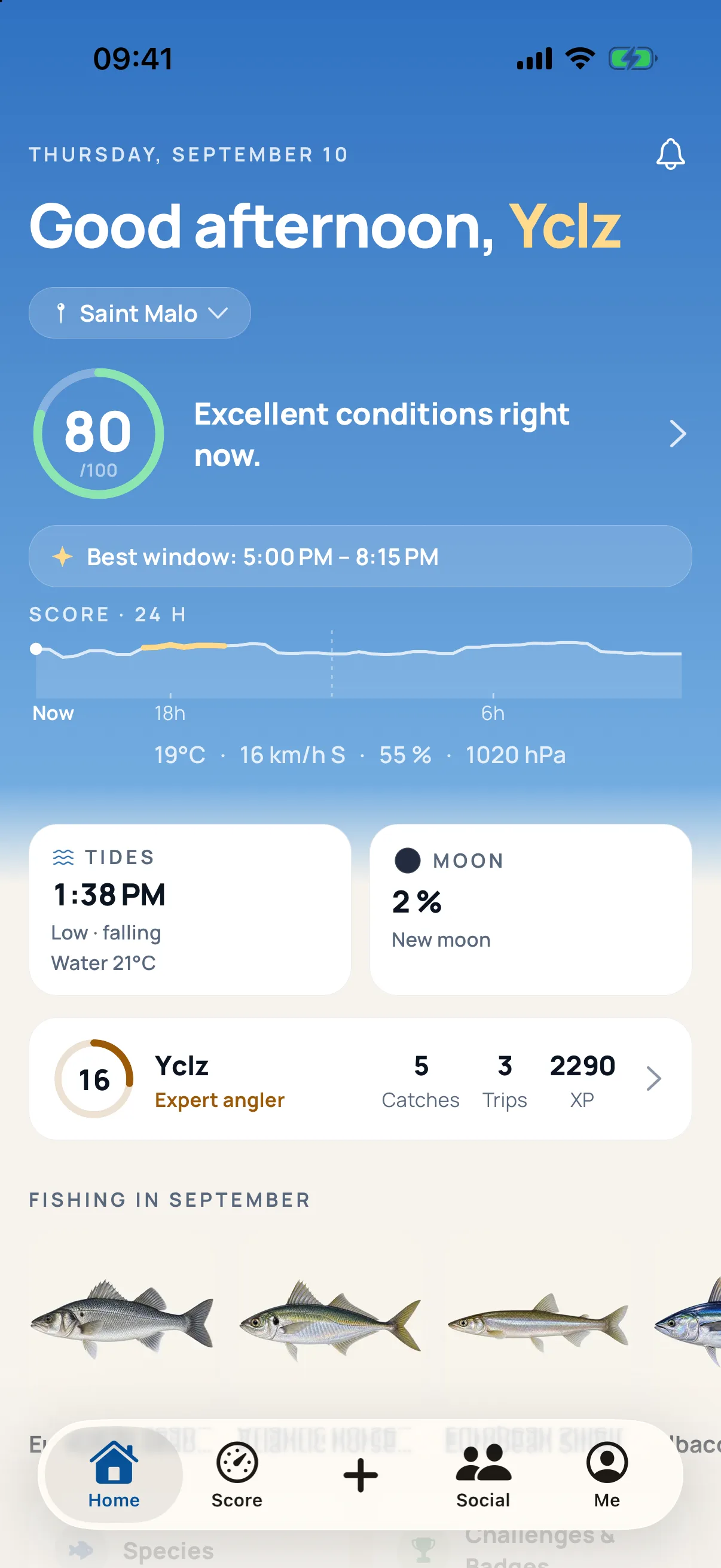
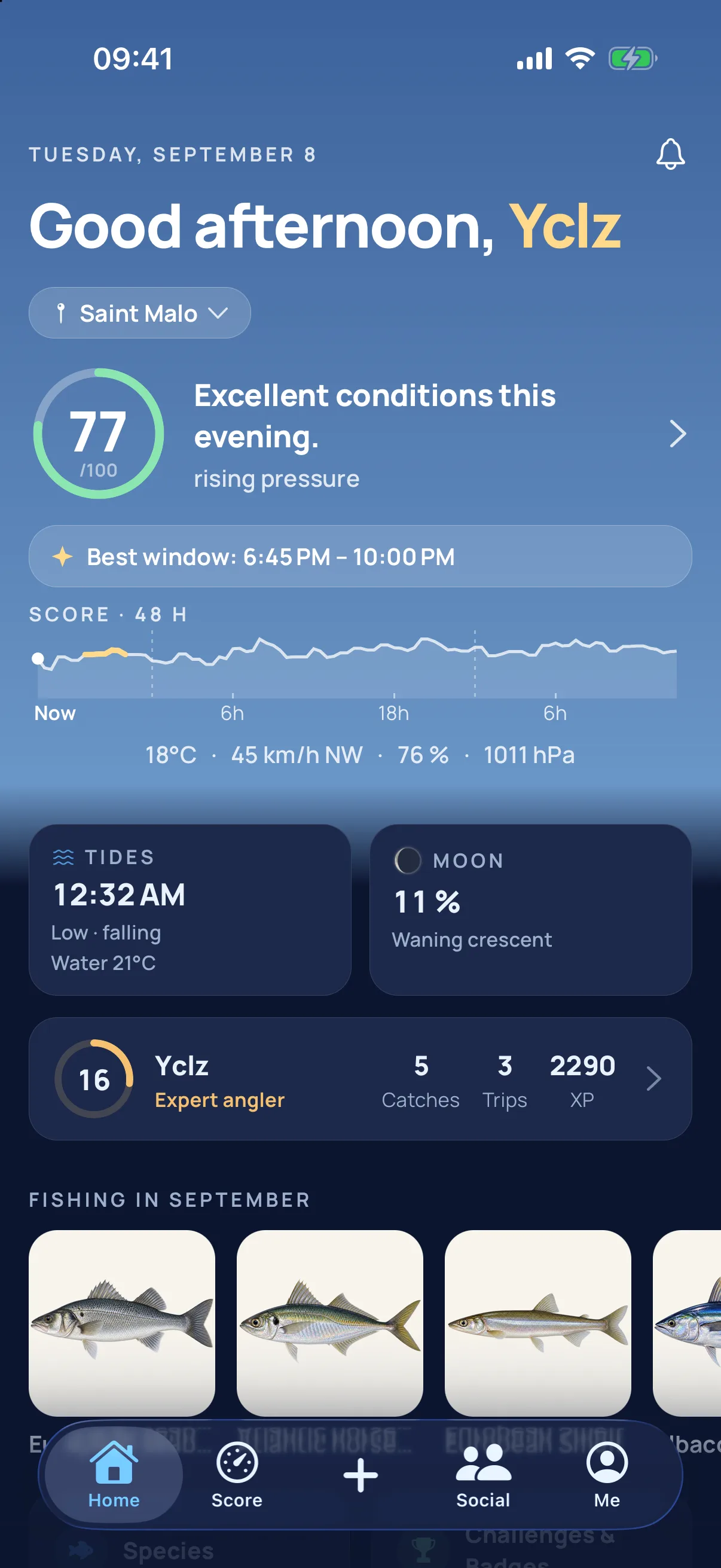
Piscary works out the real sunrise and sunset for the spot you follow each day, and adjusts the suggested window to the season rather than reusing a fixed hour lifted from a general guide. The daily score combines that window with the current weather, telling apart an overcast sky that stretches activity from a clear one that limits it to the edges of the day. The catch log also lets you compare, trip after trip, which hours actually produced something on a given spot.