Fishing after rain: flow, turbidity and active fish
Why rain gets fish feeding, when the water turns too cloudy to fish, and how to read river flow before you head out.
What rain actually changes for a fish
Three things happen at once when it rains, and each one nudges a fish differently. Barometric pressure drops, sometimes quickly if the rain rides in on an active front, and that shift appears to unsettle fish enough to push them to feed before conditions worsen further. The water reoxygenates, which matters most in high summer, when a stagnant pond or slow pool has been running short of dissolved oxygen for days. And runoff washes in worms, insects and other food that fish would otherwise have to go looking for.
None of that depends on angler folklore. A falling barometer is a number on a gauge, rising oxygen is a number on a probe, and the food arriving with the runoff shows up in the stomach of a fish caught soon after the storm. It’s the combination of the three that makes rain worth fishing, not the rain by itself.
Turbidity is not just a colour
Water that clouds up after rain carries particles washed off the banks and stirred up from the bed by the current, and that load gets measured in nephelometric turbidity units, NTU, by shining a light through a sample and reading how much of it scatters. A river running under about ten NTU reads as clear. Research on largemouth bass puts normal feeding behaviour intact up to roughly 37 NTU, water that looks clear to lightly stained. Past about 70 NTU, the “chocolate milk” stage, feeding success drops sharply: the strike zone shrinks from feet to inches, and a bass loses the ability to be choosy about what it eats.
A bit of colour in the water works in the angler’s favour before that point, because it dulls a fish’s caution along with its ability to inspect a lure closely, you included. Push much past it and the same cloudiness that hides your leader also blocks the fish’s own view of anything worth eating, clogs gills, and can smother spawning gravel along with the small invertebrates young fish rely on. The window worth fishing sits between the two: enough colour to blunt a fish’s wariness, not so much that light can’t get through at all.
Fishing water you can’t see into
Once sight stops being reliable, fish switch to the senses that still work: the vibration carried through water and picked up by the lateral line, and scent, ahead of colour. A lure that pushes a lot of water, a vibrating blade bait or a crankbait with a wide wobble, gets found faster than a subtle, natural-looking imitation. Very dark colours that read as a clean silhouette, or bright ones that throw a strong signal, tend to outfish natural tones that would blend in perfectly in clear water.
How you work the lure should track how hard it’s raining. A light drizzle changes little, and fish keep hunting close to normally. Steadier rain rewards a continuous retrieve with built-in pauses, giving a fish time to home in on the vibration before it commits to a strike. A genuine downpour muddies the water faster than it does anything else useful, and a slow presentation with deliberate pauses usually beats a fast retrieve in that situation.
Where fish hold once the flow rises
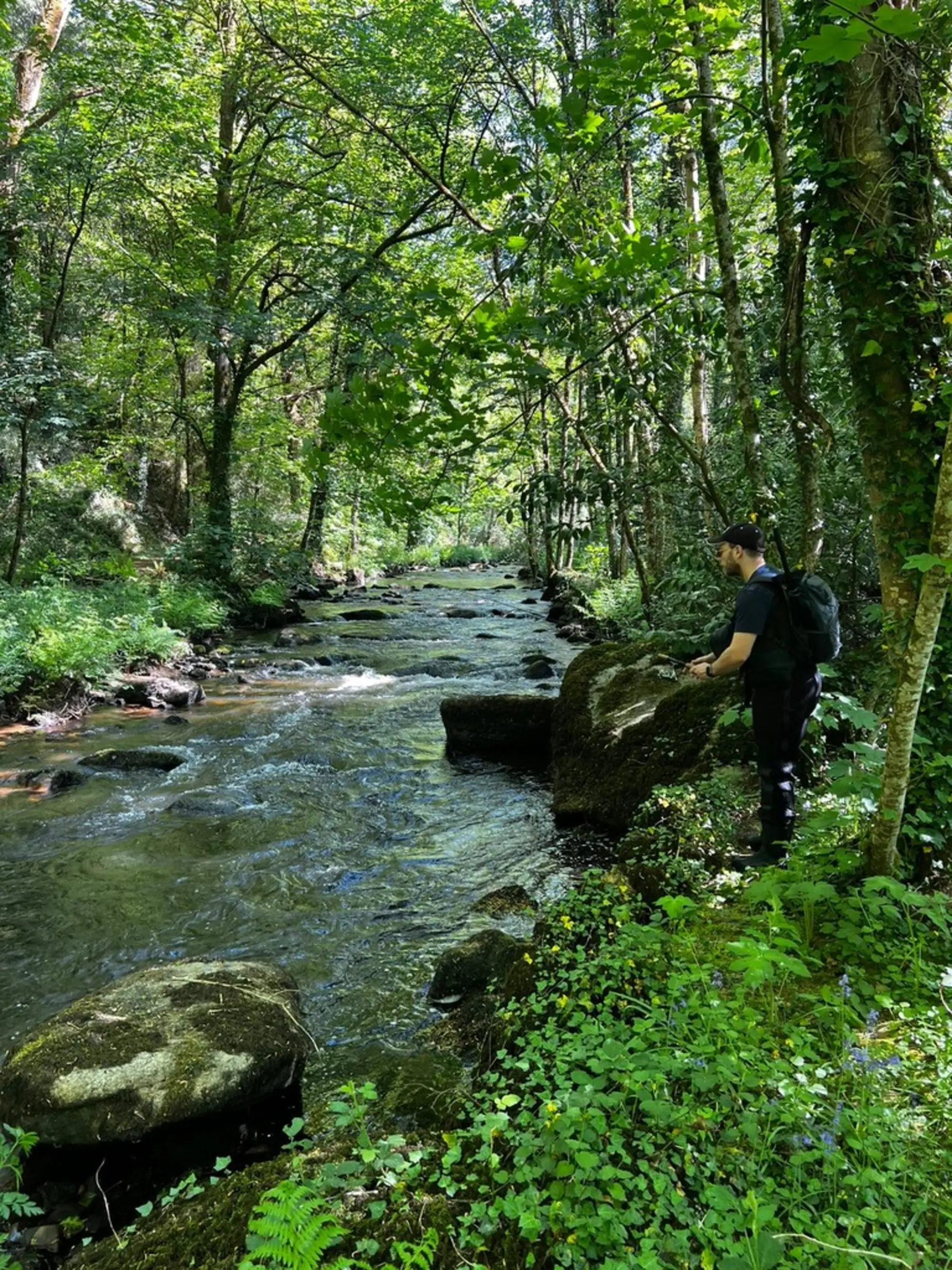
A rising river doesn’t scatter fish at random. They look for the places where current slows without disappearing entirely: behind a boulder, on the inside of a bend, or at a confluence where a smaller stream feeds in, bringing clearer water and washed-in food together at the same seam. Holding at that kind of break costs less energy than fighting the main current, while keeping a fish within reach of whatever the flow brings down.
The stretch of several hours after a summer storm often ranks among the more productive windows of the season, precisely because the water has just been reoxygenated, its temperature has dropped slightly, and turbidity hasn’t yet peaked. Staying put once the rain stops, rather than packing up, lets you fish that window while the water is still clearing rather than arriving after it’s gone.
The trap of rain that won’t stop
A single shower behaves nothing like several days of steady rain. One passing storm on an otherwise stable river gives you the effect described above: a light tint, better oxygen, extra food. Repeated rain over multiple days instead pushes the flow up continuously, and turbidity can climb past the point where fish stop feeding at all, simply because they can no longer find anything.
That situation calls for checking level and flow before you leave, not just the sky. If the river is still rising when you arrive, it hasn’t finished clouding up: the turbidity peak generally follows the rainfall peak rather than coinciding with it. You’ll do better fishing a lull between showers, on a river holding steady or already dropping, than pushing a flood that’s still building.
What Piscary does with this
Piscary shows the flow measured at the nearest gauging station to a spot, in France, the United States, England and Wales, along with its recent trend, so that number replaces a guess based on the sky; elsewhere, it shows a modelled flow. A rising river shows up directly on the spot’s conditions page, before you decide whether to head out or wait for things to settle. Piscary doesn’t calculate turbidity itself, since no sensor network covers that at scale, but flow gives a concrete way to anticipate water that has turned too cloudy to fish well.