Moon phases and fishing: what the solunar theory really says
What the research on moon phase and animal activity actually shows, and why tides remain the one mechanism that holds up.
Where the idea came from
In 1926, an American fisherman named John Alden Knight set out to work out why some days on the water paid off and others didn’t. He drew up a list of roughly thirty variables, everything from wind direction to barometric pressure. Three factors kept correlating: the sun, the moon and the tide. Ten years later he published the first solunar tables, still sold today in app form, predicting two “major” and two “minor” feeding windows for every day of the year.
The idea has lasted a century for a simple reason: it is easy to believe. You check the table, plan a trip around a major period, and if you come home with fish, the theory gets the credit. What that kind of proof never counts is every day the table promised a good window and nothing happened.
What the theory actually claims
Knight’s reasoning rests on where the moon sits relative to a given point on Earth. As it passes overhead, and again as it passes on the opposite side of the planet, its gravitational pull is supposed to trigger a burst of feeding activity in animals, fish included. Those two passages give the major periods, the longer and, on paper, the stronger windows. Moonrise and moonset give the shorter minor periods, useful mainly for narrowing down which part of a major window to actually fish. Gravity peaks, on this account, when the sun and moon line up, at new moon and full moon, and weakens at the quarters, which is why the tables mark some days as stronger than others even before weather enters the picture.
The one mechanism nobody disputes
One part of that chain isn’t in question: tides. The pull of the moon and sun genuinely moves enormous volumes of seawater, on a schedule people have charted for centuries. A fish that feeds on whatever a rising or falling tide carries past its lie is responding to the moon, just indirectly, through moving water rather than through any pull on its own body. This is why the theory reads so convincingly for coastal and estuarine species: a bass or a mullet timing its feeding to a tidal current isn’t obeying a mysterious pull, it’s exploiting a current that happens to run on a lunar clock.
What the studies on animals actually found
The jump that solunar theory needs, from moving tides to a direct pull on an animal’s own metabolism, is much harder to support. The most detailed field data come from deer, tracked by GPS collar rather than by memory. One long-running study picked up a small compensation pattern: slightly more night-time movement around the full moon, slightly more daytime movement around the new moon, as if deer feed more efficiently under bright skies and shift their routine to match. Other telemetry projects found nothing of the sort. In a study following three dozen bucks across several seasons, hunting pressure alone explained more of the variation in movement than every lunar variable put together, and the gap between individual animals dwarfed anything the moon phase produced.
Freshwater fish have had even less rigorous testing. A widely cited study on largemouth bass out of the University of Florida found no statistical link at all between moon phase and catch rate. A separate study from Carleton University reached the same conclusion. What research does exist tends to be catch compilations and field notes rather than experiments designed to isolate the moon from everything else happening that day, which leaves the freshwater question open rather than settled either way. An old experiment on oysters, which kept opening and closing on a tidal rhythm even after being moved far from the sea, hints that some animals carry an internal clock tuned to the moon. Stretching that from a filter-feeding shellfish to a pike or a carp is a much bigger leap than it sounds, and nobody has made it stick yet.
What moves fish more than the moon
The same research that stays cautious about lunar effects is consistent on one point: other conditions matter more, and are easier to measure. A pressure drop ahead of a rain front, a sharp swing in water temperature, low light under cloud cover, all of these change feeding behaviour more clearly than any moon phase has been shown to. Dawn and dusk light works on almost every species for a reason that needs no gravitational theory at all: it’s simply when a predator can still see while its prey already sees less.
Reading a solunar window without over-trusting it
Treat a major or minor period as one input among several, never as a guarantee. It works best as a tiebreaker between two otherwise similar-looking days, not as a reason to plan a trip on its own. Weigh it against the day’s weather, the season and what you already know about the species you’re after. If you take one thing from all this, make it this: tides genuinely organise the behaviour of coastal fish, the moon by itself hasn’t been shown to do the same for anything in fresh water, and pressure, light and temperature remain the more reliable signals for choosing your window.
What Piscary does with this
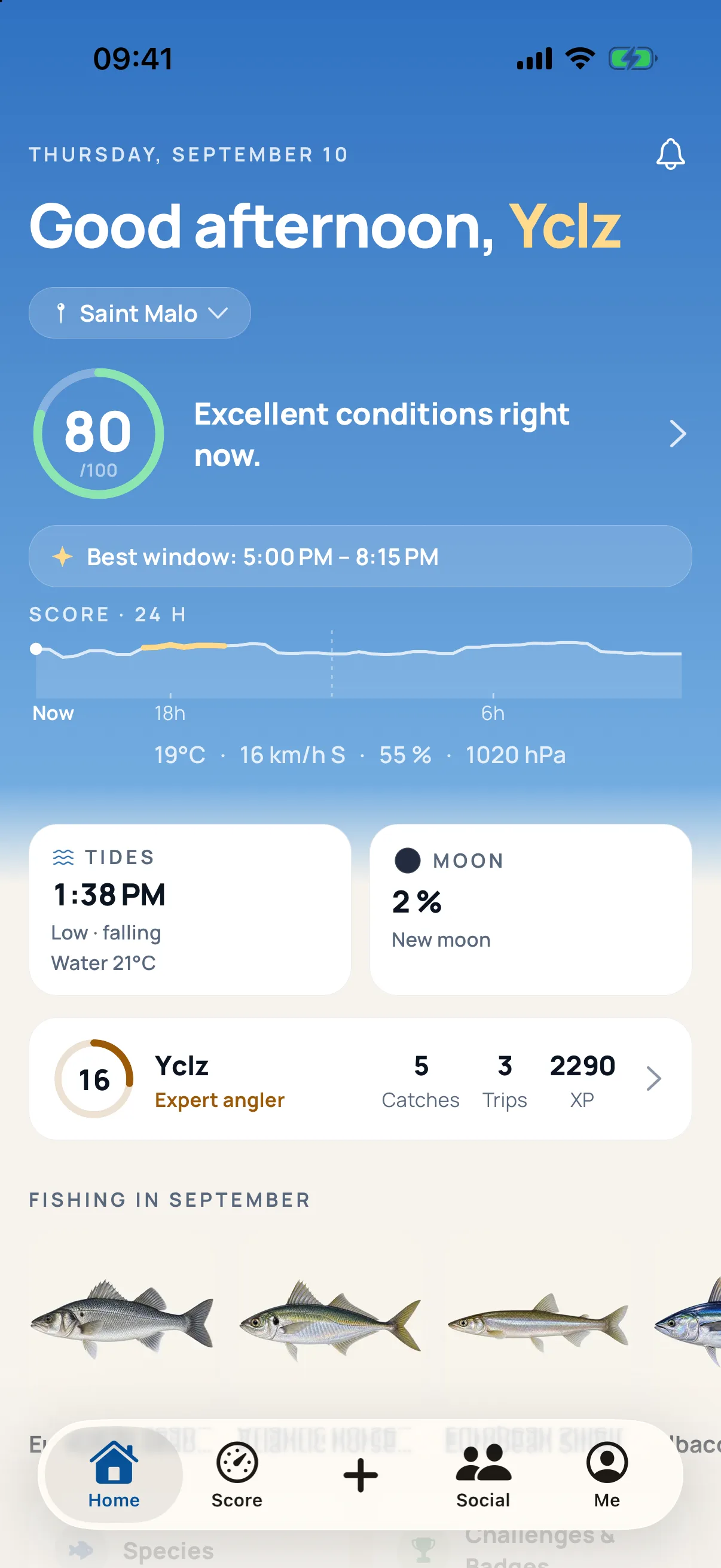
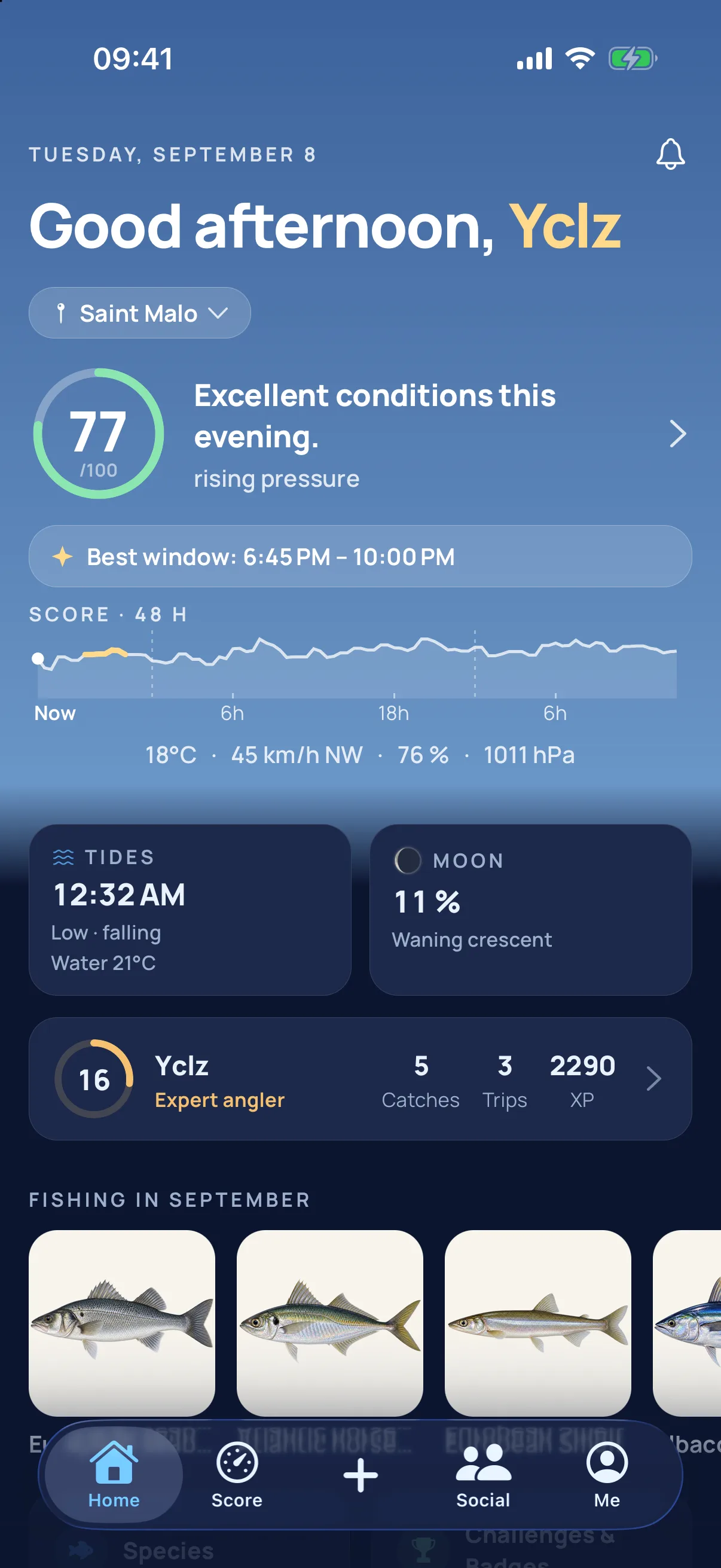
In the app, the moon feeds into the daily score as one cue among several, and a light one: its phase, plus a small bonus around its overhead pass, its rise and its set. The Moon sheet shows the phase, illumination, moonrise and moonset and the upcoming phases, next to the other signals that matter, tide where one applies, weather, pressure. Piscary doesn’t publish major and minor solunar tables: the aim is to give you several signals to weigh against each other, rather than one number to follow blindly.