Identifying a fish from a photo: the classic mix-ups
Roach, rudd, chub and asp look alike in a rushed photo. Here are the details that settle it every time.
Species covered here
Why these four keep getting mixed up
Roach, rudd, chub and asp share the same rivers, often the same landing net, and a general silvery cyprinid outline that makes a hastily taken photo genuinely unhelpful. They interbreed with each other on occasion, which now and then produces a fish with characteristics from both parents, hard to call even for someone who has handled hundreds of them. On a young fish, before eye colour or fin tone has fully developed, the resemblance gets stronger still. The right approach isn’t to guess from the overall look, but to check two or three specific details that won’t lie to you.
Roach or rudd: the mouth and the eye settle it
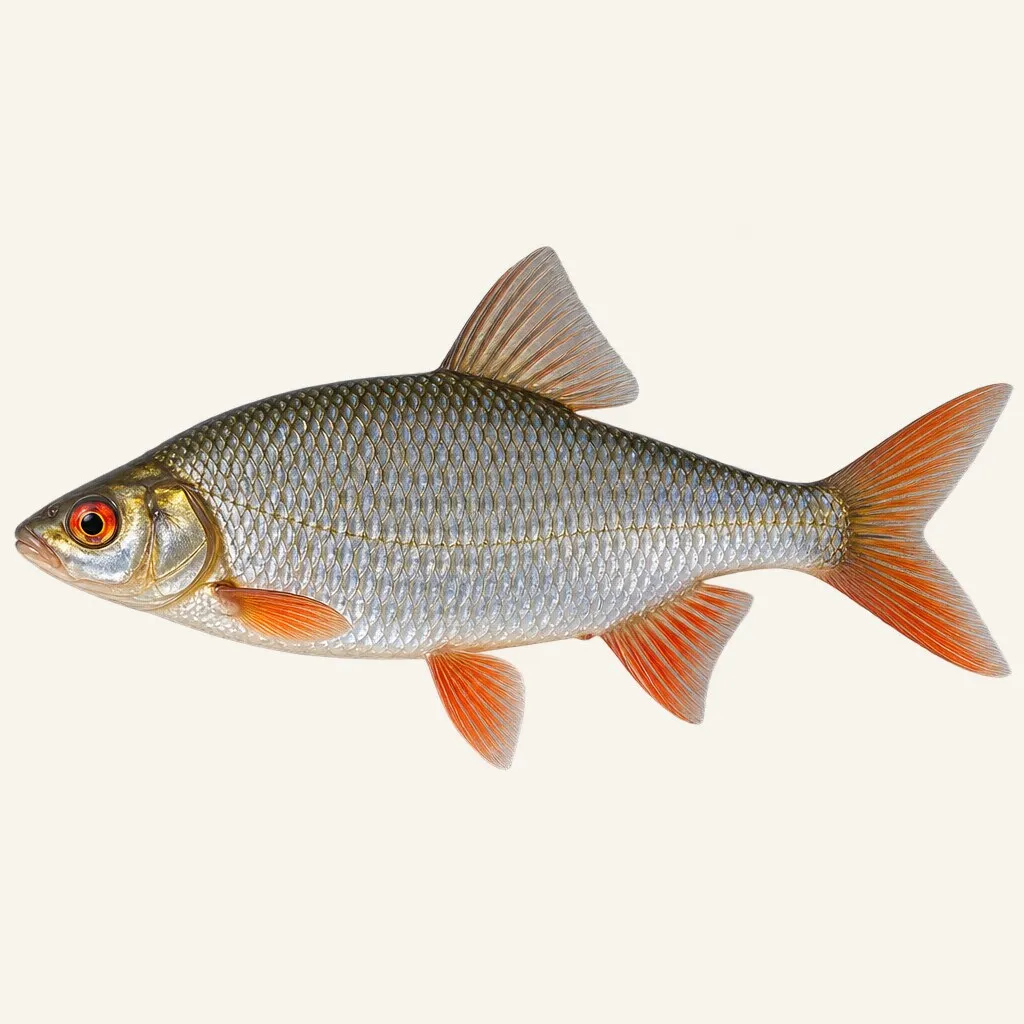
Between these two, the confusion usually starts with colour, red fins on one, more golden on the other, and colour shifts enough with water and light that it isn’t worth trusting on its own. Two steadier markers do the job instead. Start with the mouth: a roach’s points slightly downward, built for picking food off the bottom, while a rudd’s turns up, with the lower jaw projecting past the upper, built for feeding at the surface. Then the eye: a roach carries a red spot above and beside the pupil, while a rudd’s iris runs yellow to golden, occasionally tinged with red but never as solid a red as the roach’s.
A third check helps when the first two stay ambiguous on a badly lit photo: where the dorsal fin sits relative to the pelvic fins. On a roach, the two line up vertically. On a rudd, the dorsal sits noticeably further back, set behind the pelvic fins even on a young fish, and its body tends to run deeper and more oval than the roach’s leaner build. Any one of these three details can mislead on its own, but once two agree, there’s no real argument left.
Chub or asp: the mouth tells the whole story
Chub and asp share a stocky build and a wide mouth that can look similar from a distance, but the size and angle of that mouth is what actually separates them. A chub’s mouth stays fairly large but sits close to the body’s axis, barely upturned. An asp’s is considerably bigger and more powerful, with the upper jaw reaching back past the front of the eye, a trait suited to a fish that hunts other fish near the surface rather than picking food off the bottom. That oversized, forward-set mouth doesn’t turn up on any of the other three species in this group.
The fins offer a second clue. An asp’s are sharper and better defined than a chub’s more rounded ones, and it carries a distinctive keeled ridge of scales running between the base of the pelvic and anal fins, a feature none of the other three share. Size settles most doubts too: a chub commonly reaches around a foot, 30 cm, occasionally pushing two feet, 60 cm, while an asp regularly reaches 22 inches, 55 cm, and can pass four feet, 120 cm, in a good river, considerably larger than anything else in this group.
An ocean away, the same problem: largemouth and spotted bass
The same kind of confusion turns up wherever similar-looking relatives share water, and largemouth and spotted bass are the North American version of it. The giveaway is the mouth: a largemouth’s jaw extends back past its eye, while a spotted bass’s stops short of it, true to the name. Run a finger over the tongue and you find the second marker, a rough patch of small teeth on a spotted bass that a largemouth simply doesn’t have.
Spotting pattern helps too. A largemouth carries a blotchy, broken stripe down its side with little or no spotting above or below it, while a spotted bass shows rows of distinct small spots below that stripe as well as a cleaner, more continuous line along it. A spotted bass also tends to run a shade slimmer through the body and holds in deeper, clearer water with more current or rock, while a largemouth favours shallow, quiet water with weed or wood cover nearby.
What ruins a photo for identification
Most failed identifications don’t come from an impossible species, they come from a photo that never shows the details that matter. A fish held head-down distorts the mouth and hides its natural angle. A fin pinned flat by a hand or an awkward angle stops you judging its shape or position. Hard flash or backlighting that blows out the silvery scales erases exactly the eye colour that separates a roach from a rudd.
A few habits fix most of this. Hold the fish level, head and tail in line, and ease the fins open before you shoot. Look for soft light, early or late in the day, or position yourself so the sun lights the fish from the side rather than head-on, which keeps colour readable without blowing out the flanks. A full side profile, showing the mouth, the eye and every fin at once, gives you more to work with than a tight shot of the head alone.
When even the experts stay unsure
On a young fish, before its distinguishing colours have come in, or on one that is the product of interbreeding between two of these species, no single marker guarantees a clean answer. In that case, weigh several clues together, mouth, eye, fin position, body shape, rather than forcing a call on one uncertain detail. Admitting the doubt beats a confident guess that turns out wrong after the fish has already gone back in.
What Piscary does with this
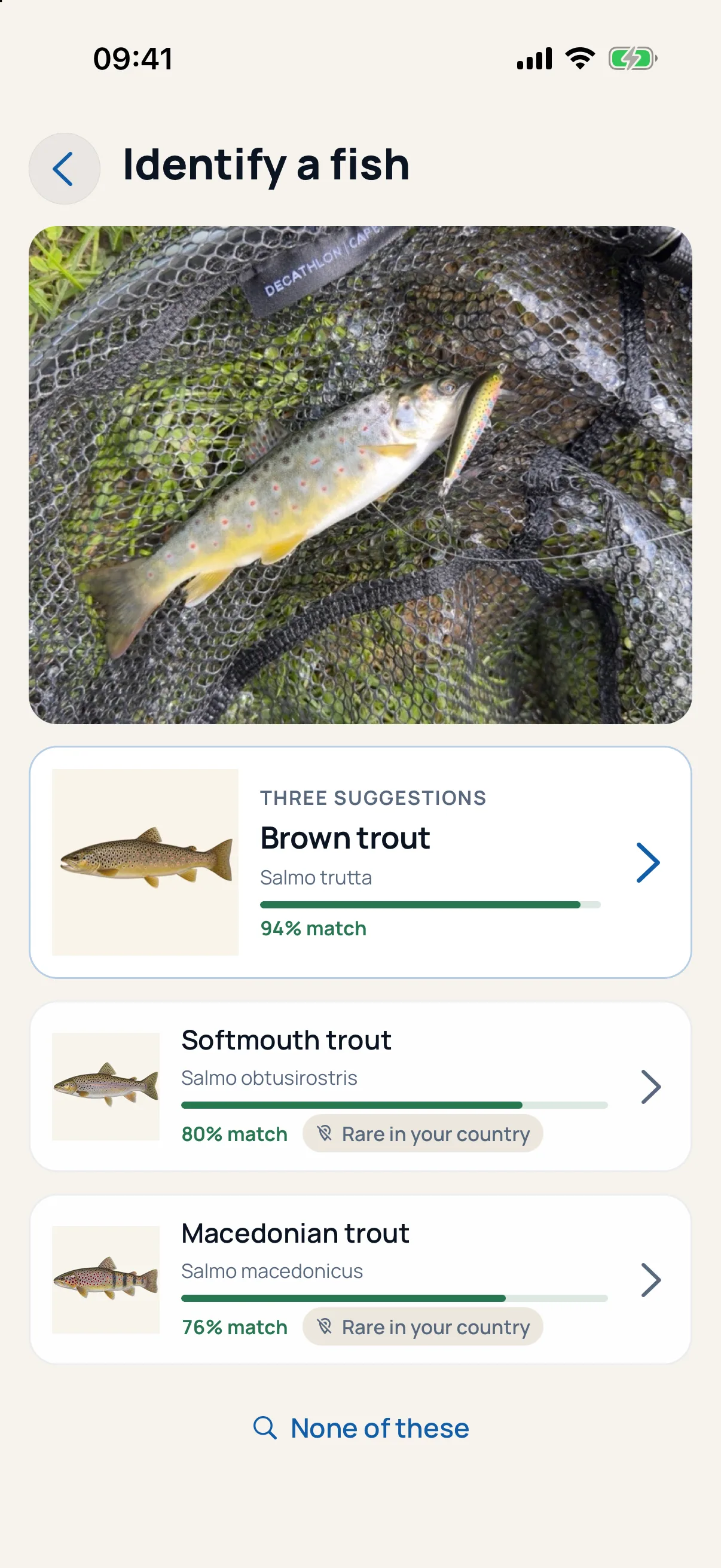
Piscary’s photo identification offers three possible species rather than a single verdict, precisely because this group of cyprinids shows the limits of calling a species from one photo alone. You pick from the three suggestions, or check the species page’s own criteria to compare the mouth, eye and fins visible in your shot. And if you choose to help improve recognition, every identification you confirm feeds back into the system’s memory for the next similar photo.