Rudd
Scardinius erythrophthalmus · Cyprinidae
- Freshwater
- Carp & coarse
- Easy
- Size
20–45 cm
- Weight
0.1–2.5 kg
- Lifespan
19 years
- Water temp.
2–22 °C
Where to fish
- River
Habitat icons: Flaticon
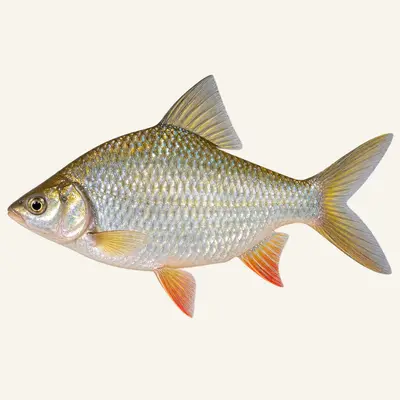
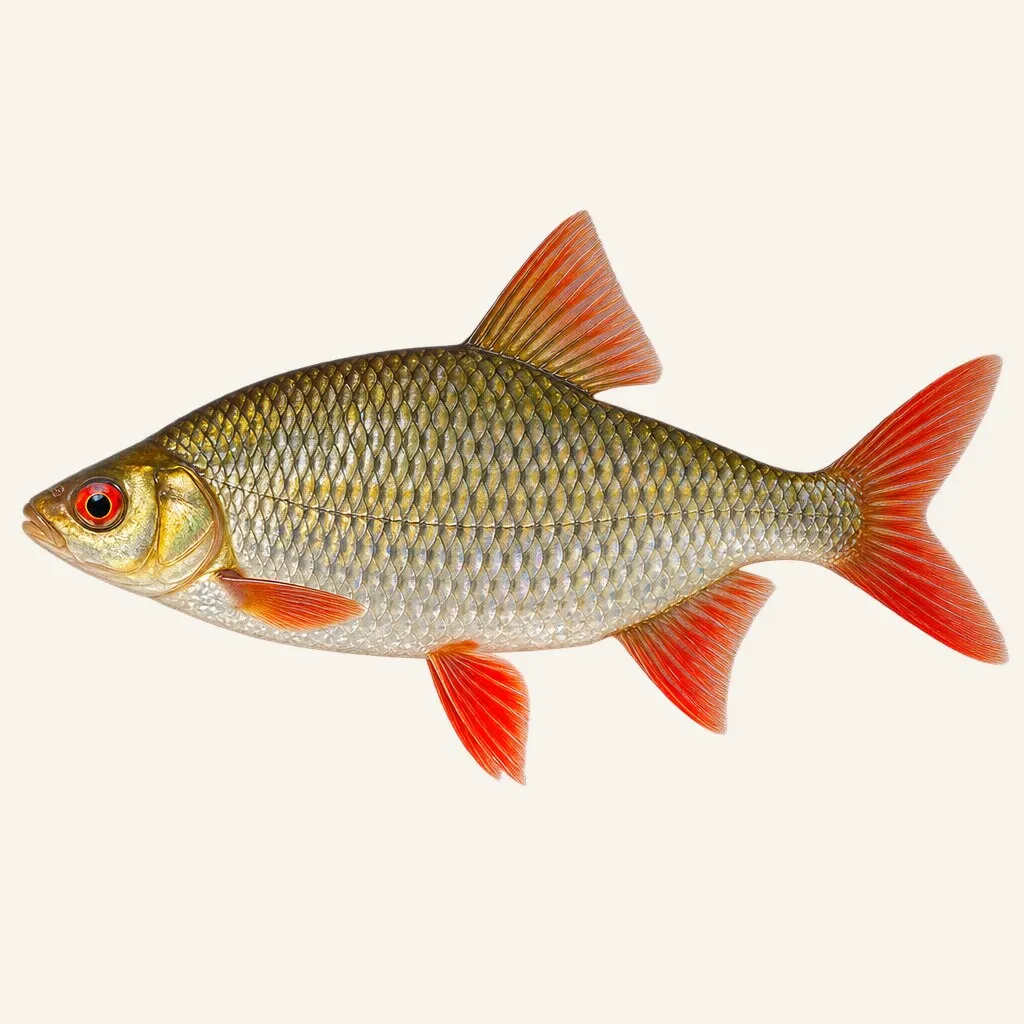
Resembles the roach but more golden, with bright red fins and an upturned mouth
Calendar
Recorded in 31 countries
Austria · Belarus · Belgium · Canada · Croatia · Czechia · Denmark · Estonia · Finland · France · Germany · Hungary · Ireland · Italy · Lithuania · Luxembourg · Moldova · Netherlands · New Zealand · Norway · Poland · Romania · Russia · Slovakia · Slovenia · Spain · Sweden · Switzerland · Ukraine · United Kingdom · United States
GBIF occurrence records — native and introduced populations combined.
Its range
Most European rivers north of the Pyrenees and the Alps, east to the Ural and the Eya, the Aral and White Sea basins, and the Black Sea basin in Europe and northern Asia Minor. Natural absences: Iberia, Italy and the Adriatic basin, Greece south of the Pinios, Britain north of the 54th parallel, Ireland, and Scandinavia above the 62nd.
One correction is worth passing on. The species is definitely absent from Siberia, and the records that once placed it there came from confusion with the roach. The same mistake anglers make on the bank was made in the survey literature, and it moved a range boundary by several thousand kilometres before anyone caught it.
Introductions have carried the fish to a number of countries, and several of them have recorded ecological damage afterwards.
Identifying it
The dorsal fin sits well behind the pelvic base. Not level with it, not just past it: the gap is obvious with the fish flat on a mat, and it shifts the whole rear half of the animal backwards compared with the silver cyprinids it swims among. This is the character to take first, because it holds on a fish of any size and in any condition.
The mouth confirms it. The dorsal profile of the head runs straight or slightly convex, the snout points forwards, and the tip of that snout falls at the level of the middle of the eye or a little above it. The opening therefore faces upwards. The articulation of the lower jaw lies ahead of the front margin of the eye, which is a second checkable landmark on the same structure. The back is not humped behind the nape, and in side view the eye sits close under the dorsal profile of the head.
The fins are red throughout, the pelvics deepest of all. Head and body are compressed, head width 13 to 14 per cent of standard length and head length 24 to 28; the wrist of the tail measures 11 to 12 per cent of standard length and is one and a half to two times as long as it is deep.
Counts, where they are needed: 39 to 42 scales along the lateral line, 10 to 13 and a half branched rays in the anal fin, nine to 12 gill rakers, 18 or 19 rays in the tail, and 36 to 39 vertebrae.
Breeding
Males assemble on the spawning ground and drive ripe females into thick weed, with a good deal of splashing, and the eggs go down among the roots and stems of submerged plants in shallow water. They are strongly adhesive and either colourless or pale yellow.
The dependence on that vegetation is absolute. No weed, no roots, no substrate, no spawning — the eggs have nothing to hold to and nothing to hide in. A bank cleared of its plants stops producing this species whatever the quality of the water above it, and that is the single most useful thing to know about its reproduction.
First maturity arrives at about 8 cm, against a common length of 20 and a recorded lifespan of 19 years. The arithmetic of that combination is a population carrying a great many year classes at once, in which small fish are adults and large fish are simply old ones.
The water it needs
Nutrient-rich, heavily vegetated lowland rivers, backwaters, cut-off meanders, ponds and lakes. The list is short because the requirement is single: weed, in quantity.
The thermal range is unusually wide, two degrees to 22, and the documentation notes an ability to cope with unfavourable conditions. Between the two, this is a fish that persists in small, warm, weedy, oxygen-poor waters that would empty of most other species — the farm pond, the old clay pit, the disused canal arm.
Areas
- Surface
- weed beds
- water lilies
- vegetated zones
Techniques
- Float
- Pole/coarse fishing
- Waggler
Baits
- Maggots
- Bread
- Corn
- Worms
What it eats
Plankton, terrestrial insects and plant material — and the second and third of those are the informative ones.
A mouth angled up is a mouth for things that are on the surface or falling towards it. Insects blown or dropped off the bankside vegetation are collected there, at the top, and the fish spends its feeding effort in the layer where they land rather than on the bed. The vegetable fraction of the diet is real and not incidental, which puts this species at a different table from the bottom-working cyprinids that share its water.
How to catch it
The mouth dictates the method. This fish takes at the surface and immediately under it, which licenses presentations that would be pointless for a bottom feeder: floating bread, a seed fished on the drop, a small artificial insect, a dry fly. Weight the rig for mid-depth and the bait passes below the entire shoal.
The swims are the weed beds and the vegetated margins, and they are the same places the fish spawns in. Look inside the vegetation and along its edge, not out in open water.
Because the shoals mix ages, a first fish tells you little about the size of the rest. What it does tell you is the layer, and the layer is the variable that matters.
Conservation
The documentation reports the species as threatened by the introduction of other species, and gives no more than that. What can be said with certainty about the pressure on it lies in the spawning: this is a fish tied without alternative to submerged plants. Dredging, bank hardening, herbicide, a stocking of grazing fish that clears the weed, a lake turned turbid enough to shade it out — each of those removes the spawning substrate, and nothing in the water replaces it. The adults carry on feeding and being caught for years afterwards, which is what makes the loss slow to notice.
The reverse case is worth stating as plainly. Outside its native range this fish is the introduction, and several countries report an adverse effect after its arrival. A weed-spawning, surface-feeding cyprinid tolerant of warm, poor water is a difficult thing to remove once it is in a pond.
Regulations
Check the local regulations in force (legal size limits, closed seasons, bag limits).
For guidance only. Legal sizes, quotas and open seasons vary by location and season: always check the local regulations in force before fishing.
Other names
Rudd in English, from a word for red, after the fins rather than the eye. That is the useful half of the naming, because the scientific name goes the other way: erythrophthalmus means red-eyed, and a red eye is a character this species shares with the roach instead of one that separates them.
The confusion is built into several languages. French calls it gardon rouge, red roach, which names it after the very fish it must be told apart from. German is the exception and the model: Rotfeder, red feather, against Rotauge, red eye, for the roach — two names, two different parts of the animal, no overlap. Italian uses scardola, from which the genus was taken.
In English the practical trap is the informal use of "roach" for any small silver fish in a mixed water. A great many rudd are counted as roach on the bank, and the record follows.
Sources: fishbase.se · api.gbif.org