Chub
Squalius cephalus · Cyprinidae
- Freshwater
- Carp & coarse
- Medium
- Size
30–60 cm
- Weight
0.3–6.5 kg
- Lifespan
22 years
- Water temp.
4–20 °C
Where to fish
- Estuary
- River
Habitat icons: Flaticon
Opportunistic omnivore - excellent fighter - distinctive large head with big scales
Calendar
Recorded in 24 countries
Austria · Belgium · Croatia · Czechia · Estonia · France · Germany · Hungary · Italy · Liechtenstein · Lithuania · Luxembourg · Netherlands · Norway · Poland · Romania · Russia · Slovakia · Slovenia · Spain · Sweden · Switzerland · Ukraine · United Kingdom
GBIF occurrence records — native and introduced populations combined.
Its range
The range covers a large part of Eurasia: the North, Baltic, northern Black, White, Barents and Caspian basins, together with the Atlantic drainages south to the Adour. In Britain it reaches 56°N; in Scandinavia it gets as far as southern Finland and, in Sweden, to roughly the latitude of Stockholm. On the French Mediterranean side it holds the drainages from the Var to the Hérault, possibly as far as the Aude.
Italy and the Adriatic basin have no native chub, which is the conspicuous hole in an otherwise continuous map, and it has since been filled by introduction — there as in several other places outside the natural range.
The width of that range is explained by the animal rather than by history. Chub work inside a 4 to 20 degree band, tolerate pH from 6.0 to 7.8 and a broad sweep of hardness, live in everything from a mountain brook to a large lake, and eat more or less anything. A species built to that specification runs out of continent before it runs out of suitable water.
Identifying it
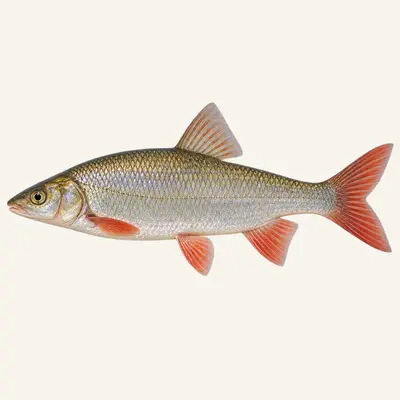
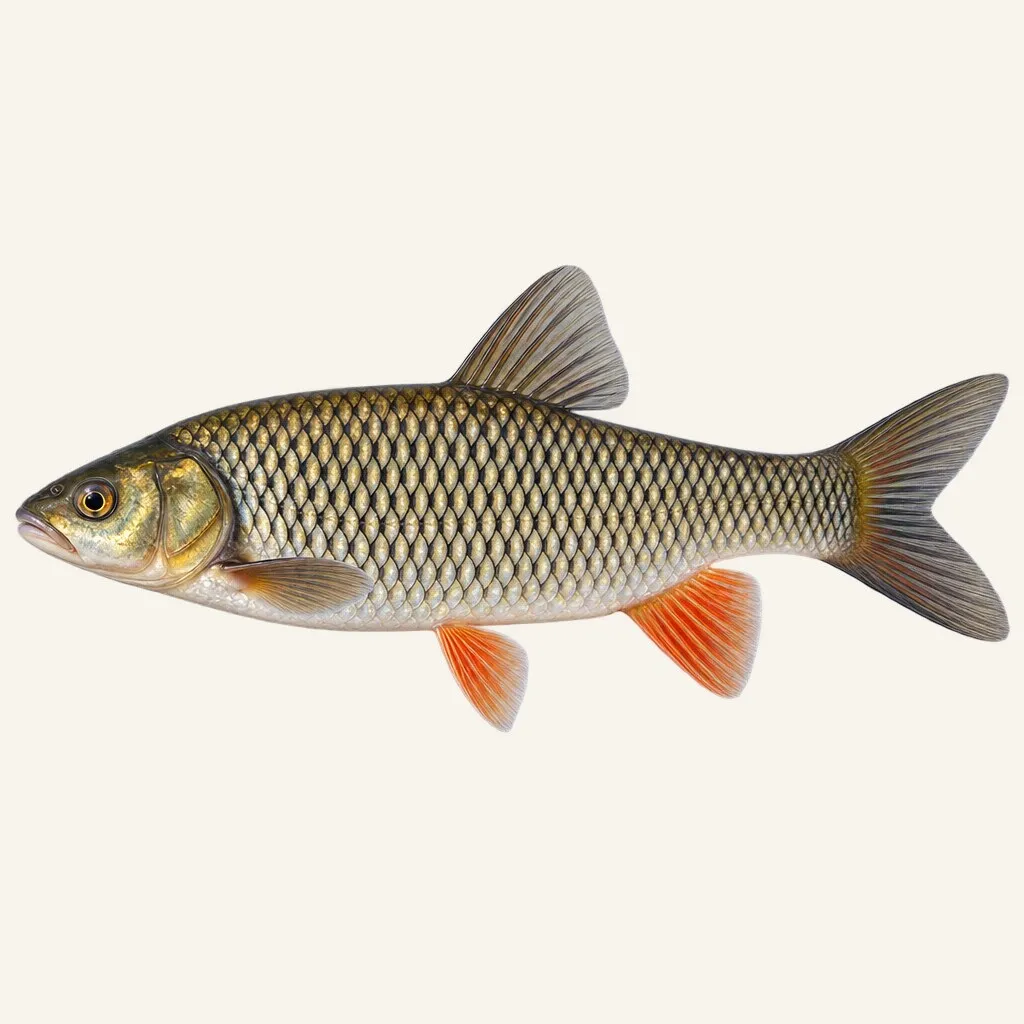
Look at the scales rather than the shape. Every scale on the flank is outlined in black along its free edge and clear through the middle, and the repetition of that outline builds a regular net pattern down the whole side of the fish, readable from the bank in clear water. No other cyprinid here carries netting that crisp.
The head is the second thing. It is large and blunt, and the dorsal profile breaks noticeably where the skull ends and the trunk begins, as though the back started abruptly behind it. The mouth is terminal and wide, with a well-marked chin, and the tip of the lower jaw stays outside the upper lip instead of tucking under it.
Anal and pelvic fins run orange to red. That colour, plus the anal fin itself, is what separates a small chub from a dace: stretch the anal on a fish over about 15 cm and the distance between the tips of the first and last branched rays comes out greater than the depth of the caudal peduncle.
The remaining counts are stable. Eight and a half branched rays in the dorsal and the same in the anal, rarely nine and a half; 40 to 45 scales on the lateral line plus two or three; pharyngeal teeth in two rows. Body depth is 22 to 27 per cent of standard length, which makes for a distinctly rounder, more cylindrical fish than a bream or a roach, and the iris is whitish.
Breeding
Spawning happens in moving water over gravel, and only rarely among submerged plants. Males collect on the shallows and escort ripe females up onto the riffles, splashing hard enough to be seen and heard from a distance.
A female does not commit her whole season at once. She spawns more than once across the period, with several males each time. Where a spring spate can scour a riffle clean overnight, splitting the output across weeks is the difference between losing part of a year and losing the whole of it.
The eggs are sticky and pale yellow. They finish up wedged into gravel and stuck to stones and trailing weed in the flow, rather than laid in a nest or buried under it.
Maturity usually arrives around 25 cm, but the published range runs from 7 to 30 — a fish can be ripe at a length most anglers would not bother to unhook carefully, or still immature at close to a foot, depending on which river it grew up in.
Chub hybridise with bleak often enough for it to matter, and the crosses are fertile. The product is a small silvery fish whose counts answer to neither parent, and because it breeds on, a population that starts producing them keeps producing them. It is the opposite of the usual hybrid situation: not a rare oddity to be photographed, but a persistent third form living in the same shoal.
The water it needs
The core is the small river and the large stream of the barbel zone, where riffles alternate with pools. What defines the species, though, is the amplitude either side of that core: chub also live along the margins of slow lowland rivers, in mountain streams barely wide enough to hold them, and in big lakes, running up inflowing streams to spawn.
Social structure inverts with age. Juveniles live in groups in very shallow marginal water; adults go solitary. That single change is what makes fishing for them unlike other coarse fishing — the target is one fish in one place, not a shoal to be found and held.
The place is almost always cover with a view. Under a leaning willow, against an undercut bank, in the shadow of a bridge, behind a raft of debris: somewhere the fish can watch open water without being in it. Chub in clear water are genuinely wary, and one that has seen movement on the bank leaves before anything is cast.
Areas
- Fast currents
- river mouths
- oxygenated zones
- structure
Techniques
- Lures
- Flies
- Worms
- Bread
- Insects
Baits
- Minnow
- Crankbait
- Micro-lures
- Dry flies
What it eats
Chub eat a wider range of things than any other fish in these rivers. Aquatic and terrestrial animals of every kind, plus plant material: fallen insects, larvae, crustaceans, molluscs, fruit, weed, scraps. Large individuals turn predominantly to fish.
Opportunism at that scale is why the species is everywhere. A specialist finds its food or it does not; a chub finds something. It persists through sections that have been enriched, warmed, silted or stripped of their invertebrates, because none of those changes takes away everything at once.
How to catch it
Since the fish will eat almost anything, technique is not the constraint — approach is. Chub have been taken on bread, worms, insects, fruit, cheese, small fish, flies and spinners, and arguing about which is best misses the point that all of them work on an unsuspecting fish and none of them works on an alarmed one.
So the fishing is stalking. Locate a fish under a branch or hard against a bank, stay low and behind cover, and make the first cast count. The first presentation is worth more than the next ten; by the third the fish knows something is going on even if it has not bolted.
They rise with real commitment, which opens up surface work — a bait dropped dry onto the fish's station is often taken on the instant. They also refuse anything that arrives with a splash or with a shadow crossing it, and an angler standing upright on the skyline has finished the swim before starting it.
Size and caution climb together. Small chub in a group are close to careless; a large solitary one has spent years learning what a person on a bank means. The flesh is poor and full of small bones, which has made this a fish to put back for as long as anyone has written about fishing for it.
Conservation
What matters about chub is not the pressure on them but what their abundance conceals. They are among the last fish left in a degraded reach, so a stretch holding nothing but chub is not a healthy stretch — it is one where everything with narrower requirements has already gone. Reading their presence as a good sign gets the diagnosis exactly backwards, and it is a common mistake on rivers under recovery.
Outside the native range the same qualities work the other way round. A large, plastic, opportunistic fish that turns piscivorous as it grows competes hard with local species and eats their fry, and the introductions have not been benign.
Within the range there is little to report: common, widespread, no identified threat. The species tolerates what removes other fish, which is a durable position to hold and a poor basis for judging the water it holds it in.
Regulations
Check the local regulations in force (legal size limits, closed seasons, bag limits).
For guidance only. Legal sizes, quotas and open seasons vary by location and season: always check the local regulations in force before fishing.
Other names
Chub is the standard English name. Older angling books use chevin and chavender for the same fish, and both still surface in regional speech; German has Döbel and Aitel, Italian cavedano.
Two confusions are worth carrying. The species spent most of its documented history as Leuciscus cephalus before being moved to Squalius, so anything written before that change files it under a different genus — the classification moved, the fish did not. And in North America "chub" names an assortment of unrelated cyprinids, creek chub among them, none of which is this animal. The epithet cephalus means head, which is the feature every description reaches for first.
Sources: fishbase.se · api.gbif.org