Roach
Rutilus rutilus · Cyprinidae
- Freshwater
- Carp & coarse
- Easy
- Size
25–50 cm
- Weight
0.2–1.8 kg
- Lifespan
14 years
- Water temp.
10–20 °C
Where to fish
- Canal
- Pond
- River
Habitat icons: Flaticon
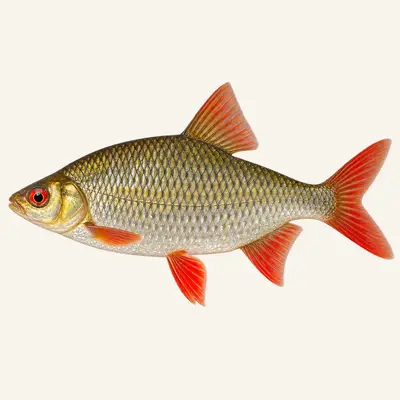
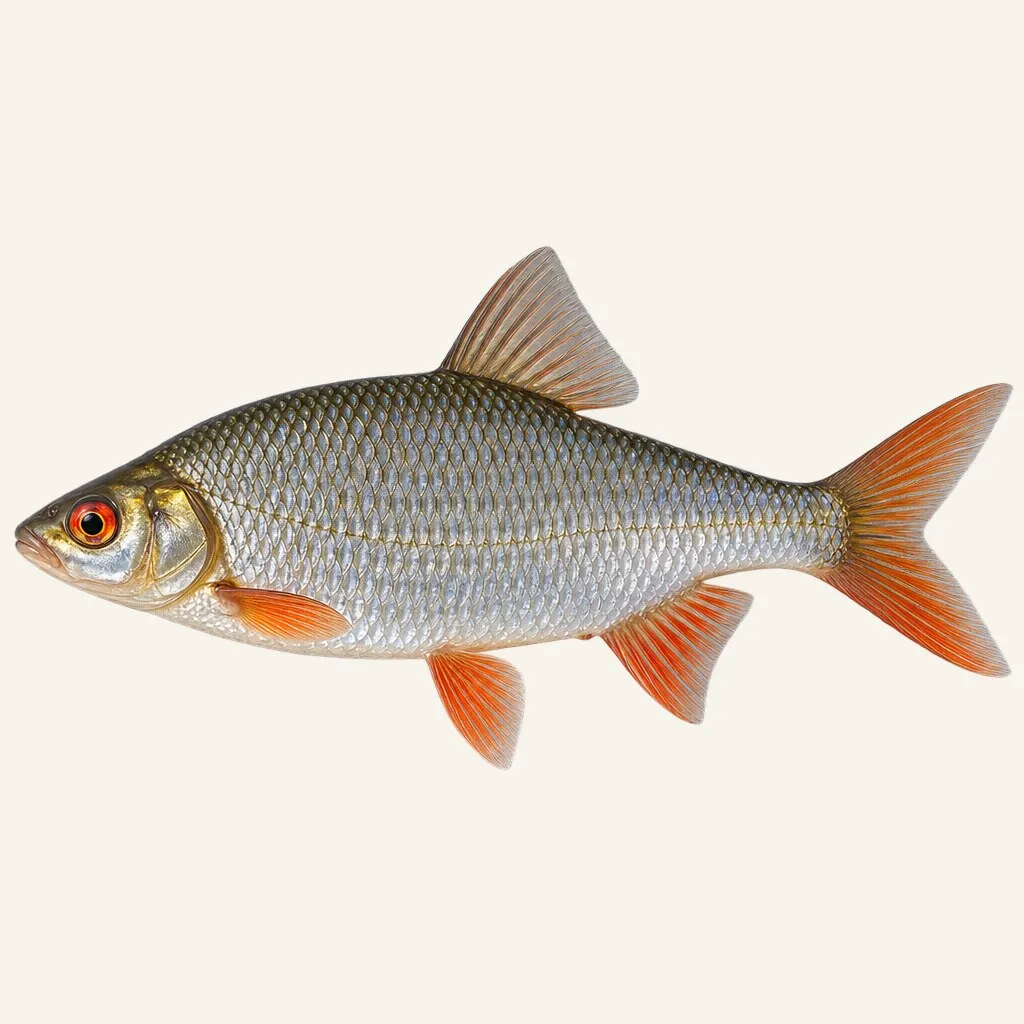
Silvery white fish with red eyes and reddish fins - an important forage species
Calendar
Recorded in 38 countries
Australia · Austria · Belarus · Belgium · Bosnia & Herzegovina · Bulgaria · Croatia · Czechia · Denmark · Estonia · Finland · France · Germany · Greece · Hungary · Iran · Ireland · Italy · Kazakhstan · Latvia · Lithuania · Luxembourg · Netherlands · Norway · Poland · Portugal · Romania · Russia · Serbia · Slovakia · Slovenia · Spain · Sweden · Switzerland · Türkiye · Ukraine · United Kingdom · Uzbekistan
GBIF occurrence records — native and introduced populations combined.
Its range
Two mountain chains hold the southern edge of the native range, the Pyrenees and the Alps. Beyond them the species is naturally missing from Iberia, from Italy and the Adriatic basin. The northern edge falls around the 56th parallel in Britain and the 69th in Scandinavia, and both limits are about winter shelter and summer warmth rather than about latitude as such.
Eastward nothing stops it. The Caspian basin with the Ural and the Eya, the Marmara and Aral basins, then Siberia from the Ob across to the Lena, with outposts in several Aegean drainages. One species, undivided, from rivers draining to the Atlantic to rivers draining to the eastern Arctic — a continuity that very few freshwater fish of this size manage.
Identifying it
Look at where the dorsal fin starts. On a roach its leading edge stands directly over the insertion of the pelvic fins, so a finger laid along the belly and a finger laid along the back arrive at the two fins together. That single alignment does more work than any other feature on the fish, because the species it is most often confused with sets its dorsal well back from that point.
Then the eye. The iris is yellow in a young fish and turns deep red with age, and on an adult it reads as two red points either side of the head at arm's length. Pectorals, pelvics and the anal fin run through the same range, orange into red. The mouth is terminal and the snout comes to a point. Down the flank there is nothing: hard silver, uninterrupted, with no dark band running lengthwise.
Body depth falls between a quarter and a third of standard length. The lateral line bears 39 to 41 scales with two or three more onto the tail, 41 to 44 counted through. Dorsal and anal fins each carry ten and a half branched rays, the tail 18 or 19, and the spine 39 to 41 vertebrae.
That anal count is worth holding, because it is the one number that survives a difficult fish. In the Atlantic drainages north of the Pyrenees this is the only member of its genus and nothing needs separating. Around the Black and Caspian basins, in the Apennines and through the Balkans it shares water with relatives, and among the Balkan ones the ten and a half branched anal rays settle it on their own.
Breeding
Maturity comes early and that governs the shape of a population. The average fish is spawning at 14 cm, the earliest at eight, in an animal that lives up to 14 years and is commonly met at 25 cm. Almost every roach visible in a water is therefore a breeding fish, and a year class lost to a bad spring is made up inside two seasons.
Two entirely unrelated kinds of spawning ground serve. One is dead water — a backwater or lake with thick submerged weed, or a flooded meadow. The other is its opposite: shallow gravel or plants under fast river current. Most cyprinids commit to one regime or the other. This one takes either, which is a large part of why it is difficult to fail.
Fish spawn in shoals after short movements, a few hundred metres to a few kilometres, never a migration through a basin. The eggs are pale yellow and adhesive, and they fix to weed and to submerged tree roots alike. The roots matter more than they look: they hold when the vegetation of a flooded meadow lies down or rots.
Incubation runs about 12 days. That is a long exposure for a clutch glued a few dozen centimetres under the surface — a fortnight in which a drop in level strands the eggs in air, and in which everything grazing the weed carries them off with it.
The water it needs
Winter, not summer, sets the limits. In a fast river the species holds only those reaches where a backwater or some other shelter allows it to sit out the cold months; where the channel has been straightened for kilometres it is absent from water that would suit it perfectly from May to September. Lakes work the same way, the fish dropping into the deep basins to winter.
Everywhere else it establishes. The optimum is a nutrient-rich lake or a slow lowland river of medium to large size with its side waters attached, but it turns up equally in a small lowland stream and in a brackish coastal lagoon, in water between 10 and 20 degrees.
Larvae and juveniles take the margins in all their forms. It is the only stage of the life cycle that can be predicted: the young are at the edge, in the shallows, whatever the water body.
Areas
- Calm zones
- canals
- ponds
- slow rivers
Techniques
- Pole/coarse fishing
- Light feeder
- Paste
Baits
- Maggots
- Bread
- Seeds
What it eats
Four resources, taken at four different levels: bottom invertebrates, zooplankton, plant material, detritus. None of them dominates on principle, and that is the point of the list.
The fish moves between food and between zones inside a single season, out of the littoral into open water, off the bed and onto plankton, for two separate reasons: because one item has become abundant, or to get away from a predator or a competitor. Where a roach sits in a lake is a settlement between what it eats and what eats it, and the settlement moves.
It is also what makes the species the forage base of every water it occupies. Plankton, algae and silt go in and a 25 cm fish comes out, and pike, perch and zander live off the conversion.
How to catch it
Winter concentrates them and that is the easiest fishing of the year. The fish leave the margins for backwaters and deep holes and pack in. Water that looked lifeless in December gives up dozens of fish over three square metres, provided the hole has been found.
The rest of the year the depth is the question, and yesterday's answer is unreliable. A shoal that fed three metres out against the weed can sit at half depth well off the bank the next day with nothing having changed in the sky; it has followed a bloom of zooplankton, or moved off a perch. Search vertically as much as horizontally, in steps, until the layer of the day turns up.
The bite is fast. Terminal mouth, light fish: it takes and goes, where other cyprinids draw a bait in and blow it out again. Fine wire, a small offering and a sensitive float follow from that, and feed goes in as small repeated helpings that keep the shoal over the swim without filling it.
A fish well clear of the common length of 25 cm is an old one rather than a lucky one, on a species recorded to 14 years. There are too few of them to matter to a population and too few to justify a keepnet.
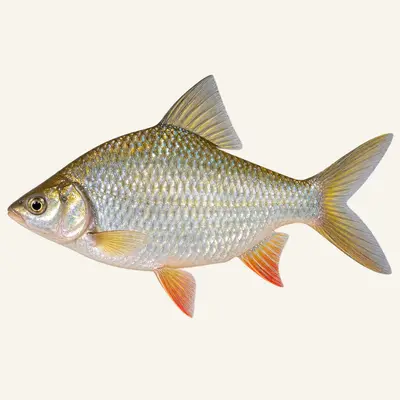
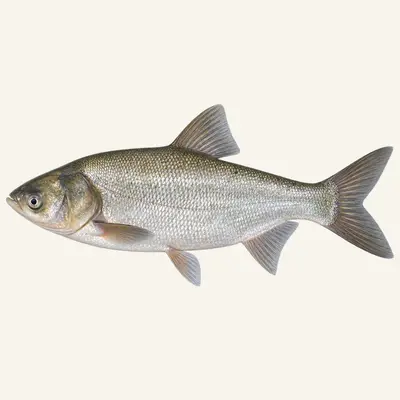
Where bream are numerous, a fish is worth counting before a name is written on it. The naming section below explains why.
Conservation
Nothing presses on this fish; it is the pressure. Local introductions established it in Spain and in north-eastern Italy, where it turned invasive, and at least one country has recorded ecological damage after it arrived. The mechanism has nothing aggressive in it — it is exactly the ordinariness described above. An animal that eats four things, changes zone with the season and spawns on either of two substrates has very little reason to fail anywhere. Specialists are hard to establish; this is not a specialist. Both of those populations arrived by the two routes the species travels, as livebait and as stocked prey, and moving live fish between waters is controlled nearly everywhere, with the local rules a question for the competent authority.
There is also a way of reading its abundance. It is at its most numerous in nutrient-rich lakes — that is, it does best precisely where the water has enriched. A fishery tipping over into a roach-dominated population has changed state, and the fish is the symptom rather than the cause.
Regulations
Check the local regulations in force (legal size limits, closed seasons, bag limits).
For guidance only. Legal sizes, quotas and open seasons vary by location and season: always check the local regulations in force before fishing.
Other names
The hybrid problem belongs here, because it is a problem about names rather than about fish. This species crosses with common bream and the young are fertile. Fertility is the whole difficulty: the crosses breed on and back into both parents, so what turns up in a net is not one recognisable hybrid form but a continuous series running from one species to the other. Anal ray count is what settles an individual — ten and a half branched rays here, far more on the bream, an intermediate figure on the cross — and the red iris and the terminal mouth back it up. Crosses with rudd are recorded as well, in the same margins the two share. In a water holding all three, an intermediate fish may simply have no correct name.
English adds its own slop. Roach is the book name for this species, but in ordinary talk the plural covers whatever small silver fish a water produces, true roach, rudd and young bream together. The imprecision is old and harms nobody until something has to be counted.
German splits the pair better than English does, and splits it by anatomy: Rotauge, red eye, is this fish, and Rotfeder, red feather, is the rudd. One name points at the iris and the other at the fins, which is exactly the order in which the two should be checked. The scientific name repeats itself, Rutilus rutilus, from the Latin for a reddish gold — the doubling marks the species the whole genus was built on.
Sources: fishbase.se · api.gbif.org