Macedonian trout
Salmo macedonicus · Salmonidae
- Freshwater
- Salmonids
- Hard
- Size
40 cm
Where to fish
- River
Habitat icons: Flaticon
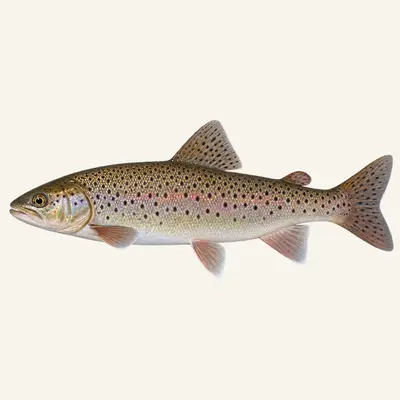
The Macedonian trout is a salmonid endemic to the river basins of northern Greece and North Macedonia, with a stocky body marked by distinctive red and black spots on the flanks.
Calendar
Recorded in 2 countries
Greece · North Macedonia
GBIF occurrence records — native and introduced populations combined.
Its range
The upper Vardar, and nowhere else. The species occupies the upstream part of that drainage in North Macedonia, with the Crna system excluded. A range of that size fits on a large-scale map with room to spare and leaves no margin at all: there is no reserve population elsewhere and no neighbouring basin to recolonise from.
The same network holds an isolated population of the Black Sea trout, in the Lipkovska stream. Two Salmo species belonging to different sea basins therefore share the headwaters of one river, which makes the upper Vardar a working exhibit of how often the Balkan watersheds have been rearranged.
Identifying it
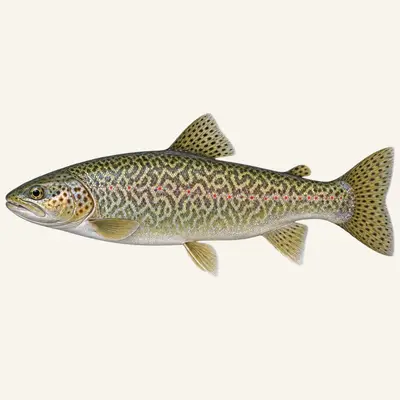
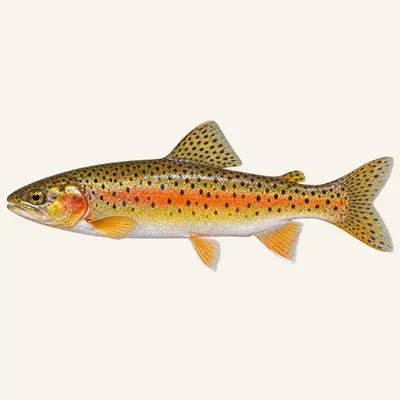
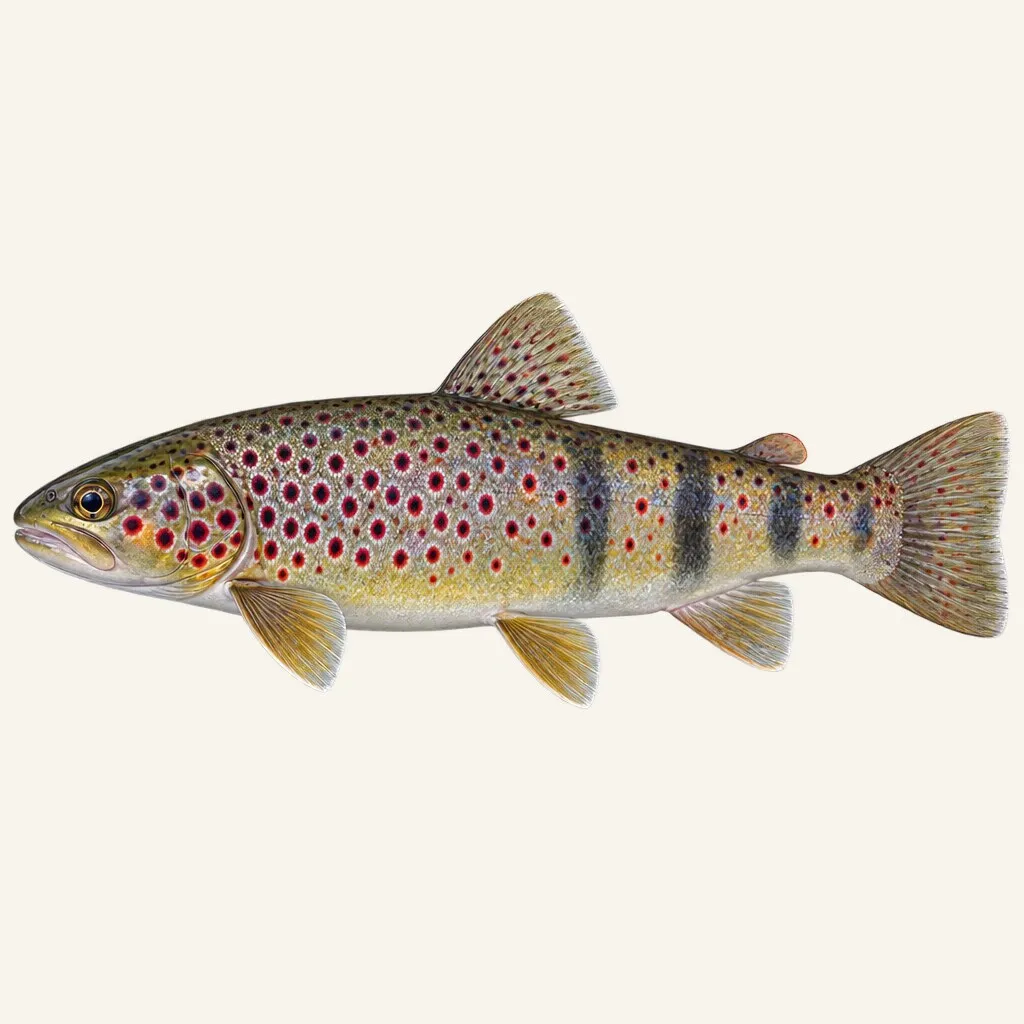
The spots are large, ocellated and wine-red, scattered over the flank and the opercle and heaviest towards the front of the body. In fish from the Kadina system their centres sometimes go blackish; in those of the Babuna and the Dosnica, black pigment covers the forward ones outright. The dorsal fin carries a few of the same spots, weaker.
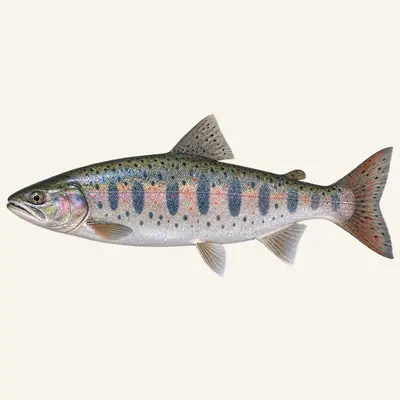
A second character only shows under duress. Individuals over 30 cm standard length develop three broad black bars across the rear half of the body, and they are distinct only when the fish is stressed. In practice that means in the net, not in the water.
Which has a consequence worth stating plainly. In the river this trout passes for an ordinary one; it declares itself in the hand. Anyone who has fished the upper Vardar tributaries and released everything without a close look has probably caught the species without recording it.
The water it needs
It takes the fast sections, the steps and the small waterfalls. This is a fish of steep gradient, living in the part of the river profile where water breaks over rock and re-oxygenates continuously.
That preference has a mechanical effect on its distribution. The surface that suits it is measured in hundreds of metres of channel rather than in kilometres, and every structure that eases the gradient or drowns a rapid removes a share of it. A modest impoundment can delete more habitat than it covers ground.
Areas
- Mountain rivers
- Gravel riffles
- Shaded pools
Techniques
- Fly fishing
- Nymphing
- Toc fishing
Baits
- Dry fly
- Artificial nymph
- Aquatic larva
How to catch it
No fishery is documented on this species. The sources file it as of potential interest, which means that neither commercial exploitation nor any organised sport fishing has been described for it — an unusual entry for a trout in a country where trout are fished.
It is nonetheless being caught. Anyone fly-fishing the upper Vardar tributaries takes this trout believing it to be the other one, since nothing separates them while the fish is still in the water. The dark bars over the back, the wine colour of the spots and the pale ring around each of them are only legible on a fish in the hand.
The ground dictates the rest: rapids, falls and broken seams, holding a trout that never grows large. Short lines and a presentation kept near the bottom, as on any steep river, and an approach from below because the water is shallow and clear.
Regulations
Check the local regulations in force (legal size limits, closed seasons, bag limits).
For guidance only. Legal sizes, quotas and open seasons vary by location and season: always check the local regulations in force before fishing.
Other names
Macedonian trout in English, Mazedonische Forelle in German. Every one of these names points at a country rather than at a fish, which is the rule among the Balkan trout: the ranges are so narrow that a place name is enough to identify the species, and geography stands in for description.
The habit has a cost. Names of that shape read like regional variants of one animal, which hides how many distinct species the peninsula actually holds, and they say nothing whatever about what the fish looks like — here, a description would have been more use than a nationality.
Sources: fishbase.se · api.gbif.org