Mountain whitefish
Prosopium williamsoni · Salmonidae
- Freshwater
- Salmonids
- Medium
- Size
23–70 cm
- Weight
0.1–2.9 kg
- Lifespan
17 years
- Depth
5–20 m
Where to fish
- Lake
- River
Habitat icons: Flaticon
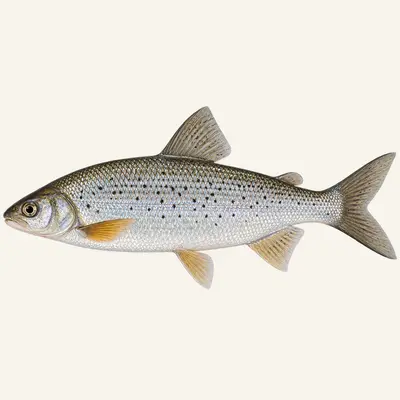
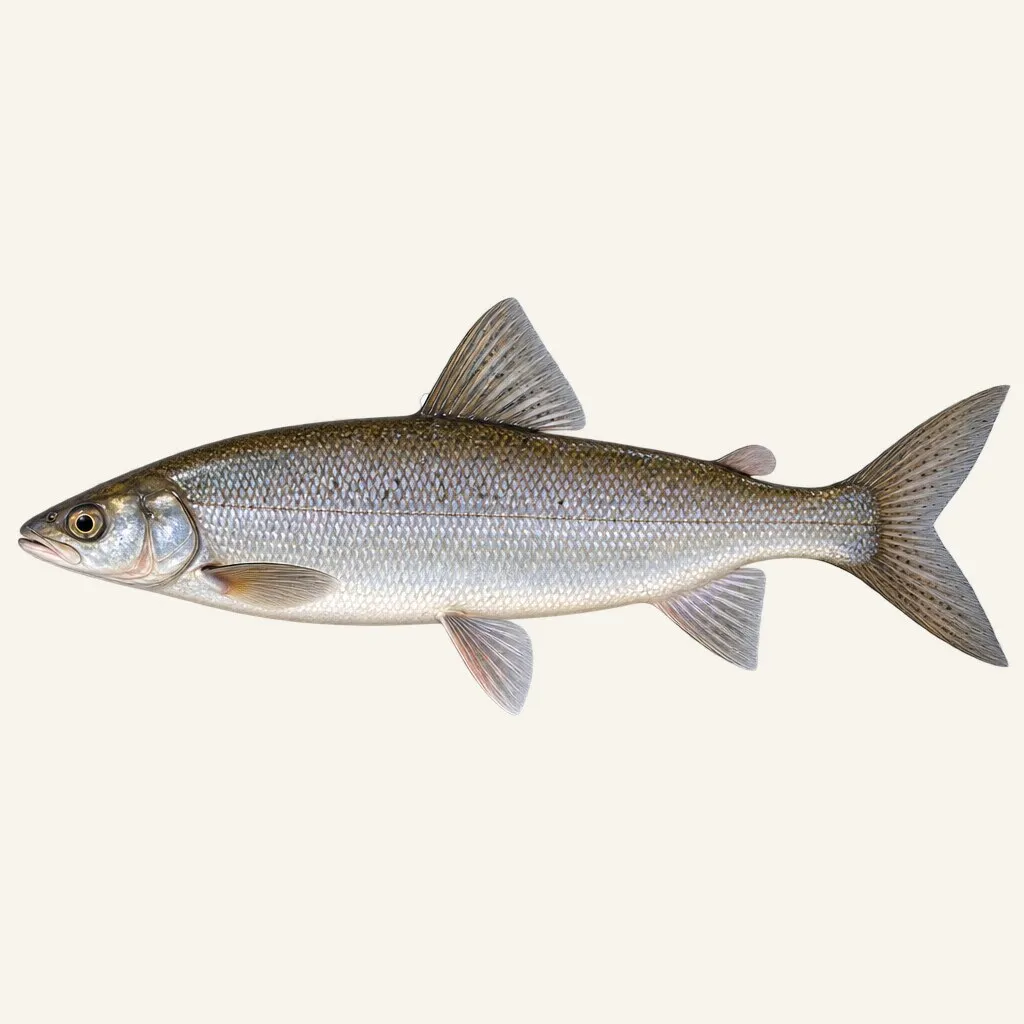
The mountain whitefish is a slender North American salmonid with a brownish-green back and silvery sides, a prominent snout and a characteristic subterminal mouth. It inhabits cold mountain rivers and lakes of western Canada and the American Rockies, feeding on benthic invertebrates.
Calendar
Recorded in 2 countries
GBIF occurrence records — native and introduced populations combined.
Its range
North America, from the Mackenzie drainage in the Northwest Territories south through western Canada and the north-western United States, across the Pacific, Hudson Bay and upper Missouri basins, as far as the Truckee drainage in Nevada and the Sevier in Utah.
Those last two are the southern outposts, and they sit in closed Great Basin drainages: isolated populations with no continuity with the rest of the range, and no route back into it.
Identifying it
Slender, elongate, close to cylindrical in section but variable, and more compressed from side to side than the round whitefish. That direct comparison is the one the literature makes, and it remains the best character available for telling the two apart.
The head is short, the snout more or less pointed and compressed with a single flap of skin between the nostrils, and the eye is smaller across than the snout is long. The mouth is small, set underneath, overhung by the snout, with the maxillary reaching back almost to the front edge of the eye in an adult.
The dentition is worth a look, because it explains the mouth. An adult has teeth only in a small patch on the tongue and on the gill rakers — none in the jaws, none on the vomer, none on the palatines; young fish may keep a few on the premaxillae and lose them. This is an animal that collects food off a surface rather than seizing it.
Colour is silvery overall, the back light or dark brown to olive, with the scales — especially over the back — often carrying pigmented borders. The dorsal is often dusky and the pelvic and pectoral fins take an amber tint in adults. The vertebral count runs 53 to 61, fewer than in its congener; the dorsal has 11 to 15 soft rays and the anal 10 to 13, with no spine in either.
The water it needs
Adults occupy lakes and fast streams, clear or silty.
That tolerance of silt is the practical division between the two whitefish of this genus, the other one requiring clear streams. Two very close species, one accepting loaded water and the other refusing it, which in a shared basin decides which reaches hold which fish.
The working band is 5 to 20 m and usually 5 or 6. The upper thermal limit is 23 degrees, and the range reaches from 68 degrees north down to 39, which is a long way south for a cold-water fish.
Areas
- Mountain rapids and riffles
- High-altitude lakes
- Stream confluences
- Cold upwelling zones
Techniques
- Dry fly fishing
- Euro nymphing
- Toc fishing
- Light spinning
Baits
- Small dry flies
- Light nymphs
- Bloodworms
- Insect larvae
- Artificial salmon eggs
What it eats
Chiefly benthic organisms: aquatic insect larvae, molluscs, fish, and fish eggs including its own. Plankton and surface insects come in when the need arises, which is the wording of the source and describes an animal with no speciality at all, switching to whatever the water is offering.
Eating its own eggs is stated explicitly and it is not an aside. In a fish that spawns on the bottom of a stream, the clutch is simply part of the food available on that bottom, and the population regulates its own numbers before any outside predator is involved. It also means that a spawning shoal is feeding on the product of the shoal.
How to catch it
Fast water and lakes, worked on the bottom, with imitations of benthic invertebrates. The mouth decides the tackle: it is small, it sits under the snout, and it holds no teeth in the jaws, so the size of the offering matters considerably more than the pattern of it.
Surface insects when the need arises leaves a genuine dry-fly window open, but it is opportunism rather than habit and it is not something a day can be planned around.
The silt tolerance is the piece of information that pays where the two species share a drainage: reaches carrying fine sediment hold this one and not the other.
Set a common length of 23 cm against 17 years at the oldest reported age and the growth rate becomes clear. A heavy fish out of a cold western river has taken a decade or more to get there. Commercial interest is minor, and most of the fish caught are caught by anglers who were fishing for trout in the same water.
Conservation
The Nevada and Utah populations are the exposed ones. They are shut inside endorheic basins, at the southern thermal edge of the species, in country where water is heavily claimed. An abstraction that pushes a reach past 23 degrees closes it, and nothing recolonises a closed basin from outside.
Elsewhere the silt tolerance protects this fish better than its congener is protected, but a benthic diet ties it to the fauna of the bed, and fine sediment alters that fauna even where it does not eliminate it. Tolerating turbid water is not the same as being indifferent to what settles out of it.
Growth is slow at these latitudes, which changes the arithmetic of keeping a large fish: it will not be replaced within a season, or within several.
Regulations
Check the local regulations in force (legal size limits, closed seasons, bag limits).
For guidance only. Legal sizes, quotas and open seasons vary by location and season: always check the local regulations in force before fishing.
Other names
Mountain whitefish in English, and under that name it is one of the commonest fish in the rivers of the American West — as well as one of the most frequently caught by accident.
Whitefish on its own is close to useless as a name. It attaches to almost any pale-fleshed fish on a counter and to a whole series of coregonines besides, so a whitefish reported from the Great Lakes belongs to a different genus and a whitefish on a menu may belong to no particular species at all. Within the rivers of the West, though, the full name is unambiguous.
French uses corégone de montagne. The genus name comes from the Greek for mask, after the bones covering the front of the head.
Sources: fishbase.se · api.gbif.org