Marble trout
Salmo marmoratus · Salmonidae
- Freshwater
- Salmonids
- Hard
- Size
120 cm
- Weight
50 kg
- Lifespan
10 years
- Water temp.
2–15 °C
Where to fish
- River
Habitat icons: Flaticon
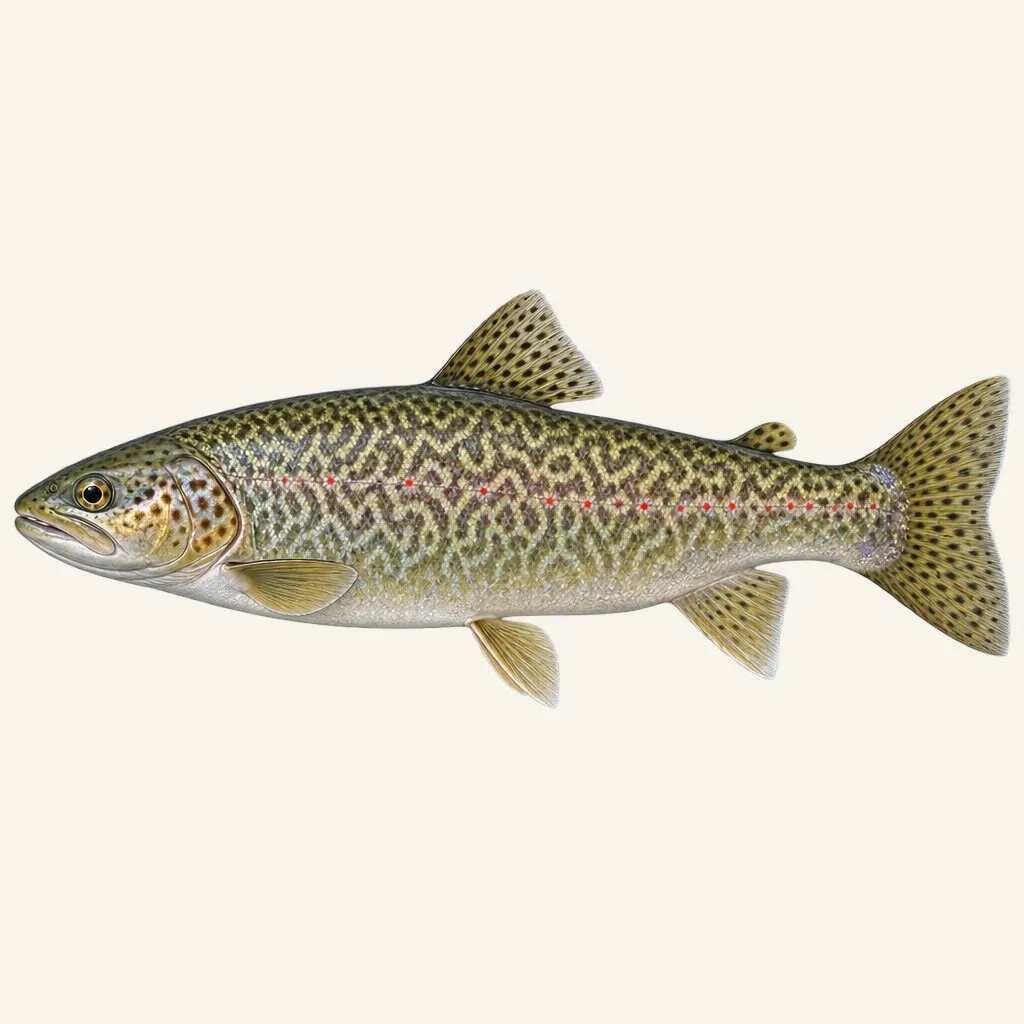
The marble trout is the largest salmonid in continental Europe, recognisable by its striking grey-green marbling on an ochre background; adults are piscivorous and can exceed one metre in the large rivers of the Dinaric Alps.
Calendar
Recorded in 4 countries
Bosnia & Herzegovina · Italy · Slovenia · Switzerland
GBIF occurrence records — native and introduced populations combined.
Its range
The range is that of a fish which stayed on the right side of the Alps. It covers the Adriatic slope from the northern tributaries of the Po — those alone — across to the Soča and Rizana drainages in Italy and Slovenia. The southern Po tributaries, warmer and with no meltwater supply, hold none: the boundary inside a single basin is thermal, not administrative.
One introduction has been added to that map, in the Tevere drainage.
The rest of the picture is a taxonomic argument. Molecular data indicate that fish identified as this species in the Neretva, and most likely those of the Lake Skadar basin and the Drin-to-Shkumbin drainages, belong to something else that has not yet been described. Records from Croatia, Montenegro, Bosnia and Albania may refer to other Adriatic trout entirely. The marble trout in the strict sense occupies far less ground than the older maps suggest, and a good deal of what was written about it was written about other fish.
Identifying it
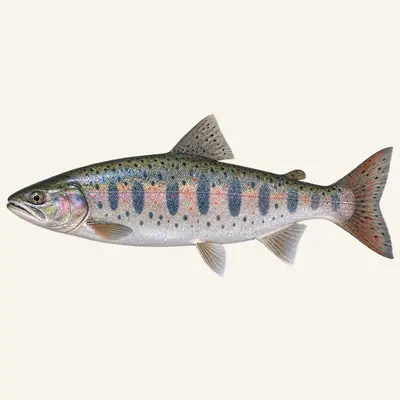
The pattern is unmistakable and nothing else in the Adriatic basin wears it. Over a ground running from silvery to olive-green, irregular brown lines interlock across the whole flank like the veining in a cut stone. No congener on that slope carries the marbling, which is why the character alone names the species.
The second mark is an absence. Past six centimetres standard length there are no parr marks left at all — the dark vertical bars that other young salmonids keep for a season or two are gone early here, so even small fish can be sorted.
Red spots are the unreliable part. Where they occur they sit on the lateral line and nowhere else, and whole populations carry none. The opercle is marked with brownish blotches or streaks. Head length is 22 to 25 % of standard length, and the eye goes 1.7 to 2.2 times into the interorbital width, 3.1 to 4.3 into the postorbital length on a fish of 25 to 35 cm.
The marbling does a second job the other characters cannot. Crossing with stocked Atlantic trout produces intermediate fish whose veining goes soft and blurred, so the one feature that names the species is also the readable index of how much local ancestry is left in the fish being held.
Breeding
It hardly moves to breed. Where other salmonids run tens of kilometres, this one spawns close to where it has been living, and only fish that feed in a lake go up into the tributaries — over short distances at that.
Males take station on the gravel about a week before the females arrive, which puts a heavy concentration of adults on a small area for a fortnight rather than a night. Laying happens over gravel in a current of 0.4 to 0.5 metres per second, under 60 to 80 cm of water. That is a tight specification, and it explains why the species answers so sharply to flow management: a reach that is drawn down or diverted loses its spawning ground without any visible change to the river.
Development is slow, in keeping with water that rarely passes 15 °C. Eggs take about 45 days to hatch. The alevins do not begin feeding until 59 to 63 days after laying at 10 °C, which is two months during which the entire cohort is inside the gravel and dependent on water still moving through it.
The water it needs
Fifteen degrees in summer, and no more. That ceiling confines it to the upper courses of Alpine rivers and to lakes of glacial origin, in montane and piedmont country.
The bed is sand and gravel, the water clean and cold, running or still. So a torrent and the lake it feeds are both acceptable, provided that summer does not warm the layer the fish is holding in.
The same requirement forbids the range to move downhill. The middle Po and its lowland tributaries stay out of reach, and warming works against the species from the bottom of every catchment upwards, taking the lowest kilometre first.
Areas
- Alpine torrents
- Pools below waterfalls
- Fast current zones
- Rocky banks
Techniques
- Fly fishing
- Light lure
- Nymphing
- Streamer fishing
Baits
- Dry fly
- Artificial nymph
- Small dead fish
- Light spinner
What it eats
The menu changes with size. Young fish take a wide spread of invertebrates, aquatic and terrestrial. Adults switch to fish and do not switch back.
That switch is what separates this trout from the small torrent fish around it. On the same water and the same insect supply they level off; this one carries on, to lengths nothing else on the Adriatic slope reaches. An animal that arrives at its published maximum inside ten years has grown at a rate no insect-feeder achieves.
How to catch it
The fact that organises this fishery is not a biological one. Genetically intact populations can be counted on one hand, and their recovery rests on deliberate restocking with pure strains. Where the species survives, access to the water is restricted and comes with particular conditions, set river by river and revised as the programmes go on.
Diet decides the rest. Adults are piscivorous, and that is what produces the metre-plus fish; a streamer or a minnow-shaped lure matches what a large individual is hunting, while insect imitations take the young and the middle sizes still living on invertebrates.
Then there is the water: cold, fast, transparent. Flight distance is long in it and the approach settles everything. The holes below drop-offs and the fast seams alongside boulders are what concentrate the better fish.
One last point is specific to this species. The fish in your hands is a data point. Crisp marbling indicates something close to the native strain; a smeared, indistinct pattern betrays an Atlantic ancestor. On these rivers the description of a capture is worth recording, and several of the recovery programmes rely on exactly that.
Conservation · Vulnerable (IUCN) — This species is threatened with extinction. Always release it (no-kill), handle it with the utmost care and check local rules — fishing for it may be prohibited.
Conservation
The species is being lost without its numbers falling. Atlantic brown trout and Salmo cenerinus were released into the Adriatic basin for decades; they cross with the marble trout and the offspring are fertile. The native population dissolves into the introduced one, and the mechanism leaves no corpses. A river can stay full of trout without holding a single pure marble trout.
Only a handful of populations escaped that mixing. Stocking with selected pure strains has improved matters, and the improvement is conditional: it depends on the programmes continuing, and it would reverse if they stopped.
The ordinary pressures sit on top of that — pollution, overfishing and river regulation, weirs and diversions included. All of them bear on the same short length of river, because there is no other length of river for the species to be in.
Regulations
Check the local regulations in force (legal size limits, closed seasons, bag limits).
For guidance only. Legal sizes, quotas and open seasons vary by location and season: always check the local regulations in force before fishing.
Other names
Marble trout is the settled English name, trota marmorata in Italian, Marmorierte Forelle in German, and the scientific epithet says the same thing again. Every one of them describes the flank, which is unusual — a name that points at the single character the eye actually retains, and, by a piece of luck, at the one that also reports the genetic state of the animal.
Sources: fishbase.se · api.gbif.org