Iwame trout
Oncorhynchus iwame · Salmonidae
- Freshwater
- Salmonids
- Hard
- Size
25 cm
Where to fish
- River
Habitat icons: Flaticon
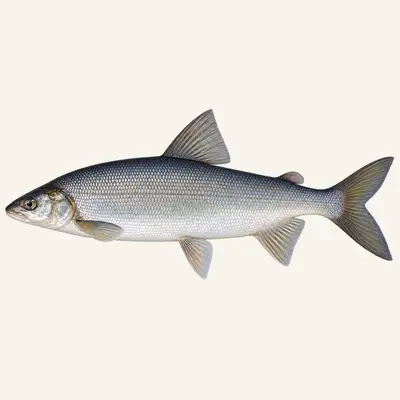
The iwame is an extremely rare depigmented form of the Japanese yamame, recognizable by its nearly silver coloration without the typical salmonid markings.
Calendar
Its range
This salmonid exists only in Japan, and its range is not a territory but a list. The known populations are landlocked, each in its own basin — the Ôno, the Niyodo, the Inabe, the Ibi, the Sakawa, the Hananuki. Six rivers, six nuclei with no contact between them.
A map of that shape records a partition rather than a conquest. A salmonid that no longer goes down to the sea is a prisoner of its own network; each basin then evolves on its own account and receives nothing from outside. A local extinction is repaired by no natural recolonisation, and what is observed in one of these rivers does not transfer to the other five.
Breeding
The ovary of this fish ripens as one block. Its organisation is synchronous and its fecundity determinate: the stock of oocytes is built before the season, is not added to along the way, and the female releases what she formed, with no second attempt before the following year.
That arrangement ties the spawning to the condition of the female several months before it happens. A poor growing season is paid for at the next reproduction, and nothing corrects the shortfall in between. In a fish shut inside a small mountain basin, where the food available depends on a narrow flow regime, the rigidity counts double.
Areas
- Isolated Japanese mountain torrents
- Remote headwater river sections
- Deep pools below waterfalls
- Rocky riffles with strong current
Techniques
- Dry fly fishing (very stealthy approach)
- Traditional tenkara
- Very light lure fishing
- Free-drifting nymph
Baits
- Imitative dry flies
- Artificial nymphs
- Natural insects
- Micro-spoons
Conservation
Nobody knows what state this fish is in. No monitoring says whether numbers are rising, falling or holding: the last international examination, in August 1996, stopped at the finding that the data were not there, and it has been carried forward since without review.
Thirty years of silence weigh more here than they would elsewhere. The fish is split into six nuclei, none of which can relieve another, so a population can go out without the apparent total moving much and without anything registering that it has gone. The rest of the file is empty in the same way: the animal falls under neither CITES nor the convention on migratory species, and it presents no danger to people.
Regulations
Check the local regulations in force (legal size limits, closed seasons, bag limits).
For guidance only. Legal sizes, quotas and open seasons vary by location and season: always check the local regulations in force before fishing.
Sources: fishbase.se · api.gbif.org