Lake trout
Salvelinus namaycush · Salmonidae
- Freshwater
- Salmonids
- Hard
- Size
50–150 cm
- Weight
1.1–33 kg
- Lifespan
50 years
- Water temp.
4–13 °C
- Depth
3–61 m
Where to fish
- Lake
Habitat icons: Flaticon
Large North American char - Lives in deep water - Specialized fishing
Calendar
Recorded in 6 countries
Canada · France · Norway · Sweden · Switzerland · United States
GBIF occurrence records — native and introduced populations combined.
Its range
The species holds Atlantic, Arctic and Pacific basins from northern Canada and Alaska south to New England, the Great Lakes and northern Montana. It has been widely introduced beyond that range.
Two footnotes matter. Splake — the hybrid with brook char — has been successfully stocked across much of North America, so a char in a stocked water may be neither parent. And Lake Superior alone carries three recognised phenotypes: lean, siscowet, and humper. One lake, three forms, which is a warning against reading any single description as the species.
Identifying it
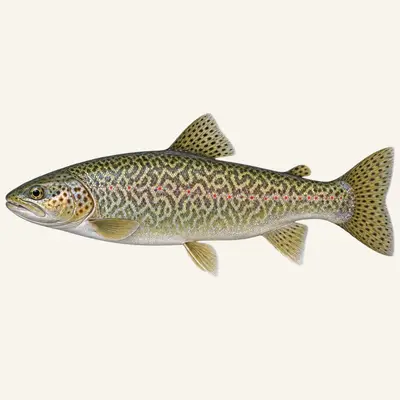
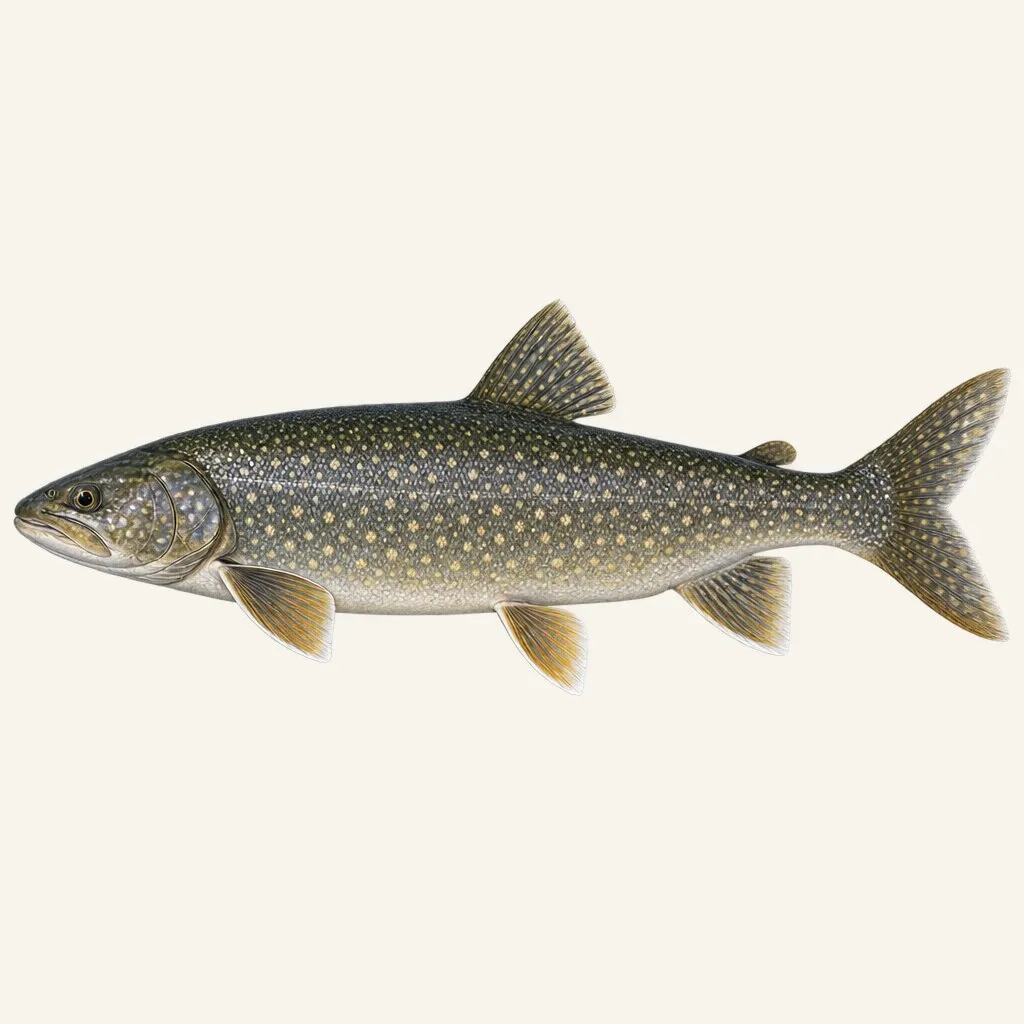
Pale spots on a dark ground, a deeply forked tail, and a great many pyloric caeca: those three together identify the fish. The spots are white or yellowish on dark green to grey — never the red or halo-ringed spots of the other chars.
The forked tail is the field character. Brook char and Arctic char carry a tail that is barely notched; this one is cut deeply, which reads at a glance on a fish in the net.
The lateral line curves slightly at the front. The pelvic fins carry a small axillary process. The body is trout-shaped, elongate and fairly round in section, the head stout and broad above.
Counts: 4 to 5 dorsal spines with 8 to 10 soft rays, the same at the anal, and 61 to 69 vertebrae.
Breeding
Spawning happens mostly at night, peaking between dusk and about ten. During the day the fish scatter away from the beds and return in numbers through the late afternoon.
The males arrive first and spend time cleaning the rocks. Females follow a few days later and are courted on the beds.
And that is the whole of it. No redd is dug. The eggs are released over cleaned rock and drop into the interstices, which is why the substrate itself — clean, loose, coarse — decides whether a lake produces lake trout at all. A fish that excavated its own nest could work poorer ground; this one cannot.
Maturity comes at about 52 cm, in a reported range of 42 to 50.
The water it needs
Adults use both shallow and deep water in northern lakes and streams, and are confined to relatively deep lakes in the southern part of the range. They are rarely found in brackish water.
Usual depth runs 18 to 53 m, with a temperature window of 4 to 13°C. That window is narrow, and it is what pushes the fish deep as summer warms the surface — and what confines the southern populations to lakes deep enough to hold cold water all year.
The species is described as a solitary wanderer, the extent of its movement apparently set by the size of the lake and of the individual.
Areas
- Large deep lakes
- Cold deep holes
- Under-ice zones
- Deep weed beds in summer
Techniques
- Deep lures
- Trolling
Baits
- Spoon
- Deep jigs
- Trolling
What it eats
Lake trout take a wide spread of prey — freshwater sponges, crustaceans, insects, small mammals — but the preference is for ciscoes.
That preference is worth holding onto, because cisco is a pelagic plankton feeder. A predator keyed to it hunts open water rather than structure, and where cisco populations have collapsed or been displaced, lake trout growth follows them down.
How to catch it
Depth and temperature set everything. Between 18 and 53 m, in water of 4 to 13°C: find that band and you have found the fish, and it moves down through the season as the surface warms.
A solitary wanderer means covering water rather than working a mark. Trolling and deep jigging both follow from that, and from a diet centred on a mid-water baitfish rather than on bottom invertebrates.
The arithmetic of age changes what a large fish is. Maximum recorded age is 50 years, in water at 4 to 13°C where nothing grows fast. A big lake trout has been in that lake for decades, and a returned fish is worth far more than the number on the scale suggests.
Spawning is at night over cleaned rock, and the fish disperse by day — which is why the beds look empty at the hours most people are on the water.
Conservation
Fifty years of life against maturity at half a metre gives a stock that answers a decision across decades, in either direction.
The absence of a redd is the specific weakness. Eggs left in the interstices of cleaned rock depend on that rock staying clean and open, so siltation removes recruitment without touching an adult. Restoration that would work for a redd-digging salmonid does not apply here.
Introductions raise the mirror problem: a deep-water predator dropped into a lake outside its range restructures what it finds, and the splake hybrid muddies what is left.
Regulations
Check the local regulations in force (legal size limits, closed seasons, bag limits).
For guidance only. Legal sizes, quotas and open seasons vary by location and season: always check the local regulations in force before fishing.
Other names
Lake trout in English — a name that is doubly wrong, since the fish is a char and not all populations are lacustrine. Also lake char, touladi in eastern Canada, and grey trout, mackinaw or siscowet regionally, the last two naming Lake Superior forms rather than the species. Touladi in French.
Sources: fishbase.se · api.gbif.org