Lake whitefish
Coregonus clupeaformis · Salmonidae
- Freshwater
- Salmonids
- Medium
- Size
54–100 cm
- Weight
2.2–19 kg
- Lifespan
50 years
- Water temp.
8–14 °C
- Depth
8–128 m
Where to fish
- Lake
Habitat icons: Flaticon
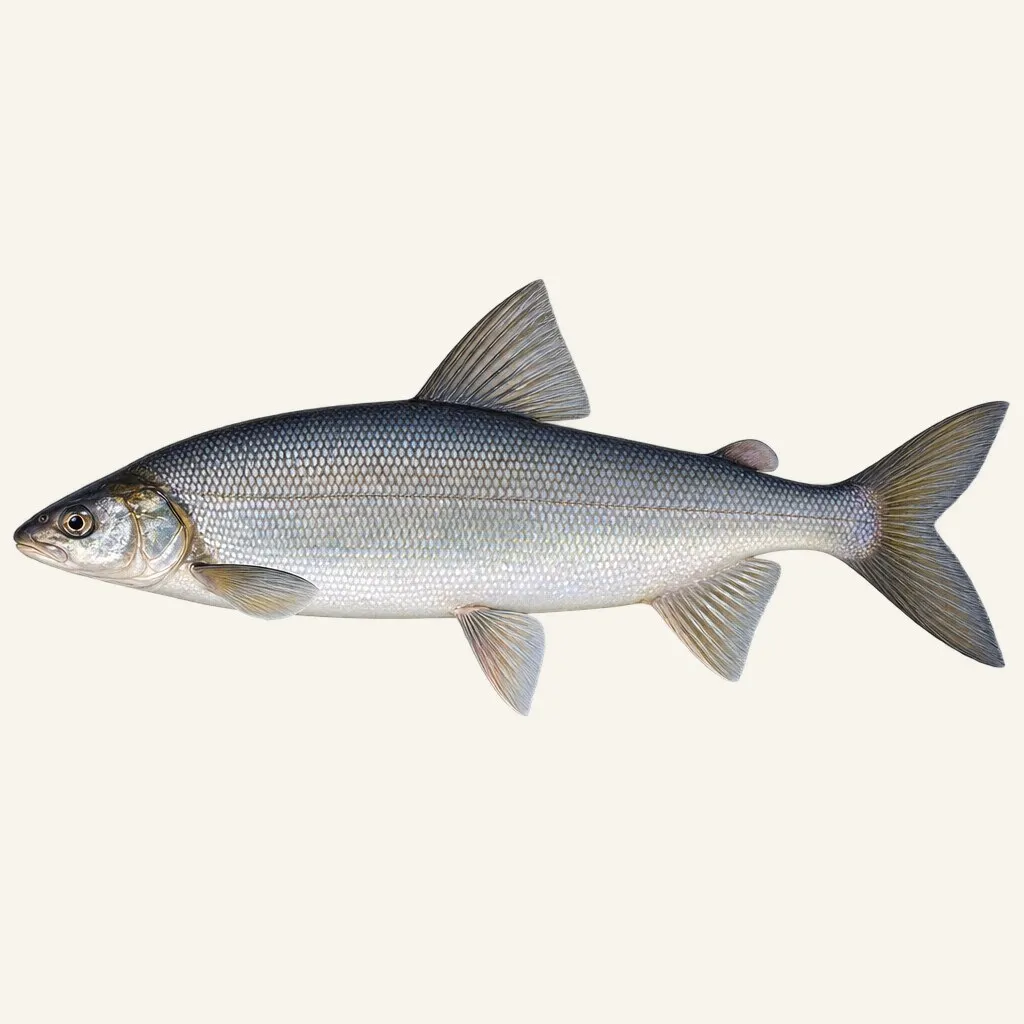
The lake whitefish is a North American freshwater salmonid with a laterally compressed silvery body, a rounded snout and a small mouth adapted to filtering zooplankton. It inhabits the large cold deep lakes of Canada and the northern United States, where it schools in open water.
Calendar
Recorded in 2 countries
GBIF occurrence records — native and introduced populations combined.
Its range
The species occupies the Atlantic, Arctic and Pacific basins across most of Canada, extending south into New England, the Great Lakes basin and central Minnesota, plus the Copper and Susitna drainages in Alaska.
It has been introduced into the north-western United States and stocked into high-altitude Andean lakes in two South American countries — a transfer of a fish adapted to 8 to 14 degrees into tropical latitudes, which works only because altitude supplies the temperature that latitude does not.
Identifying it
The adipose fin is well developed and often larger on males, and the pelvic fins carry an axillary process, a narrow pointed scale at their base.
Colouring runs from dark brown to midnight blue over the back, breaking into silver down the flanks and paling underneath. Young fish carry no parr marks, which is the quickest way to separate them from juvenile trout and salmon sharing the same water — those three all have the adipose fin, and only the salmonids proper have the bars.
Counts: 11 to 13 soft rays in the dorsal, 10 to 14 in the anal, no spines, and 55 to 64 vertebrae, which is a high number and a useful one on a preserved specimen.
The taxonomy carries the usual reservation for this genus. The species is probably conspecific with the common whitefish of Europe, and it belongs to a species complex of its own besides. Neither statement is settled, and both mean the name covers more variation than a name should.
Breeding
Spawning happens at night and near the surface. A female and one or more males rise together, release eggs and milt, and drop back down separately to the bottom.
Spawning fish are extremely active and will leap clear of the water entirely — startling behaviour from an animal that spends the rest of its year at depth in cold water, and a good way of locating a spawning shoal after dark.
The frequency is where the species does something few others do. In the southern part of the range it breeds every year. In the Arctic and subarctic it breeds every second year, or every third. The same species can therefore reproduce three times less often at one end of its range than at the other, and that single difference changes what any given fish removed from a population actually costs.
The water it needs
Large lakes and large rivers, with some use of brackish water. Primarily this is a lake fish, living in the water mass rather than on the bottom or at the edge, and comparatively sedentary — in the Great Lakes at least, individuals do not travel far.
Its year divides into four movements, and that sequence is the most useful thing anyone fishing for it can hold in their head. In spring it comes up from deep water onto the shallows. Through summer it retreats to depth as the shallow water warms. In autumn and early winter it migrates to shallow spawning ground. After spawning it goes back down.
Recorded depth spans 8 to 128 m and the thermal range is narrow, 8 to 14 degrees. Large lakes hold several separate populations of the species at once rather than one mixed stock.
Areas
- Deep North American lakes
- Deep pelagic waters
- Shallow lake areas in autumn
- Ice-covered lakes in winter
Techniques
- Light mid-water jigging
- Boat trolling
- Lure fishing (silver spoons)
- Ice fishing (jigging)
Baits
- Silver spoons
- Bloodworms
- Maggots
- White soft lures
What it eats
Adults feed mainly on aquatic insect larvae, molluscs and amphipods, with fish and fish eggs — including eggs of their own species — making up the remainder.
That is a bottom-feeding diet, and it is the important distinction within the genus. The European whitefish filter the open water for plankton; this one works the sediment, and the downturned snout and inferior mouth that all of them share are being used here for what they most obviously suit. It is also how the species can share a large lake with the cisco without either of them going short: one takes the bottom, the other takes the water above it.
How to catch it
The four seasonal movements supply the entire strategy. Shallows in spring, depth in summer, shallow spawning ground in autumn and early winter, offshore again afterwards. Fishing the right lake in the wrong season is fishing an empty one, and the fish will be several kilometres and 50 m of depth away from where it was.
The benthic diet then points every presentation at the bottom rather than into the water column, which is the reverse of what works for the open-water members of the genus.
Two numbers frame what a large fish represents: a maximum reported age of 50 years, against a common length of 54 cm. Nothing grows fast at 8 degrees, and a heavy fish from a northern lake has been accumulating that weight for decades.
North of the treeline the biennial or triennial spawning changes the arithmetic of keeping a fish. It will not be replaced on the schedule that a southern population would replace it on.
Conservation
The difference in breeding frequency between the north and the south of the range is the fact to carry away. An Arctic population that spawns one year in three needs three times as long to rebuild, in water where growth is already slow, so the same level of removal has entirely different consequences at the two ends of the map.
The separate populations within a single large lake compound it. Those are not interchangeable stocks, and emptying one basin is not offset by fish from the next one over; the recovery has to come from within, or it does not come.
Extensive hatchery programmes have operated on the Great Lakes and elsewhere for many years, which supports the fishery and raises the standing question about what is being released into which population.
Regulations
Check the local regulations in force (legal size limits, closed seasons, bag limits).
For guidance only. Legal sizes, quotas and open seasons vary by location and season: always check the local regulations in force before fishing.
Other names
Lake whitefish in English, and in this case the name is doing something specific: in North America it belongs to this species rather than functioning as a general market term, and a Great Lakes fish house selling whitefish means this fish.
That is not true of whitefish elsewhere, where it labels almost any pale fillet and identifies nothing. The word travels badly, and a whitefish quota in one country and a whitefish menu in another may have no species in common.
Quebec French has grand corégone and also poisson blanc. The fish has carried a commercial fishery on the Great Lakes for as long as those have been recorded, sold fresh, smoked and frozen, with the roe processed into caviar — which is the reason a large ripe female has a second value on top of the fillet.
Sources: fishbase.se · api.gbif.org