Lacustrine brown trout
Salmo trutta lacustris · Salmonidae
- Freshwater
- Salmonids
- Hard
- Size
72–100 cm
- Weight
3.7–20 kg
- Lifespan
38 years
- Water temp.
18–24 °C
- Depth
0–28 m
Where to fish
- River
Habitat icons: Flaticon
Lake form of the brown trout - Fast growth in lakes
Calendar
Recorded in 6 countries
Austria · France · Germany · Italy · Poland · Switzerland
GBIF occurrence records — native and introduced populations combined.
Identifying it
Address does the identifying. Nothing in the determination keys tells a lake fish from the one in the stream that feeds the lake: vertebrae, fin rays, the teeth along the vomer, the size of the scales all belong to Salmo trutta, and the trinomial carries no systematic weight. What the label names is a way of earning a living.
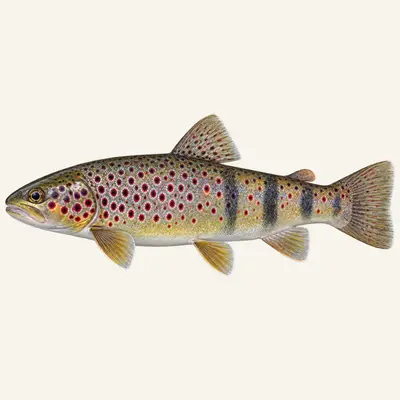
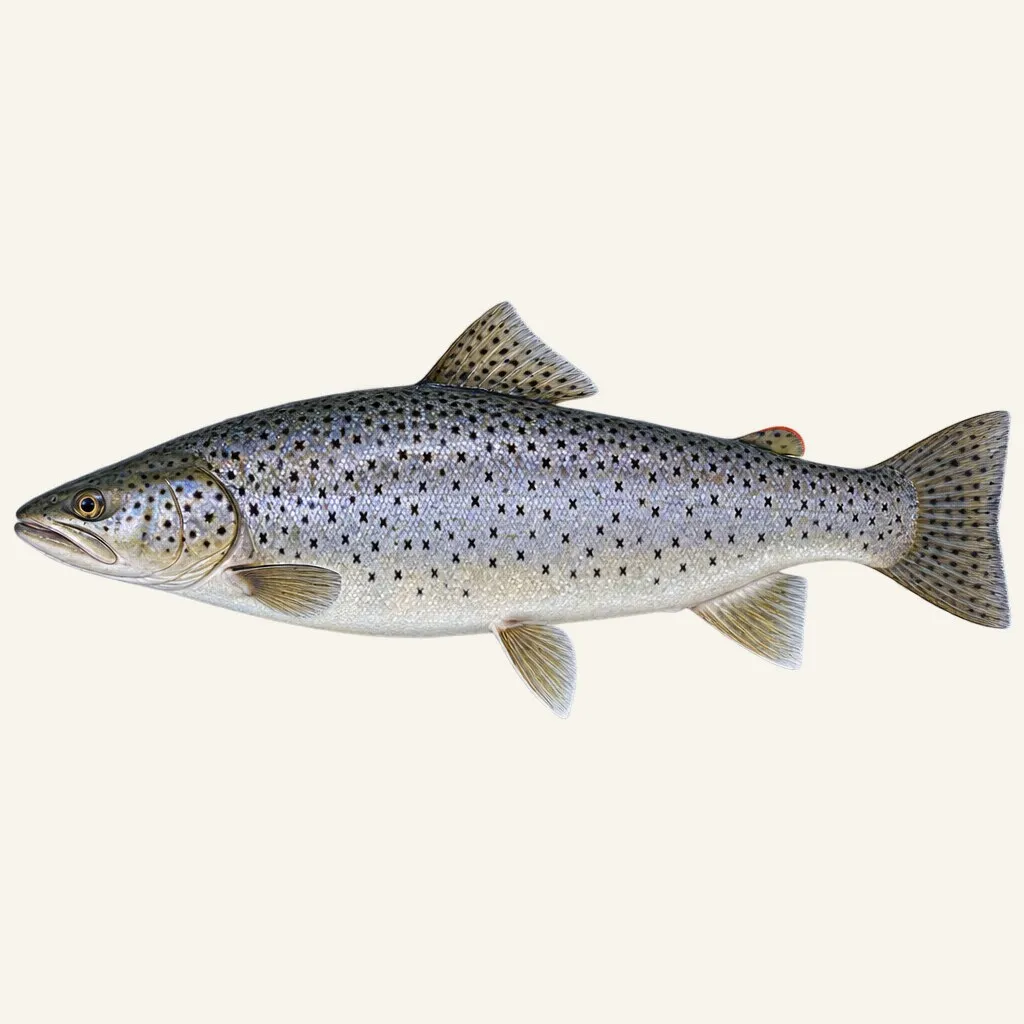
What can be seen is what open water made. A trout that grows in the pelagic zone turns pale and metallic, its spotting thins out and loses the light rings round it, and its belly goes white. The dark, heavily marked livery belongs to the tributary, not to the species.
In practice the fish is named by where it was hooked. One taken over deep water in a large Alpine lake is a lake trout; the same animal caught two hundred metres up the inflow will be called a fario. The split is useful to fishery managers and to anglers, and means nothing to a taxonomist.
Breeding
Almost nothing spawns in the lake itself. Adults run up the tributaries, and some drop down into the outlet, to lay in current over a bed that water can pass down through. Laying on stony, wave-washed shorelines does happen, and is recorded as rare.
That rarity is the important half of the sentence. A lake stock has next to no fallback: cut off from its inflows it stops breeding altogether while the lake stays exactly as it was. A culverted stream mouth does it.
The young travel the other way. Born in running water, they hold there through their first two years before dropping into the lake, where the fast growth begins. One basin has to supply both media, and above all the passage between them, or the form disappears from it.
The water it needs
A lake abolishes the station. In a river each fish takes a holding and defends it; here there is no current seam worth owning, so the trout ranges after its prey instead. That is the clearest behavioural gap between the two forms, and it is imposed by the water rather than chosen.
The thermal requirement does not slacken, but deep water satisfies it more reliably than a river does. Under the thermocline the temperature stays low right through August, which is how trout hold on in basins whose feeder streams turn uninhabitable in high summer.
Areas
- Deep water
- open water
- trolling
Techniques
- Lures
- Flies
- Live baits
Baits
- Spoon
- Deep-diving crankbait
- Trolling lure
- Streamers
What it eats
The diet turns over when the medium does. Juveniles still in the river eat aquatic and terrestrial insects. Adults that have dropped into the lake take molluscs, crustaceans and fish, and it is the last of the three that produces the growth.
Feeding happens in open water and along the margins alike, with no specialisation reported either way. A lake trout is wherever its food currently is, which is why the productive sector moves through the season instead of staying put.
How to catch it
You look for forage fish, not for lies. Nothing pins a lake trout in place: it follows its food and the layer of water that suits it, which makes searching the real work of the day. A productive depth or a productive shoreline will repeat; a precise spot will not.
The fish uses both compartments of the water body, the littoral zone and the open water, and it feeds in daylight. That last point separates it from the predators most anglers go out for at dusk, and it means the middle of the day is worth fishing properly rather than waiting out.
Prey size sets lure size. Adults down in the lake are living on fish, molluscs and crustaceans, so baitfish imitations hold up where the small insect patterns that take stream trout out of the same catchment will not.
The autumn ascent into the inflows is the second act. It packs into a few hundred metres of river fish that spend the rest of the year scattered over square kilometres. It is also the moment they are most exposed, and access to those reaches is frequently restricted — the restrictions are set by whoever manages the water, and they change.
Conservation
The point of failure is in the river. Pipe a tributary mouth, rebuild an outlet, or take the low-flow discharge out of an inflow, and reproduction ends without anything about the lake changing.
A lake stock can therefore go extinct as a form while the species loses no ground whatever. Trout are still there in the catchment in their stream shape, and the lake goes on yielding fish that came out of a hatchery lorry. Nothing in the catch records registers the loss, which is what makes it so hard to document.
Then there is the question of strain. Farmed trout tipped into a water body mix with whatever still runs up the inflow, and the local adaptation of those survivors is diluted a little further with each release.
Regulations
Check the local regulations in force (legal size limits, closed seasons, bag limits).
For guidance only. Legal sizes, quotas and open seasons vary by location and season: always check the local regulations in force before fishing.
Other names
English does have a word for the extreme of this form, and it is not lake trout. A big piscivorous loch fish is a ferox, from Salmo ferox, the name it was described under in the nineteenth century, and the term is still current in Scotland and Ireland for a life history rather than a species.
Lough Melvin carries that vocabulary furthest: gillaroo and sonaghen name two more forms sharing the water with the ferox, all three of them brown trout under any modern reading. Technical writing in Europe settles for lacustrine brown trout; Italian says trota lacustre.
Sources: fishbase.se · api.gbif.org