Lake charr
Salvelinus umbla · Salmonidae
- Freshwater
- Salmonids
- Hard
- Size
30–80 cm
- Weight
0.3–15 kg
Where to fish
- Lake
Habitat icons: Flaticon
Glacial relict - Orange-red belly - Favors deep cold waters
Calendar
Recorded in 5 countries
Austria · France · Germany · Italy · Switzerland
GBIF occurrence records — native and introduced populations combined.
Its range
The species holds alpine and subalpine lakes in Italy (Trentino, Alto Adige), France (Lac du Bourget), Switzerland, Germany and Austria. It has been introduced into numerous high-altitude lakes and is reported from Sweden.
The native range is therefore a scatter of deep glacial basins, each isolated from the next since the ice retreated. Introductions have blurred that map considerably.
Identifying it
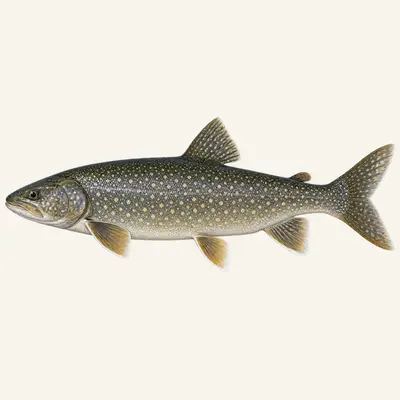
Among the chars of central Europe this one is told by a short list: the mouth terminal to subterminal with the lower jaw not enclosed by the upper, a conical snout, and 25 to 31 gill rakers.
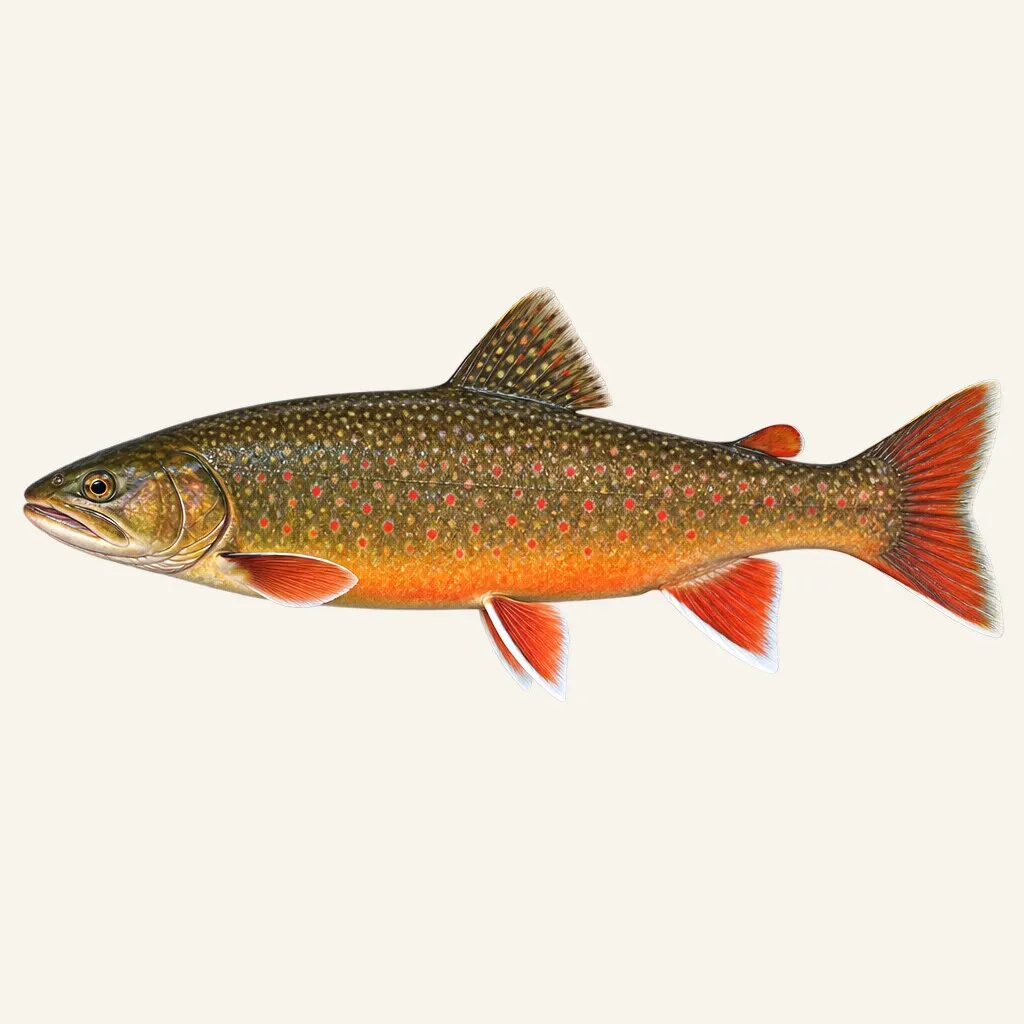
The colouring is the part anyone will notice. The flanks are greenish brown with reddish spots, the belly yellowish to reddish orange, and the fins run red to orange with clean white margins. Those white leading edges are the mark of the genus and they survive on a dead fish.
Breeding
Spawning takes place on pebble to stone bottom, on steep slopes, between 30 and 120 m down.
That depth is the whole of the species' predicament, and it is worth stating plainly. Every conventional restoration measure for a spawning salmonid — gravel cleaning, weir removal, riparian work, flow management — operates in the top few metres of a river. None of them reaches a stony slope 80 m down in an alpine lake. If that ground is degraded, there is no practical way to repair it.
The water it needs
It lives in deep lakes in glacial valleys and in high-altitude lakes.
There is no river phase and no sea phase. The fish spends its entire life in a single cold, deep body of water, which is why each lake population is effectively its own stock.
Areas
- Deep lake basins
- Cold deep zones
- Steep margins of alpine lakes
Techniques
- Spoon
- Jig
- Crankbait
- Trolling
Baits
- Lures
- Flies
- Worms
What it eats
The prey are crustaceans, insects and bottom fauna.
A few individuals in a population develop into large piscivores, and they do so with a distinct morphology — a bigger head and mouth. That is not a variation in diet but a divergence in form within a single lake, and it means two visibly different fish can belong to the same population.
How to catch it
Deep water is the whole context, and it makes this a boat fishery with sounding gear rather than a bank one.
Two prey types call for two approaches. The invertebrate feeders, which are most of the population, take very small imitations worked near the bottom. The few large piscivores, recognisable by their heavier head, take something imitating a fish — and they are the specimens anyone remembers.
Conservation
The spawning ground is the issue, and it is out of reach. Stony slopes at 30 to 120 m are unaffected by the work that repairs a river, and equally unaffected by anything a manager can practically do to them.
Each lake holds a separate stock, isolated since the last glaciation. A population lost is not replaced from the next valley, and stocking between lakes mixes lineages that have been apart for ten thousand years.
Introductions into high-altitude lakes, where the species is not native, put a cold-water predator into small waters that had none.
Regulations
Minimum size 20-25cm depending on the lake
For guidance only. Legal sizes, quotas and open seasons vary by location and season: always check the local regulations in force before fishing.
Other names
Alpine char in English, though the fish is often filed under Arctic char, Salvelinus alpinus, from which some authors do not separate it. That disagreement is not academic: whether this is a species or a form of Arctic char changes what any count of it means. Omble chevalier in French, Seeforelle and Namaycush being other fish entirely despite the confusion the names invite.
Sources: fishbase.se · api.gbif.org