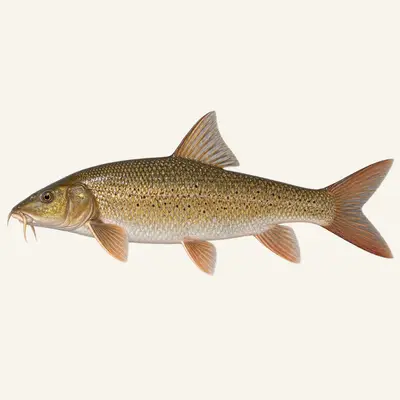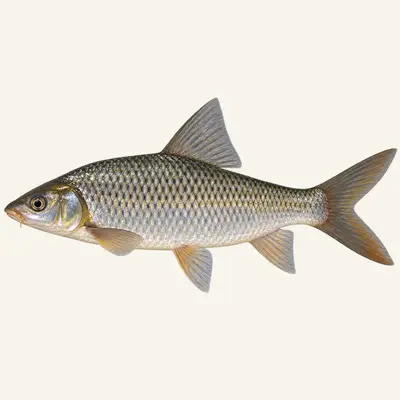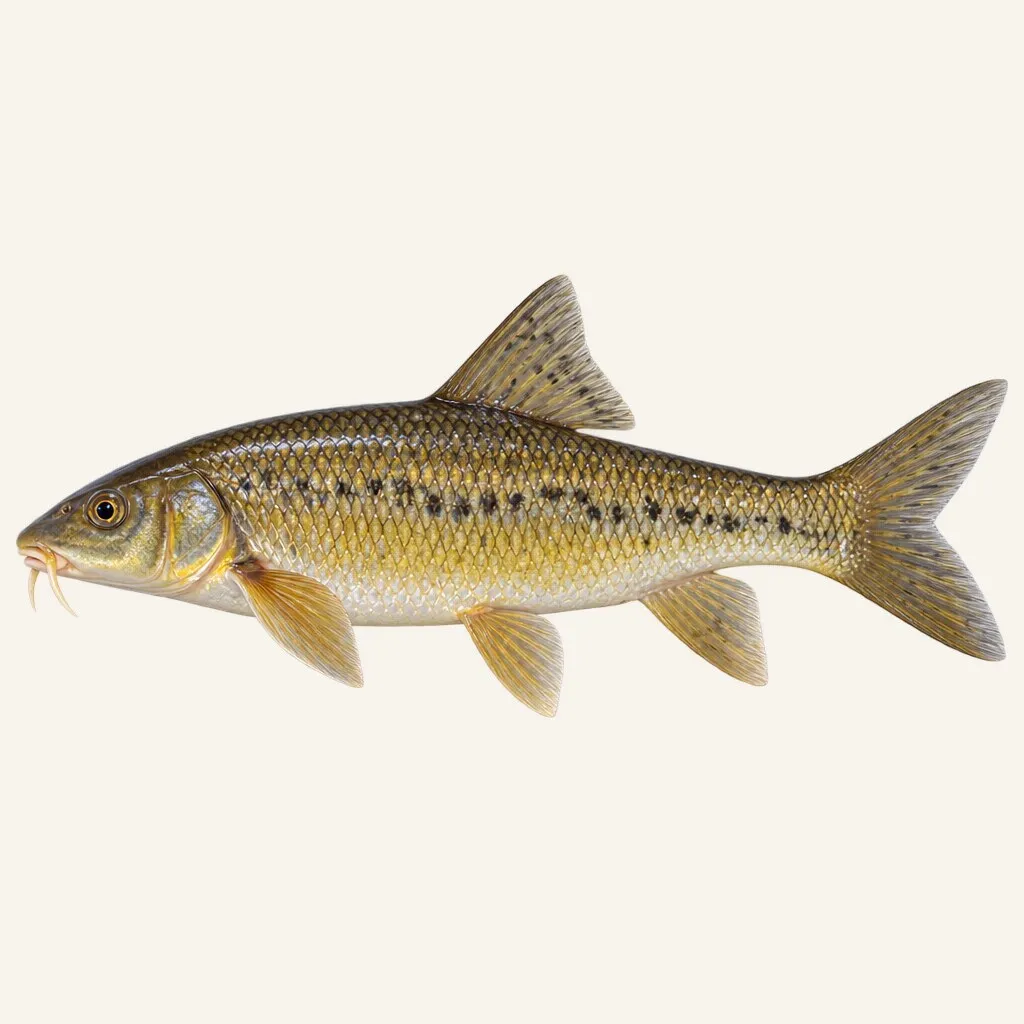
Algerian barb
Luciobarbus callensis · Cyprinidae
- Freshwater
- Carp & coarse
- Medium
- Size
30 cm
Where to fish
- River
Habitat icons: Flaticon
Algerian barbel - coarse fish, North Africa
Calendar
Recorded in 3 countries
Algeria · Morocco · Tunisia
GBIF occurrence records — native and introduced populations combined.
Its range
This is the only barbel of the group living on the African side of the Mediterranean. It is widespread through Tunisia and stops westward at the Kebir drainage in eastern Algeria, so the entire range fits inside one country and the margin of the next.
Its place in the classification matters as much as its place on the map. It belongs to Luciobarbus, the genus of the Iberian barbels, and not to Barbus, which holds France, Italy and the Balkans. The division between the two lineages does not follow the shoreline. It runs through Europe, and the same lineage occupies the southern half of Iberia and the north-east of the Maghreb, on opposite sides of the western Mediterranean.
Areas
- Rocky shallows
- Deep holes under banks
- Wadi confluences
- Moderate current zones
Techniques
- Light bottom fishing
- Float fishing
- Pole fishing
- Running line fishing
Baits
- Earthworms
- Maggots
- Bread paste
- Insect larvae
- Small shrimps
How to catch it
It is a small fish, in a different class from its Iberian relatives, three of which reach eighty. Tackle follows that size rather than the reputation of the genus: light bottom fishing, float tackle, a bait travelled through the flow of a wadi.
The water dictates the rest. North African wadis run at wildly variable levels, and the sections holding a stable flow are the ones worth working — rocky shallows, undercut holes beneath the banks, and the junctions where two channels meet.
Two uses run on this species at once, and the combination is rare in a river cyprinid. It supports a commercial fishery, and it also supplies the aquarium trade. The same fish is taken to be eaten and taken to be kept alive, out of a range that does not exceed two countries.
Regulations
Check the local regulations in force (legal size limits, closed seasons, bag limits).
For guidance only. Legal sizes, quotas and open seasons vary by location and season: always check the local regulations in force before fishing.
Other names
English calls this one a barb rather than a barbel, and the choice is less arbitrary than it looks. In English usage barbel means the large river cyprinids of Europe and barb means the small ones of Africa and Asia kept in tanks — and this fish, small and on the aquarium market, answers to both descriptions at once. Of the five barbels treated here, this is the single one English declines to call a barbel.
Every language calls it Algerian: Algerian barb, barbo argelino, Algerische Barbe, barbo algerino. Most of the documented range is Tunisian, and Algeria holds only its eastern margin. The epithet comes from the same corner of the map — La Calle, now El Kala, on the eastern Algerian coast, which is to say the precise point where the known distribution stops.
Sources: fishbase.se · api.gbif.org