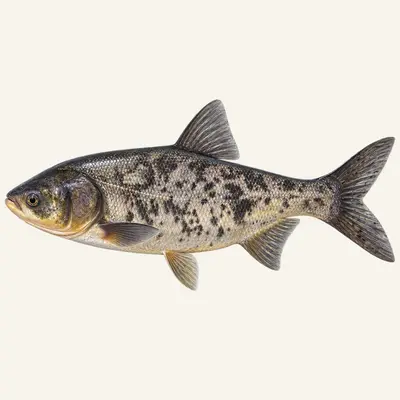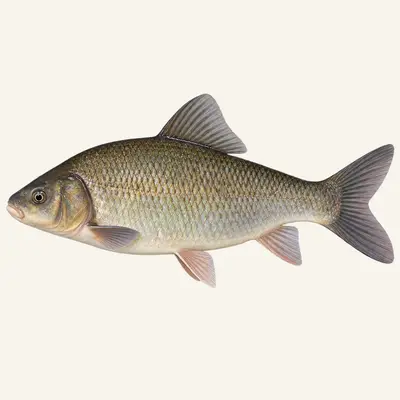
Amur carp
Cyprinus rubrofuscus · Cyprinidae
- Freshwater
- Carp & coarse
- Medium
- Size
28 cm
Where to fish
- Lake
- River
Habitat icons: Flaticon
Amur wild carp - coarse fish, Asia (Amur)
Calendar
Recorded in 33 countries
Argentina · Australia · Austria · Brazil · Canada · China · Colombia · France · Germany · Hong Kong SAR China · India · Indonesia · Italy · Japan · Macao SAR China · Malaysia · Mexico · Netherlands · New Zealand · Panama · Poland · Portugal · Qatar · Russia · South Africa · South Korea · Spain · Taiwan · Thailand · United Arab Emirates · United Kingdom · United States · Vietnam
GBIF occurrence records — native and introduced populations combined.
Its range
The map of this species is uncertain, and the reason is historical. For close to two centuries the carps of eastern Asia were filed under Cyprinus carpio, as a subspecies or as a plain synonym. Every record predating the separation counts the two together, so a mention of common carp in East Asia does not say which of them was seen.
The confusion did not stay in Asia. East Asian carp were moved to Europe, where they cross with the common carp, and that hybridisation is among the causes recorded for the continuing decline of wild stocks of the latter. Where the two species meet outside their respective ranges, the question of which one is present no longer has a simple answer.
Fresh water is the habitat, with a tolerance of slightly brackish conditions — which is one more thing it shares with its congener rather than a way of telling them apart.
Identifying it
Nothing on the fish in the hand separates it from a common carp. Four barbels, a bony last simple anal ray serrated down its rear edge, between 18 and 22 branched rays in the dorsal: that is the description of the other species, word for word.
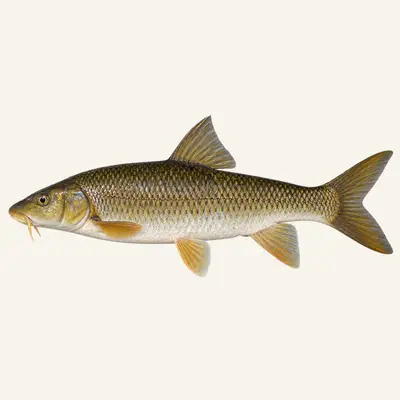
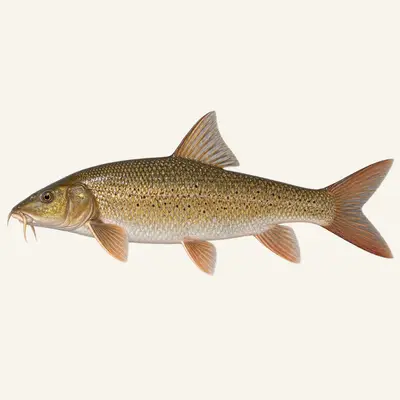
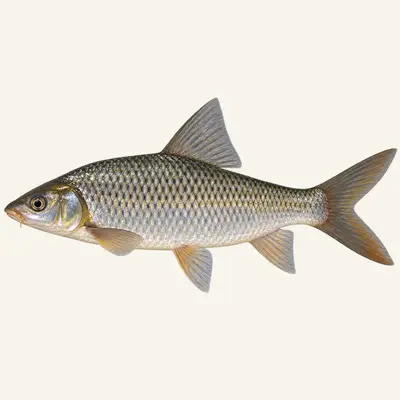
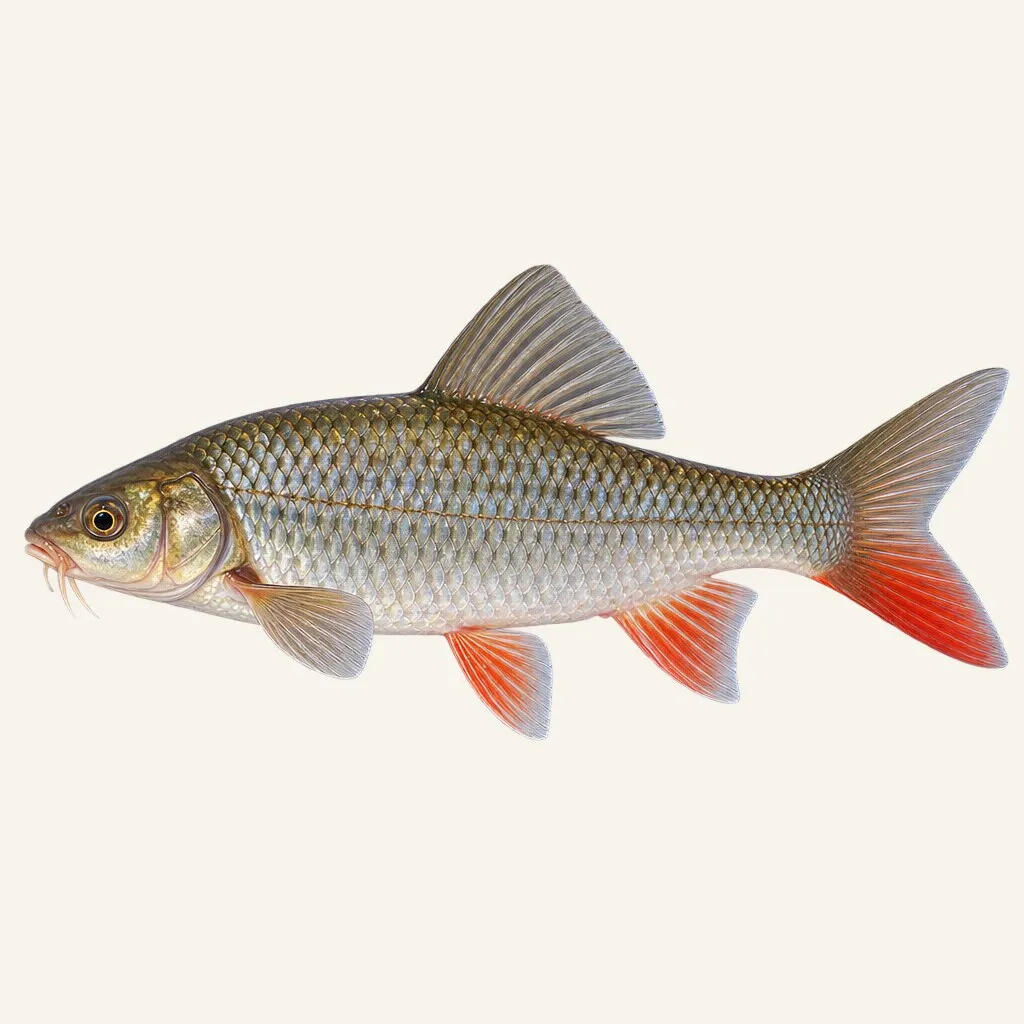
Colour is the only character recorded as its own, and it is not constant between populations. A Laotian stock from Xiangkhouang is silvery with red pelvic fins, a red anal and a red lower caudal lobe; another, from Louang Phabang, is grey. Two rivers in one country produce two liveries.
The length data need a caution. The only measurement on record in that source was taken from those Laotian samples, which are small fish, and it cannot be read as a ceiling for an animal that reaches carp size elsewhere in its range.
Determination therefore rests on provenance and on genetics, not on examining the animal. Anyone who wants certainty needs to know which river the fish came out of.
Areas
- Muddy lake and reservoir areas
- Vegetated banks
- Downstream of dams and locks
- River confluences
Techniques
- Bottom fishing (hair rig)
- Method feeder
- Boilie fishing
- Pellet fishing
Baits
- Boilies
- Corn
- Hemp seeds
- Earthworms
- Pellets
Regulations
Check the local regulations in force (legal size limits, closed seasons, bag limits).
For guidance only. Legal sizes, quotas and open seasons vary by location and season: always check the local regulations in force before fishing.
Other names
The scientific name has had an eventful history, and that history is the substance of what there is to say about this fish. Described early in the nineteenth century, it was absorbed into the common carp and stayed there for a long time, ranked at best as an eastern subspecies. Recent work, morphological and then genetic, pulled it back out as a species in its own right.
The separation carries a consequence that reaches well beyond taxonomy: koi descend from the East Asian carp and not from the European common carp. Since the species was recognised, the ornamental fish has been referred to it. The red pelvic fins, red anal and red lower caudal lobe recorded on a wild Laotian population show, incidentally, that the pigment Japanese breeders worked on was already there in nature.
English usage sets two traps. Amur carp is the name most often applied to the species, after the northern river; the ornamental line is called koi or koi carp, so the same animal has one name in a river and another in a garden pond. Worse is the label Asian carp, which in North American usage covers the four species moved together for aquaculture — silver, bighead, grass and black carp — none of which belongs to the genus Cyprinus. The one East Asian species that is a true carp is the one the phrase leaves out.
Rubrofuscus means dark red, after the tint of the fins.
Sources: fishbase.se · api.gbif.org