Barbel
Barbus barbus · Cyprinidae
- Freshwater
- Carp & coarse
- Hard
- Size
40–120 cm
- Weight
0.5–12 kg
- Lifespan
15 years
- Water temp.
10–24 °C
Where to fish
- River
Habitat icons: Flaticon
Streamlined body with 4 barbels - Exceptional fighting power - A prized sport fish
Calendar
Recorded in 12 countries
Austria · Belgium · Czechia · France · Germany · Italy · Luxembourg · Netherlands · Poland · Switzerland · Ukraine · United Kingdom
GBIF occurrence records — native and introduced populations combined.
Its range
Barbel occupy Europe north of the Pyrenees and the Alps, from the Adour east to the Neman, in rivers draining to the Atlantic, the North Sea and the southern Baltic, plus the Danube-to-Dnieper basins north of the Black Sea. They also run through almost all the Mediterranean drainages of France. In England they are native to the south-east, north as far as Yorkshire.
That last clause repays a second reading. Several rivers with the largest British barbel reputations are not native barbel rivers: the Wear, the Tees, the Medway and most of the western English drainages hold introduced stock. Northern and central Italy hold them for the same reason.
The southern boundary is a mountain boundary. Iberia and the Italian peninsula have Barbus species of their own; this one stops where the Pyrenees and the Alps stop it, and wherever it has crossed those lines it has been carried across.
Identifying it
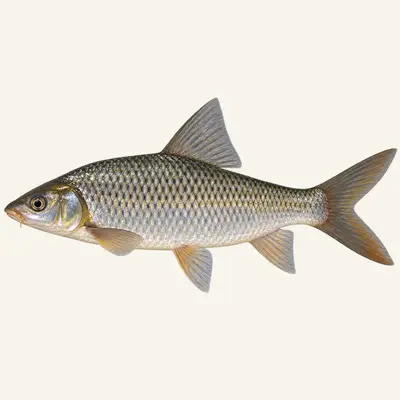
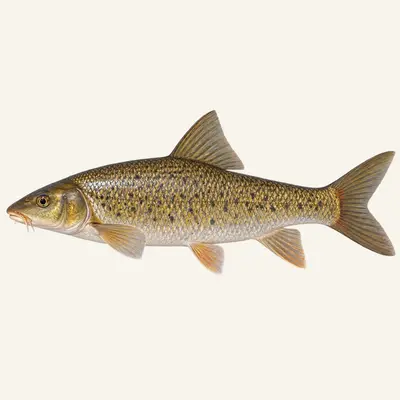
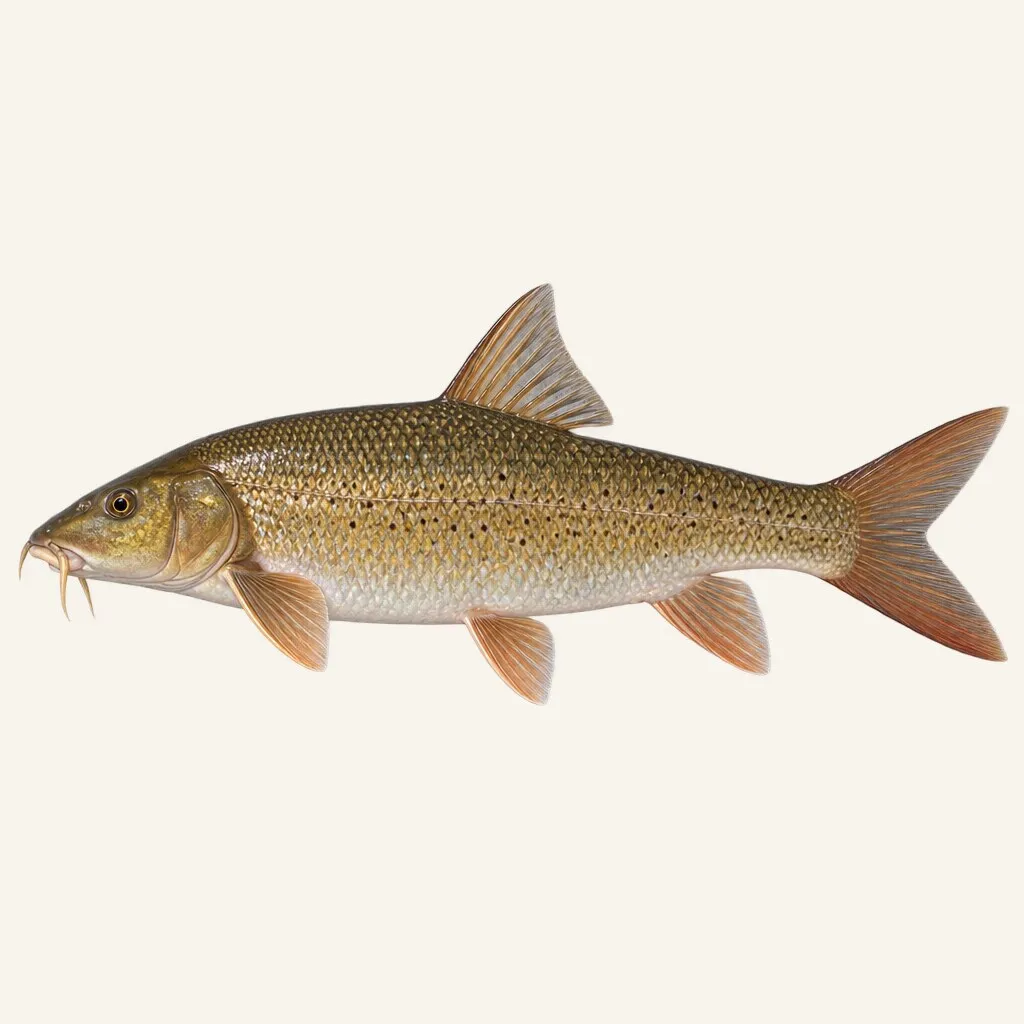
Nothing in a European river is built like a barbel, and the shape reads at distance: a long, round-sectioned body, flat along the underside, broadest at the shoulder and tapering hard to a deep wrist. It is an animal designed to sit on gravel with fast water going over it, and it looks it.
Close up, the mouth settles the question. It is slung underneath the head, fringed by four barbels, and the lower lip is thick with a swollen pad through the middle of it. That pad is a working surface: barbel read the bed by touch and by taste.
The dorsal fin carries the character worth remembering for practical reasons. Its last simple ray is bony and serrated along its entire rear edge — a saw that parts line and opens a hand laid across the fish's back. The fin is pointed at the tip and its rear margin is distinctly concave.
Colour is bronze-green over the back, brassy yellow down the flanks, pale below. Fish under about 10 cm carry fine dark spots; past that size the spotting fades or vanishes, so a heavily marked small barbel and a plain large one are the same animal at different ages.
The counts are 53 to 63 scales on the lateral line, 12 to 14 rows between the dorsal origin and the lateral line, 46 or 47 vertebrae, and the pelvic fins set directly below the start of the dorsal.
Breeding
Spawning runs from May to July, after a migration upriver, and it happens in water shallow enough to leave backs showing. The males reach the gravel first and wait. When a ripe female comes onto it they follow her up in a churning mass that can be heard from the bank before it is seen.
Two male strategies run at once on the same shallow. Some court: they escort the female to the site, and one of them lies head to head with her at the moment of release. Others do not bother, holding station on the gravel and cutting into the pair at the instant of spawning to fertilise what they can. As many as 130 males have been counted around a single spawning act.
The eggs are not sticky, which is unusual among cyprinids and consequential. Rather than being glued to weed, they go down in two or three batches into hollows the fish excavate in the gravel, where current runs through the stones and keeps them oxygenated. That puts the whole of barbel recruitment on clean, loose, well-flushed substrate.
The eggs are also poisonous to people. This is old and settled knowledge, and it is the only reason an otherwise harmless fish is flagged at all in the standard databases. The flesh has been eaten for centuries; the roe is not eaten under any preparation, and a fish taken in the spring months is the one carrying it.
The water it needs
The barbel zone in river typology takes its name from this fish, and the name describes what it wants: the clear, warm, moderately large middle river, from the foothills down into the lowlands, with genuine current and a gravel bed. Lakes hold barbel occasionally and never typically.
By day the adults group up and get under something — an overhanging tree, a bridge, an undercut bank. They come out at dusk, stay active into the dark, and work again at first light. Juveniles keep a different clock, feeding by day and night alike, and a different address: the very shallow margins, hard against the bottom, moving out into faster water as they grow. A river with barbel in it is therefore stratified across its whole width by size.
Winter relocates everything. Barbel gather into large groups in slow water for the cold months, sometimes dormant, sometimes feeding lightly. Hunting a January fish in the riffle that produced in August is an error about the calendar, not about method.
Areas
- Strong currents
- riffles
- gravel beds
- oxygen-rich areas
Techniques
- Feeder
- Bolognese
- Lures
Baits
- Worms
- Pellets
- Maggots
- Cheese
What it eats
The diet is bottom invertebrates: small crustaceans, insect larvae, mayfly and midge larvae, molluscs. Small fish are taken as well, and algae occasionally.
The four barbels carry chemical and tactile receptors, so the fish sorts the bed without needing to see it. That one fact explains the best conditions of the year. When a river rises and colours after rain, sight-hunting predators shut down while a barbel carries on working the gravel exactly as before. Falling, clearing floodwater is not an obstacle to fishing for them. It is the invitation.
How to catch it
The bait sits on the bed, in the flow, and stays there. Everything else follows: enough lead to hold without rolling, a hooklength that will not part on a fish leaving at speed, and a hook proportioned to substantial baits rather than fine ones.
Barbel are strong out of all proportion to their weight because they use the current instead of fighting it. A hooked fish turns broadside, drops downstream and lets the river do the work. The answer is angle — pressure applied from below and off to the side — rather than lift.
The water reads clearly. Tails of riffles, gravel drop-offs, the deeper crease immediately under fast water, the shade of bridges and leaning trees: those hold fish by day. Two hours around dusk and two around dawn are worth more than the middle of the day.
Two things to get right at the net. The serrated dorsal ray cuts, so a fish is lifted with a hand under the belly and never gripped across the back. And a barbel that has fought in current has to be held head into the flow until it drives itself out of the hands holding it; let go early and it rolls away downstream in no state to recover. The roe goes back with the fish.
Conservation
The twentieth century went badly for barbel, and the record is specific about why. Large reservoir construction and pollution drove populations down sharply through much of the range. Numbers have since stabilised at a moderate level, and the central European rivers worst hit by pollution are recovering. The Baltic drainages, the Elbe, the South Bug and the Dnieper are where the species remains locally under pressure.
The vulnerability is a salmonid's vulnerability, for a salmonid's reason. A fish that buries non-adhesive eggs in swept gravel needs clean gravel, real flow and an unobstructed route upriver in spring. Aggregate extraction takes the substrate outright. Fine sediment seals whatever is left, filling the spaces between stones where eggs sit and cutting off the water moving through them. Weirs remove the run to the spawning shallows. Flow regulation removes the high-water pulses that would otherwise scour the bed clean each year.
Adults are long-lived and remain visible for years in a river that has quietly stopped producing young ones, which is why declines in this species are noticed late, and why a good day's fishing proves nothing at all about recruitment.
Regulations
Minimum size 30-40cm depending on area / Closed season during spawning
For guidance only. Legal sizes, quotas and open seasons vary by location and season: always check the local regulations in force before fishing.
Other names
Barbel is both the fish and the whiskers, and English is alone in that: French has barbeau against barbillons, German Barbe against Barteln, Spanish and Italian barbo against barbillones and barbigli. The root is shared, the word is not, and the English doubling is harmless. The export of the name is not: dozens of Barbus and related species across Europe, Africa and Asia are called barbel locally, so the word alone rarely means this fish once you leave its range.
The other trap crosses into salt water. French names the red mullet rouget-barbet for the two barbels on its chin, and it is no relation to any cyprinid — the same collision recurs wherever a marine fish is named for its whiskers. When it has to be exact, Barbus barbus is what settles it.
Sources: fishbase.se · api.gbif.org