Andalusian barbel
Luciobarbus sclateri · Cyprinidae
- Freshwater
- Carp & coarse
- Medium
- Size
35–70 cm
- Weight
0.4–5.0 kg
- Lifespan
18 years
Where to fish
- River
Habitat icons: Flaticon
A barbel endemic to the Iberian Peninsula - Several distinct species
Calendar
Its range
The southern quarter of the peninsula, from the Segura round to the Mira, Guadalquivir included.
A point about the geography of genera belongs here, because it holds for all four Iberian species. Barbus, the genus that occupies France, Italy and the Balkans, reaches this peninsula only at its Catalan corner, in the shape of Barbus meridionalis. Everything else — and the Maghreb across the strait besides — belongs to Luciobarbus. The line follows neither the coastline nor the Pyrenees: it runs inside Catalonia, and two barbels from different genera divide the north-east of Spain between them.
Identifying it
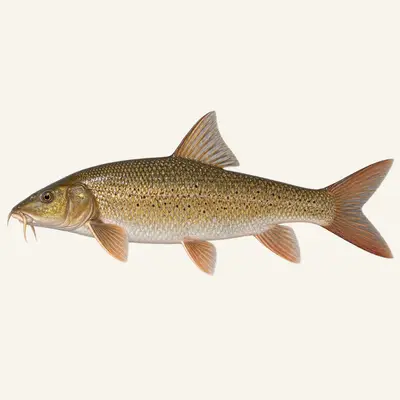
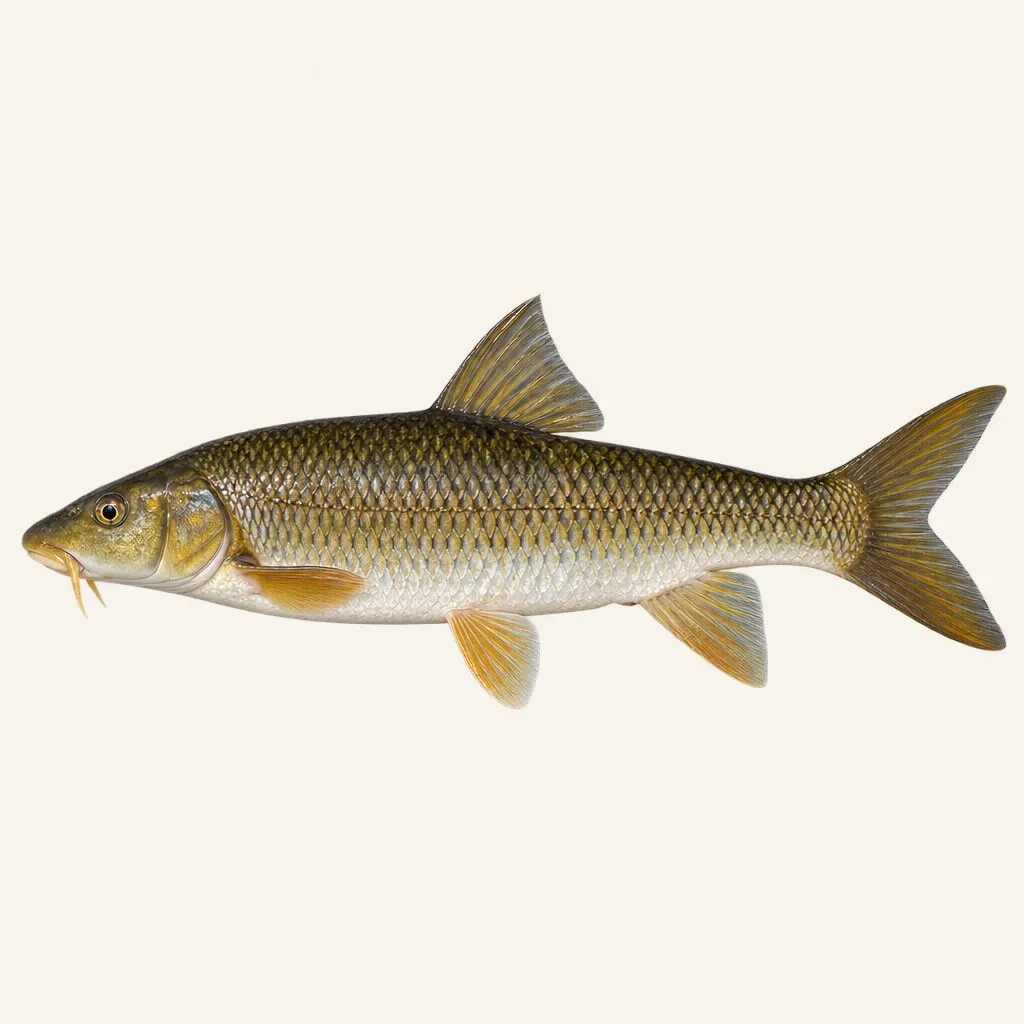
The diagnostic livery only arrives with size. Past about 30 cm standard length the contrast between a dark back and a whitish belly turns abrupt, nearly a line; below that the animal is an unremarkable Iberian barbel. It is an adult character, and on a fish of 20 cm it is worth nothing.
The wrist of the tail is thick. Its depth goes 1.2 to 1.4 times into its length, so the tail root is close to as deep as it is long — a squat proportion by the standards of these fish. Head length is 24 to 29 per cent of standard length. The lateral line holds 42 to 45 scales plus three on the tail base, the lowest count of the four species on the peninsula.
The dorsal is armed, but only in part: the first ray is hardened and rigid over half to three-quarters of its length, with small teeth along most of that stretch. The lower lip usually has no median lobe, occasionally has one, and hides the tip of the mandible.
It reaches 49.5 cm fork length and 18 years — the smallest and the oldest of the Iberian barbels at once.
Breeding
The breeding season does not close on a date. It closes on a measurement: the end of spawning in this species has been recorded as coinciding with a fall in the oxygen saturation of the water, which is to say with the arrival of low summer flows and heat.
Females release two batches of eggs across a season. The second is the one at risk. In a dry year the oxygen drops earlier, the window shuts, and half of the year's production disappears without any visible event having removed it.
Maturity comes early and small, at around 13.5 cm within a span of 11 to 16. A ripe fish is therefore not a big fish, and most of those 18 years are spent as an adult.
The water it needs
Adults hold lowland water with weak flow, and the species is most abundant in large rivers and in streams whose current is slow to moderate. It avoids the cold headwaters.
In this peninsula that avoidance decides everything. The upper courses are precisely the reaches that keep water through the summer; this fish lives in the part of the network that heats up, loses its oxygen and dries out first.
Areas
- Gravelly shallows
- Deep pools
- Bank margins
- Confluences
Techniques
- Feeder
- Bolognese
Baits
- Worms
- Pellets
- Cheese
How to catch it
Look downstream, not up. The cool quick water at the top of a catchment — the water anyone would search first for a barbel — is the water this one refuses. Big slow rivers, deep holes and confluences are where it is.
Feeder tackle and a Bolognese float cover the two situations, a bait laid still in the calm and a bait travelled over the gravel shallows along the margins. Worm, pellet and cheese are among the baits on record, the last with the practical advantage of staying on a hook where paste washes off.
The two known ceilings of the species go together: half a metre and 18 years bound the same life. A fish near one of them is near the other, and nothing replaces it inside a season.
Conservation · Near Threatened (IUCN) — This species is in decline. Release your catch quickly and handle it with care — wet hands, as little time out of the water as possible.
Conservation
Two timescales disagree about this fish, and that is what makes its condition hard to read.
Across a year, everything is fragile. The populations are heavily fragmented, many of the small watercourses in its range run dry in summer, and the second spawning depends on an oxygen level that collapses with low flow. A dry year costs habitat and reproduction at the same time.
Across the life of a fish, everything looks steady. An 18-year ceiling means a lost year class is invisible: the adults remain, get counted, get caught, and present the picture of a healthy population for more than a decade after recruitment has stopped. Longevity is not protection here. It is a delay — it postpones the diagnosis without altering the outcome.
Regulations
Check the local regulations in force (legal size limits, closed seasons, bag limits).
For guidance only. Legal sizes, quotas and open seasons vary by location and season: always check the local regulations in force before fishing.
Other names
Andalusian barbel is the English name, and it is fixed on the region the fish was described from rather than on the middle of its range. Italian barbo andaluso and German Andalusische Barbe make the same choice; Spanish alone goes elsewhere, with barbo gitano.
The distribution does not cooperate. It reaches north-east to the Segura, on the Mediterranean side of Murcia, and north-west to the Mira in southern Portugal, and neither of those is Andalusia. On a peninsula where every barbel name is a compromise this one at least points somewhere inside the range. It just points at a third of it.
Sources: fishbase.se · api.gbif.org