Bighead carp
Hypophthalmichthys nobilis · Cyprinidae
- Freshwater
- Carp & coarse
- Medium
- Size
60–146 cm
- Weight
3.2–40 kg
- Lifespan
20 years
- Water temp.
1–38 °C
Where to fish
- Lake
- River
Habitat icons: Flaticon
Lives in rivers with marked water-level fluctuations, overwintering in middle and lower stretches. Forages in shallow waters
Calendar
Recorded in 17 countries
Austria · Bangladesh · Belgium · China · France · Germany · Hong Kong SAR China · India · Moldova · Netherlands · Poland · Russia · Switzerland · Taiwan · Ukraine · United States · Vietnam
GBIF occurrence records — native and introduced populations combined.
Its range
The natural range fits inside one country: China, between the 21st and the 34th parallel. That is very little ground for a species now present on almost every continent.
The worldwide spread has a feature that no map shows. Most of those populations do not breed. The spawning requirements are too exact — the deep river, the flood, the sustained current, the kilometres of drift — to be met in a pond or an impoundment, and numbers are maintained by hatchery reproduction or by continuous importation. The fish is everywhere and establishes itself almost nowhere unaided.
The range therefore reads in two layers. Where the species appears, it has usually been put there, and a few years without stocking would end it. The exceptions are the large rivers with floodplains, where the cycle closes without help, and those are the places where the host countries report consequences.
Identifying it
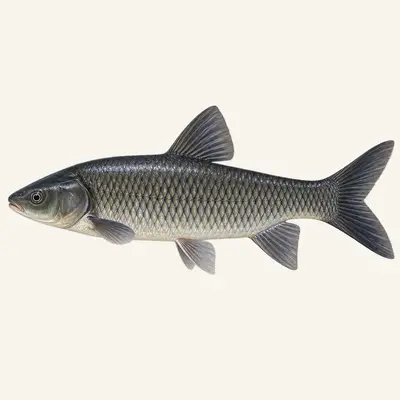
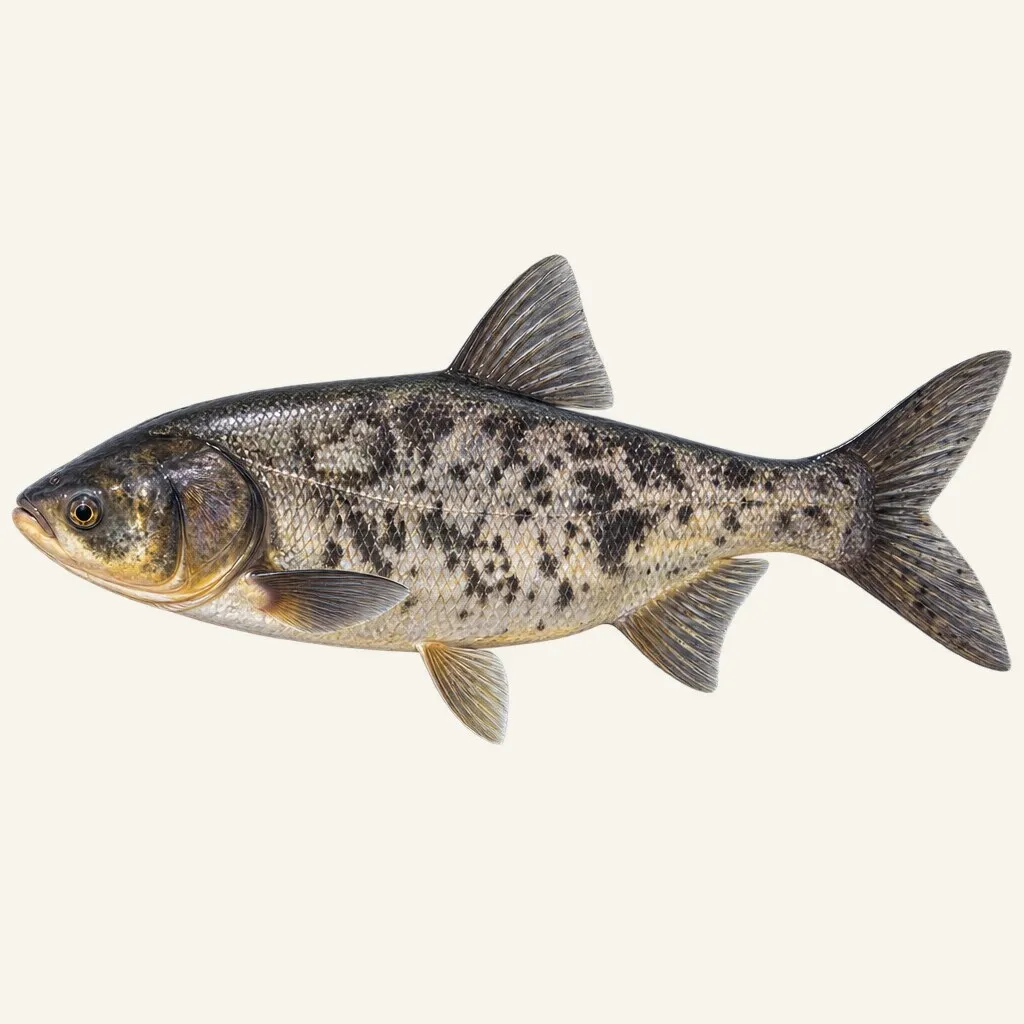
The flank is blotched. Large dark marks, very irregular in shape, scattered without order over a dark ground, with the fin bases, the underside of the head and the belly washed with yellow. That livery gave the fish its German name, and it is enough on its own to separate it from its uniformly silver relative.
The head is enormous — 27 to 35 per cent of standard length, close to a third of the animal in a large specimen. The English name records nothing else.
The third character is checked by touch, under the belly. The keel here is scaled and begins only at the base of the pelvic fins, ending at the anus; on the silver carp it is naked and sharp and starts much further forward. A hand run along the underside answers the question in a second.
Three spines in the dorsal followed by seven soft rays, one to three anal spines and 12 to 14 soft rays, no barbels. And 240 to 300 gill rakers: that is the figure to keep hold of, because it is a third of what the other species carries, and it is the whole difference between them.
Breeding
The egg drifts, and everything else follows from that. Shed at the surface during a flood, it is taken by the current and develops in open water, in the deep layer of the channel, for about two days at 25 degrees before hatching. Two days of drift at better than a metre per second means tens of kilometres of river that have to stay free and moving.
The conditions demanded are narrower still than the silver carp's. Very deep water, very turbid, above 18 degrees and usually between 22 and 30, a current of 1.1 to 1.9 m per second, a high oxygen concentration. The upriver run begins with a rapid flood, between April and July depending on latitude, and release halts the moment the regime changes, to resume on the following rise.
A female produces up to 100,000 eggs. The figure looks modest for a cyprinid of this size, and it looks smaller still set against the losses of a two-day drift in open water. First maturity comes at about 64 cm, in a range of 55 to 70.
The water it needs
A river with a swinging water level is the reference habitat, and the fish occupies it by season: the warm shallow margins in summer, the deeper water of the middle and lower course in winter.
The autumn movement carries a detail that belongs to this species alone. As the temperature drops to 10 degrees the shoals divide by age — juveniles in their own gatherings, adults in theirs — each forming separately before dropping downstream to the deep water. Where other fish winter mixed, this one sorts itself first.
Its usual receiving habitat is neither of those. Stocked, it most often ends up in a lake, a pond or a reservoir, where it grows extremely well and will never spawn. Seven parts of salt per thousand do not kill it either, so a release into a lagoon or an estuary does not end there.
Areas
- Open-water lake zones
- Downstream of dams
- Wide river meanders
- Large sun-exposed reservoirs
Techniques
- Drift fishing with meal
- Liquid bait rig
- Float fishing in open water
- Fermentation feeder
Baits
- Suspended fermented meal
- Planktonic liquid baits
- Crumbled bread
- Sprouted seeds
What it eats
Zooplankton, for the whole of life. That is the deepest division between the two filtering carps: this one never gives up animal prey in suspension, where the other abandons it before reaching 2 cm. Algae supplement the diet; they do not take it over.
The sieve accounts for the rest. Two hundred and forty to three hundred rakers retain particles far coarser than 800 would, a wide mesh matched to animal plankton rather than to algal cells. The literature also describes the species as a bottom feeder, which makes sense in a filterer working the rich layer immediately above the sediment.
Heat is a precondition for feeding: over 24 degrees, in half a metre to a metre and a half of water, over margins with a slow current. Three degrees more than its relative needs, which pushes its whole feeding season into the middle of summer.
How to catch it
It does not jump. The point is worth making because the silver carp does, and the two share water constantly: where a shoal comes out around a passing outboard, those are silver carp, and the bighead is underneath them. Calm water is not evidence of empty water.
The rest follows from what it strains. Animal plankton held on a wide mesh means the suspension that interests it is coarser than its relative's, and the fishing is done with fermenting baits or liquid preparations that hold a cloud suspended in mid-water. A float there fixes the depth; it is not there to register a decisive take.
Depth itself is set by temperature. Above 24 degrees the fish works between half a metre and a metre and a half over slow ground. Outside that window, prospecting means persisting with an animal that is not eating. Common length is 60 cm and the oldest reported fish was 20 years.
Conservation
The paradox is administrative as much as ecological. No review has ever been able to reach a conclusion about the state of the native populations, and the last attempt dates from 2010 — this for one of the most heavily produced fish in the world. The abundant data concern farming. The wild Chinese population has not been measured.
What weighs on it at home is understood without being quantified. Its spawning requires a deep river, a flood and tens of kilometres of unobstructed drift, and the large Chinese rivers have been dammed, regulated and partitioned over the last half-century. A cycle that demanding is the first thing to give way.
Elsewhere it ranks among the potential pests, and the mechanism differs from its relative's. A consumer of zooplankton competes directly with the fry of every local species, all of which depend on the same food at the same stage. The pressure falls on recruitment rather than on adults, and a population that has stopped renewing its young takes years to show what is happening to it.
Regulations
Check the local regulations in force (legal size limits, closed seasons, bag limits).
For guidance only. Legal sizes, quotas and open seasons vary by location and season: always check the local regulations in force before fishing.
Other names
Bighead carp in English and carpe à grosse tête in French describe the same proportion. German prefers the marks — Marmorkarpfen, the marbled carp — and names the fish by its livery instead of by its skull. Both characters are good ones and they complete each other: the head gives the silhouette, the blotches give the colour.
The epithet nobilis is not an obvious choice for an animal usually described by its disproportion.
Confusion with the silver carp runs through the entire literature, technical work included, to the point where the specialist databases take the trouble to flag it on both entries. The phrase Asian carp, which lumps the two together with several unrelated species, sustains the imprecision rather than clearing it up.
Sources: fishbase.se · api.gbif.org