Giant tigerfish
Hydrocynus goliath · Alestidae
- Freshwater
- Predators
- Medium
- Dangerous
- Size
133 cm
- Weight
50 kg
- Water temp.
23–26 °C
Where to fish
- River
Habitat icons: Flaticon
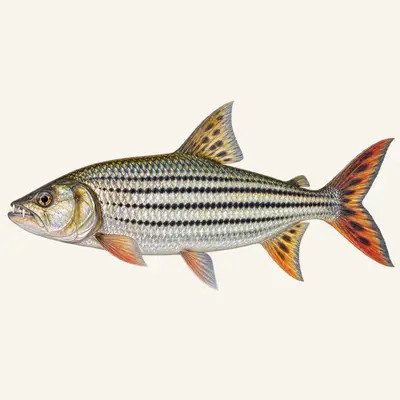
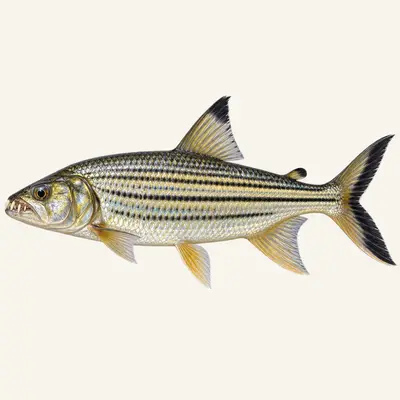
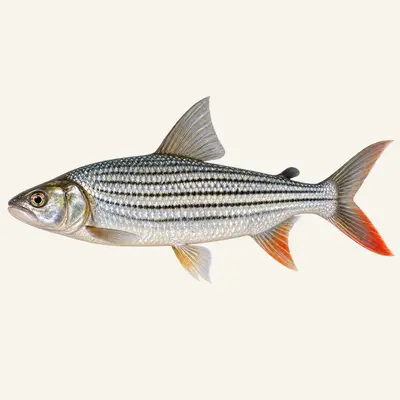
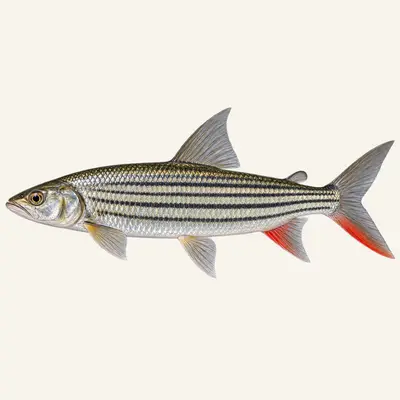
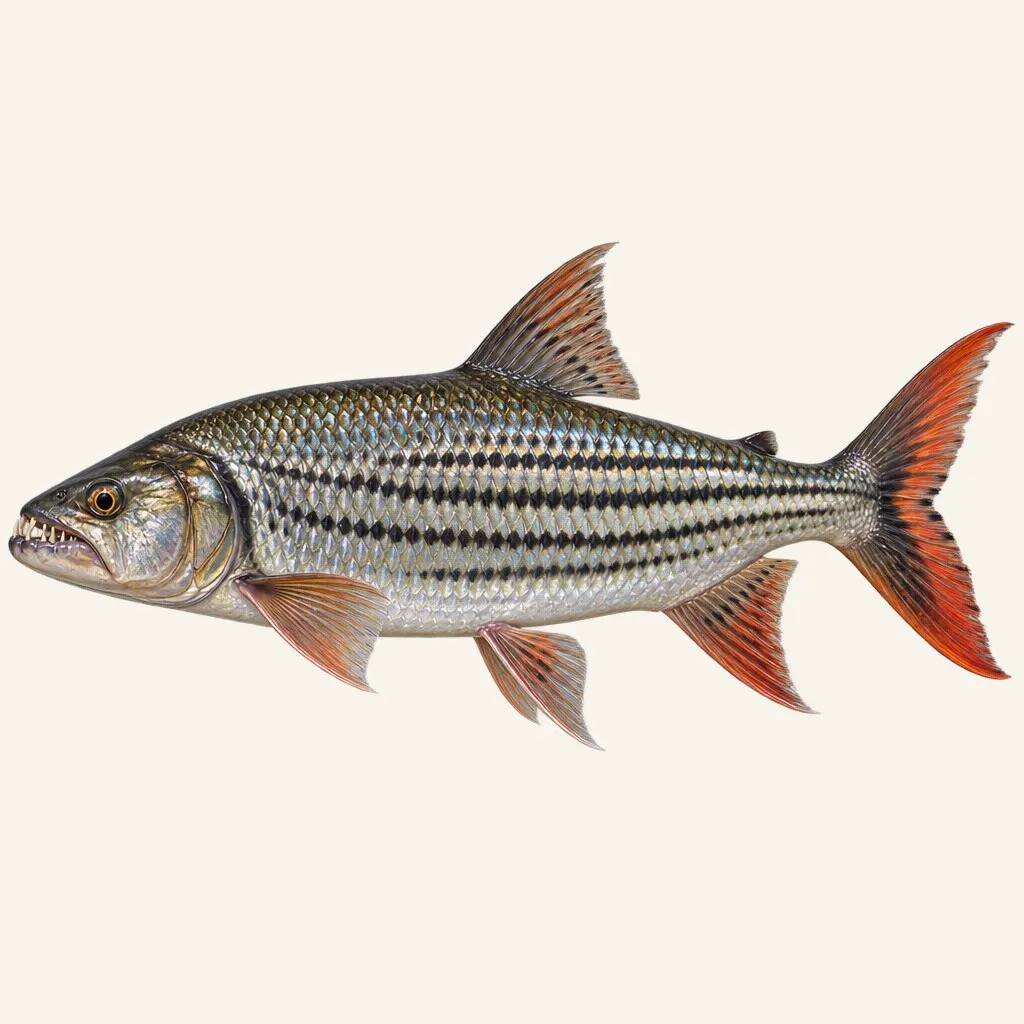
The Goliath tigerfish is one of the most formidable predators of central African rivers, especially the Congo, with a powerful silvery body adorned with dark stripes and a jaw armed with impressive conical teeth.
Calendar
Recorded in 3 countries
Central African Republic · Congo - Brazzaville · Congo - Kinshasa
GBIF occurrence records — native and introduced populations combined.
Its range
The species lives in the Congo basin, from the estuarine lower Congo up to the upper Lualaba, in the Democratic Republic of the Congo and the Republic of the Congo. It is also reported from Lake Tanganyika.
One basin, then, and no comparison with the African tigerfish, whose range covers most of the continent. The Congo is the only system that produces a fish of this size in the genus, and its discharge and length are the reason: a predator on this scale needs a prey base and a volume of water that smaller rivers cannot supply year-round.
The water it needs
This is a pelagic freshwater fish, living in the body of the water rather than on the bottom.
Its requirements are narrow: 23 to 26 °C, a pH between 6.5 and 7.5, and hardness up to 25 dH. A window that tight inside a basin that large is why the fish is not met everywhere in the Congo but in particular sectors of it, and it explains why local knowledge decides the outcome of a trip far more than gear does.
Areas
- Powerful Congo rapids
- Deep pools below falls
- Major river confluences
- Rocky zones in strong current
Techniques
- Large surface lure fishing
- Dead-bait in current
- Heavy casting with metal lures
- Anchored live-bait fishing
Baits
- Large local live fish
- Giant spoons
- Large surface lures
- Rigged dead fish
How to catch it
It is the largest tigerfish in the world, and most of what has to be prepared for follows from that one fact.
The fangs of the genus rule out any plain link between line and lure. At this size the point is not abrasion but severance, and the mass behind the jaws goes straight through what most rigs put in front of them.
Living in open water rather than on the bottom directs the search into the column of the main currents instead of onto marked features. There is no lie to cast at; there is a depth to find and a stretch of moving water to cover.
The reputation of this fish reaches well beyond the fishing world and brings specialist expeditions to the Congo. It is a destination fishery, locally organised, and its conditions are verified with the authorities of the country concerned before anything is planned.
Dangerous — Risky handling: gear, release, and safety practices must be adapted.
Conservation
A single-basin species that outgrows every other tigerfish and has become the object of international expeditions: the three facts combine badly.
A very large individual is necessarily an old fish in a system that produces only so many of them, and its removal is made good from nowhere else. There is no second basin. Whatever pressure the Congo takes, this species takes all of it.
Regulations
Check the local regulations in force (legal size limits, closed seasons, bag limits).
For guidance only. Legal sizes, quotas and open seasons vary by location and season: always check the local regulations in force before fishing.
Other names
Goliath tigerfish in English, and mbenga in several languages of the Congo basin, which is the name that came first.
The goliath qualifier is used in ichthyology to mark the giant of a genus, and it recurs in the goliath grouper, an unrelated marine fish. Both names describe a size class rather than a relationship.
Sources: fishbase.se · api.gbif.org