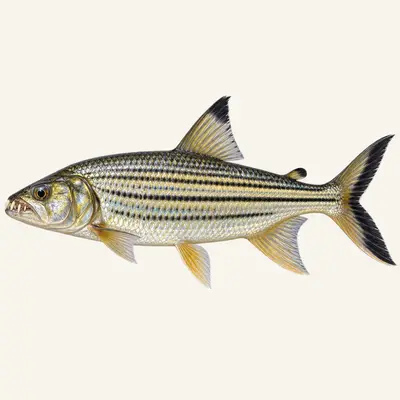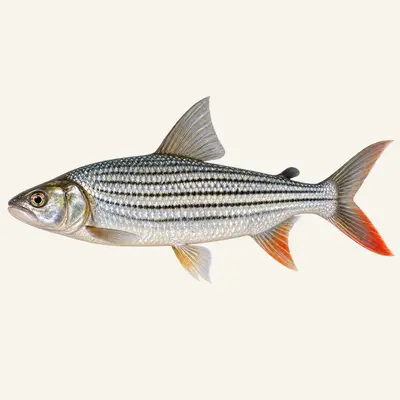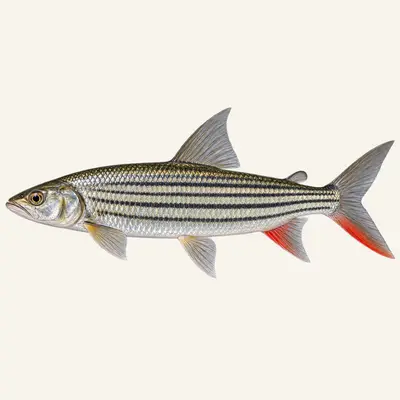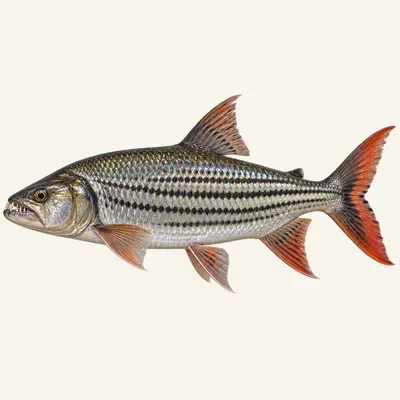
Tanzanian tigerfish
Hydrocynus tanzaniae · Alestidae
- Freshwater
- Predators
- Medium
- Dangerous
- Size
25 cm
Where to fish
- Lake
- River
Habitat icons: Flaticon
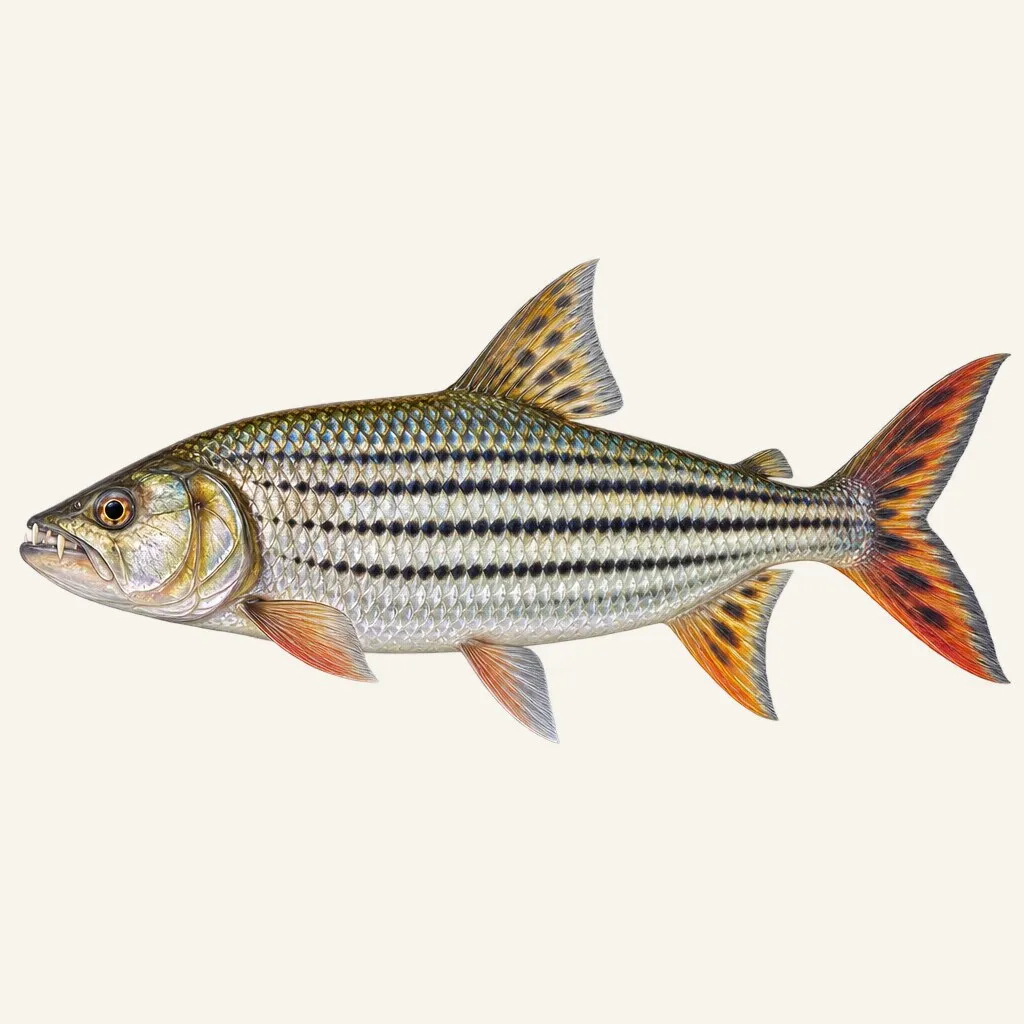
The Tanzania tigerfish is a freshwater predator endemic to Tanzanian rivers and lakes, with a slender silvery body crossed by dark bars and the sharp hooked teeth typical of African Alestidae.
Calendar
Recorded in 1 country
Tanzania
GBIF occurrence records — native and introduced populations combined.
Its range
The species is endemic to the rivers and lakes of Tanzania.
The reference file carries no distribution section at all — no basin, no coordinates, no locality list. That absence and the endemism explain each other. The tigerfish that have been described in detail are those of the large exploited systems, the Nile, the Congo, the Zambezi and the Niger, where a fishery and a century of scientific collecting piled up observations. A small endemic in one country's rivers fed none of that.
The only reference attached to the file is a revision of the genus Hydrocynus published in 1986. This species exists in the literature as the product of taxonomic work, not as the subject of a field study.
Identifying it
What can be said without risk is short. The catalogue description rendered on this page gives a slender silvery body crossed by dark bars and the sharp hooked teeth of the African Alestidae — and that description is true of the genus before it is true of the species.
The reference file adds nothing to it. There is no morphology section: no fin ray counts, no lateral line scale count, no gill raker length, no body depth measured against standard length. Those are precisely the characters by which tigerfish are separated from one another, and the published diagnoses of its relatives turn on exactly those numbers. For this species not one of them is on file.
The single entry the file does carry is a size, and it rests on one female measured in standard length. The measurements block at the top of this page is that fish. Which leaves one usable statement: this is a small tigerfish, and the difference in size between it and the Congo, Zambezi and Sahelian species is the most reliable character available.
Areas
- Rapids and fast currents
- Stream confluences
- Rocky river margins
- Pools below rapids
Techniques
- Light casting with small spoons
- Live-bait drift fishing
- Micro-jigging in current
- Light soft plastic lures
Baits
- Small live fish
- Small spoons
- Micro soft lures
- Aquatic insects
How to catch it
Nothing is documented: no season, no prey, no schooling behaviour, no technique. That has to be said precisely rather than in general terms, because the temptation is to transpose what is known about the large tigerfish, and the transposition would fail on at least two points.
Size first. A predator of this size is not fished with the tackle the Zambezi species calls for. It is light work — small lures and light rigs, in running water.
Teeth second, and they do not scale down with the animal. Sharp fangs on a small fish cut monofilament as effectively as those on a large one: the diameter of the leader falls with the size of the quarry, the fineness of the teeth does not. An abrasion-resistant link stays the basic precaution at any size in this genus.
Everything else — the lies, the hours, the prey to imitate — belongs to what has not been published.
Dangerous — Risky handling: gear, release, and safety practices must be adapted.
Conservation
The reference assessment dates from 2006 and has not been revisited. Twenty years, on a species whose file contains no population figure, no trend and no description of habitat, means that a change, had one occurred, would have left nothing on record to consult.
The endemism is the fact that carries weight. A species confined to the waters of a single country has no population outside them to rebuild from, and whatever reached its rivers would reach all of it at once. That is not an alarm — nothing indicates a decline — but it is a reason not to read an absence of reports as an absence of problems.
Regulations
Check the local regulations in force (legal size limits, closed seasons, bag limits).
For guidance only. Legal sizes, quotas and open seasons vary by location and season: always check the local regulations in force before fishing.
Other names
Tanzanian tigerfish in English, and all six of the catalogue's languages say exactly the same thing: the tiger and the country, nothing more.
That uniformity is itself information. Vernacular names accumulate where a fish is caught, eaten and talked about, and the large African tigerfish carry dozens of them, basin by basin. Here six languages content themselves with translating a scientific label, which points to a fish nobody needed a word for before the naturalists arrived.
Hydrocynus means water dog, from the Greek for water and for dog, and it names the dentition — the same image as the tiger, borrowed from a different animal.
Sources: fishbase.se · api.gbif.org