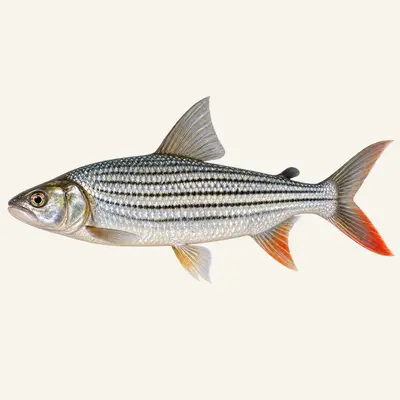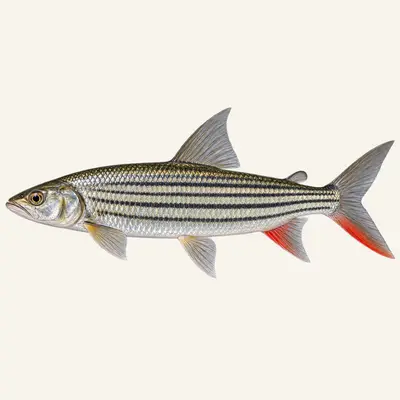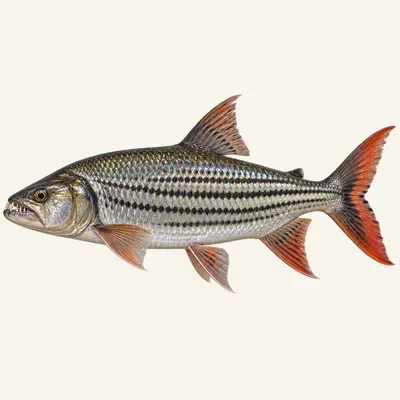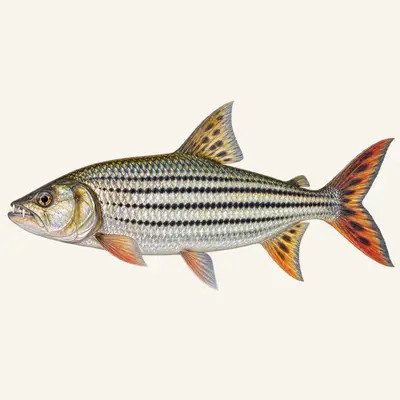
Tiger fish
Hydrocynus vittatus · Alestidae
- Freshwater
- Predators
- Medium
- Dangerous
- Size
105 cm
- Weight
28 kg
- Lifespan
8 years
- Water temp.
22–28 °C
Where to fish
- Estuary
- Lake
- River
Habitat icons: Flaticon
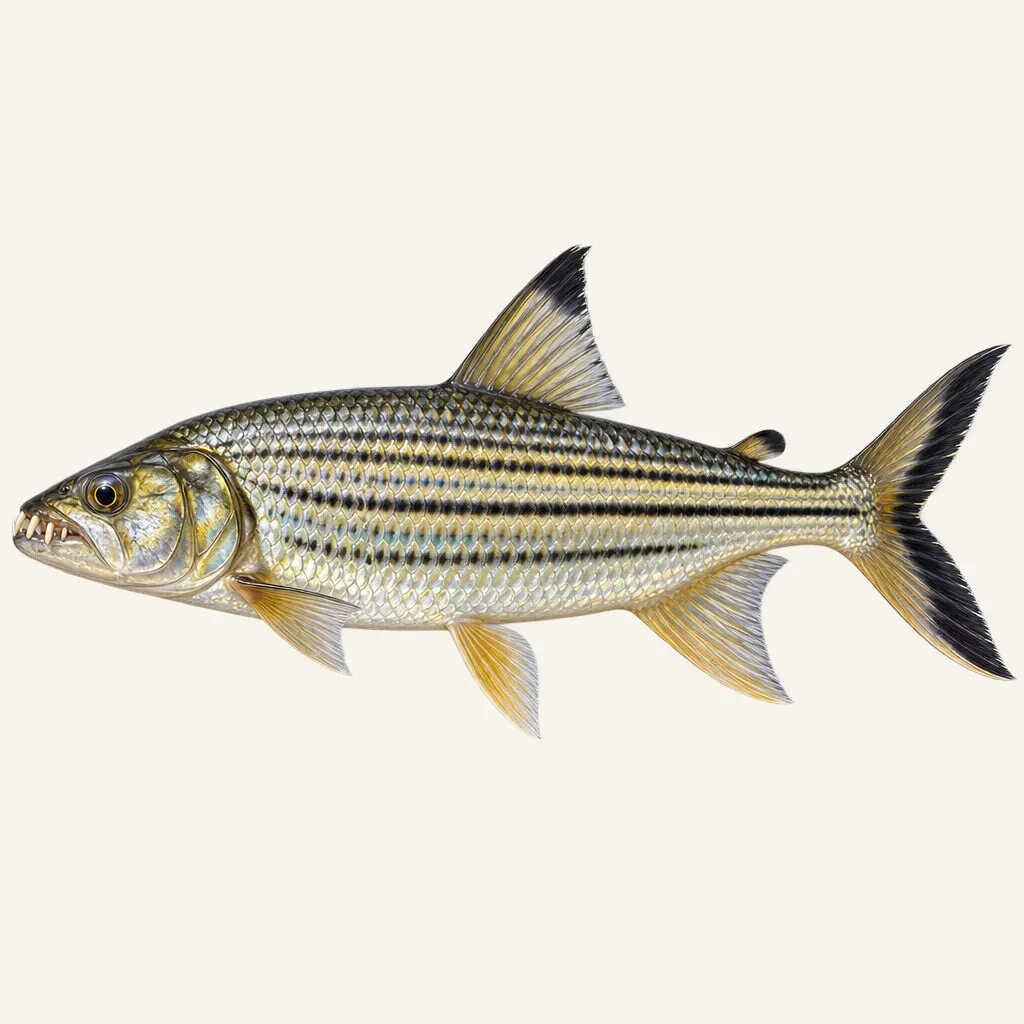
African predatory fish recognizable by its dark longitudinal stripes, sharp teeth, and streamlined silver body characteristic of the Alestidae family.
Calendar
Recorded in 12 countries
Angola · Botswana · Central African Republic · Chad · Congo - Brazzaville · Congo - Kinshasa · Malawi · Mozambique · Namibia · South Africa · Zambia · Zimbabwe
GBIF occurrence records — native and introduced populations combined.
Its range
The range is enormous and covers most of tropical Africa. In West Africa: the Niger, the Bénoué, the Ouémé, the Senegal, Chad, the Volta and the Mono. In Lower Guinea: the Cross and Sanaga basins. The Congo basin as a whole.
It is also reported from the Nile, the Omo, the Zambezi, the Limpopo, the Rovuma, the Shire, the Rufiji, the Ruaha, Lakes Tanganyika, Rukwa, Albert and Kariba, the Malagarasi, the Okavango, and the lower reaches of coastal systems as far south as the Pongolo.
Identifying it
The teeth are outside the jaws when the mouth is shut. They are large fangs that overlap on the exterior of the closed mouth, and nothing else in African fresh water shows a dentition that is visible at rest. The character belongs to the genus, so it identifies a tigerfish and not this tigerfish.
The gill rakers do that. They are long — about the length of the gill filaments themselves — and few, five to nine on the upper limb and nine to 12 on the lower. Relatives with reduced rakers are excluded on that alone.
Body depth exceeds 22 per cent of standard length, which makes this a deep-bodied fish for the genus. The lateral line carries 43 to 53 scales, and two rows of scales separate it from the scaly process at the base of the pelvic fins; one Sahelian relative has three there, and the count is the accepted way of telling them apart. The dorsal fin originates at roughly the same level as the pelvic insertions.
Colour supplies two more marks. The tips of the dorsal and adipose fins are black and the forked edge of the caudal is black, the dark pigment sometimes running onto the median rays to form a crescent-shaped blotch. Above the lateral line the flank carries dark longitudinal streaks — the stripes that gave the fish its name, and the epithet vittatus, banded.
Ten soft rays in the dorsal, 15 in the anal, no spines anywhere.
The water it needs
What the species wants is warm, well-oxygenated water, and it finds it mainly in large rivers and lakes rather than in small tributaries.
All but the largest individuals form roving schools of like-sized fish. Sorting by size is the notable part: it holds cannibalism down and produces homogeneous groups, and it means that a group located is a set of comparable fish. The biggest animals leave the schools and live alone.
Areas
- Rapids and fast currents
- Deep river pools
- Tributary mouths
- Submerged rocky shorelines
Techniques
- Cast-and-retrieve with metal lures
- Live-bait drift fishing
- Surface dead-bait fishing
- Deep jigging
Baits
- Spinner spoons
- Local live fish
- Soft plastic lures
- Dead-bait rigged fish
What it eats
The diet turns increasingly piscivorous with growth and becomes exclusively so past 90 to 100 mm in length. An adult tigerfish eats nothing but fish.
It takes whatever is abundant, with a preference for Brycinus, Micralestes, the African barbs and Limnothrissa. Shrimps of the genus Caridina and insects fill in the remainder.
The dentition explains the method. Fangs that overlap outside the mouth are not built to hold prey but to cut it: the strike severs, and a tigerfish routinely takes half of what it attacks. Everything about the tackle follows from that single mechanical fact — a metal or heavy abrasion-proof link ahead of the lure is a condition of fishing for the genus at all, not a refinement, because plain monofilament is cut through on the first take rather than frayed.
How to catch it
The size-graded school is the piece of information that shapes a session. Finding a group means finding fish of one stamp; hunting a very large specimen means hunting a loner, and the two exercises have nothing in common — the same stretch of river is fished differently depending on which is wanted.
Hooking is notoriously poor, and for the same reason as everything else here. A bony mouth bristling with fangs offers very little for a hook point to reach, so the proportion of dropped fish is high. That is an anatomical problem and not a failure of technique, and it is the reason strike rates and landing rates diverge so widely in accounts of this fishery.
The maximum reported age is only eight years. Growth is correspondingly fast. The largest recorded female measures 74 cm fork length, well short of what the species reaches overall, so the very biggest fish are not a random sample of the population.
Dangerous — Risky handling: gear, release, and safety practices must be adapted.
Conservation
Maturity around 40 cm and a life capped at eight years describe a stock that renews itself quickly, and one that can absorb a level of pressure that long-lived species could not.
The dependence lies elsewhere. Warm, well-oxygenated water in large rivers and lakes presupposes functioning systems with flow and depth in them. Impoundments have in fact worked in the species' favour where they created exactly that kind of water body, Lake Kariba among them, which makes this one of the few African predators to have gained ground from dam building rather than lost it.
Regulations
Check the local regulations in force (legal size limits, closed seasons, bag limits).
For guidance only. Legal sizes, quotas and open seasons vary by location and season: always check the local regulations in force before fishing.
Other names
African tigerfish in English, and tigerfish alone in southern Africa, where it is the fish that word refers to. Numerous local names apply basin by basin.
The name comes from the dark longitudinal stripes as much as from the dentition, and it is attached in South America to characins with no relationship to this genus at all — a point worth checking when a fishing report says tigerfish without naming a river.
Sources: fishbase.se · api.gbif.org