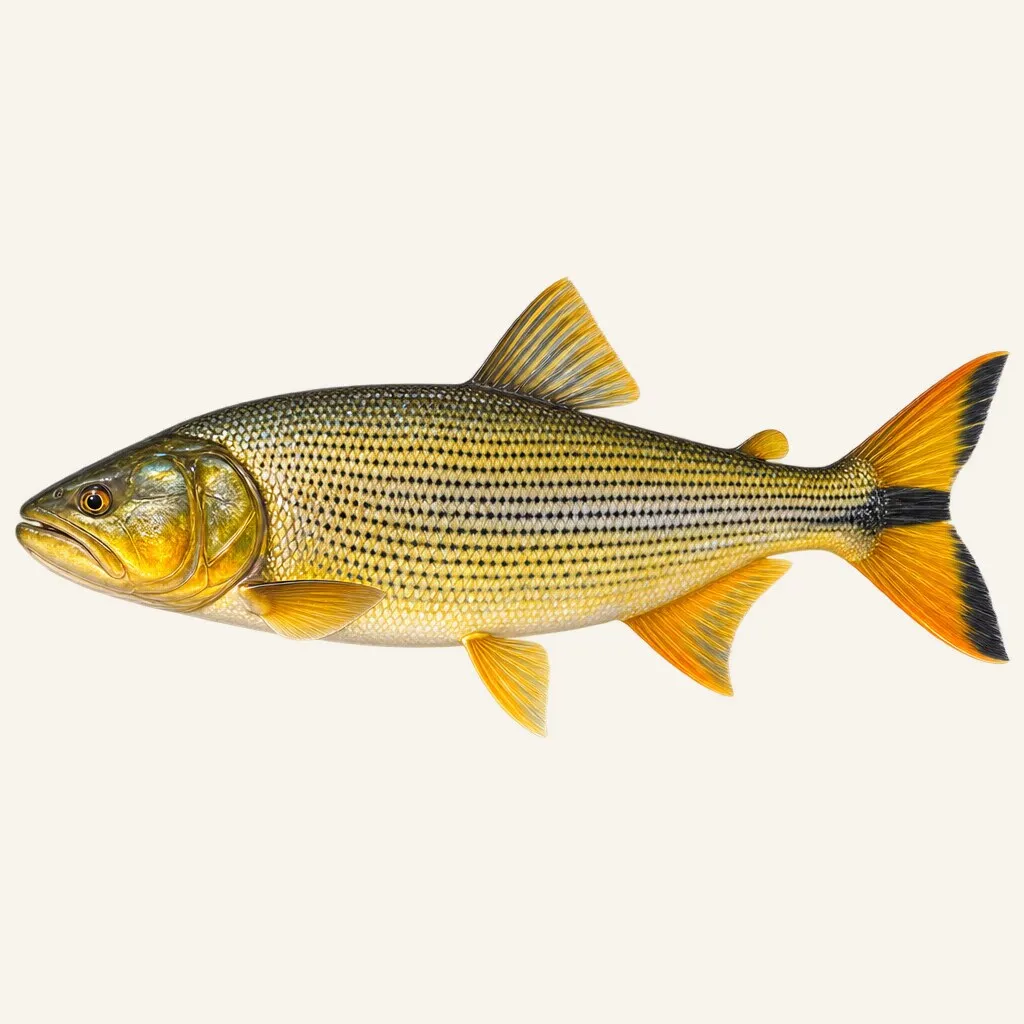
Golden Dorado
Salminus brasiliensis · Bryconidae
- Freshwater
- Predators
- Hard
- Size
60–100 cm
- Weight
3.1–30 kg
- Lifespan
9 years
Where to fish
- Estuary
- River
Habitat icons: Flaticon
Powerful golden predator of South America's great rivers, famed for its spectacular fights and aerial leaps.
Calendar
Recorded in 4 countries
Argentina · Brazil · Paraguay · Uruguay
GBIF occurrence records — native and introduced populations combined.
Its range
Three groups of waters carry the species, and the third is the interesting one. The Paraná, the Paraguay and the Uruguay form a single network. The Laguna dos Patos drainage, on the Atlantic side, is separate from it. Then come the upper Chaparé and the upper Mamoré, in Bolivia, which belong to the Amazon slope.
And occurrence in the rest of the Amazon is called highly doubtful by the source. The reading that follows is fairly clear: this is a fish of the southern basins with a foothold on the far side of the continental divide, where the headwaters approach one another on the Bolivian plateaus, and it has never colonised the great river beyond them.
A record flagged as doubtful is worth what its source is worth. A map has no way of drawing a reservation, so the reader has to carry it.
Breeding
The file holds one clause about how this fish breeds — that pairing is distinct at spawning — and nothing else. No site, no substrate, no season, no fecundity, no incubation. What is established is that it pairs.
Two figures do exist, and they belong together. First maturity arrives near 38 cm. The oldest individual ever reported was nine years old.
A large predator that breeds early and does not grow old is carried by recruitment rather than by accumulation. There is no stock of long-lived breeders holding a reach together for decades here; there are year classes replacing one another quickly. The consequence is a matter of arithmetic. Two or three poor years in a row cost a population like this one far more than they cost a fish that lives thirty and can wait for its turn.
Areas
- Paraná River
- Paraguay River
- Deltas and confluences
- Rapids and current seams
Techniques
- Lure casting
- Fly fishing
- Live bait fishing
- Light trolling
Baits
- Hard lures (crankbaits/jerkbaits)
- Spoons and spinnerbaits
- Large streamers
- Live baitfish
What it eats
Carnivorous: fish and crustaceans. The second item is the one that gets dropped.
A lure box built entirely on imitations of forage fish addresses half of what this animal is recorded as eating. Nothing in the file says how the two halves divide, but a predator with crustaceans on its list is not exclusively a chaser of shoals.
How to catch it
Start with the teeth, because the advice attached to this species in the catalogue names them outright: a wire or heavy fluorocarbon trace, because the dentition of this fish parts ordinary line. On a predator of this size that is not a refinement. It is the condition for landing anything at all.
Then the marker. First maturity near 38 cm, against a common size of 60, is the number to hold in mind with a fish in the net.
The habitat line is unusable, and saying so beats filling the gap. One word, ponds, for an animal taken in the current seams and confluences of the Paraná: the map and the habitat icons at the top of this page carry more information than that sentence does, and the fishing marks listed above carry more still.
The uses are the last thing worth knowing. This species is simultaneously a sport fish, a commercial catch and a farmed animal. Three uses converging on one species is uncommon, and it means the pressure on it does not come from a single direction and cannot be read off a single set of figures.
Conservation
What presses on this fish is easier to establish than what is known about it.
Three simultaneous uses is the first half. The biology is the second, and it offers no buffer: maturity at 38 cm, nine years at the top of the age range, and a population structure that depends on the last few year classes rather than on a reservoir of old fish.
The doubtful Amazon record then narrows the picture further. If the occurrence beyond the divide is not real, the species holds fewer basins than a range map suggests, and everything falling on it falls on those. A range read generously makes a fishery look better distributed than it is.
The species is managed in several of the countries that hold it, and what applies on a given river has to be checked with the authority responsible for it. Where release is the practice, the fight itself is what the fish has to survive: shortening it is worth more than any care taken afterwards.
Regulations
Often subject to quotas, minimum sizes and catch-and-release practices; per local regulations.
For guidance only. Legal sizes, quotas and open seasons vary by location and season: always check the local regulations in force before fishing.
Other names
Golden dorado is the catalogue's English entry, and the qualifier is doing real work. Dorado on its own is claimed, in Spanish, by a marine fish — the dolphinfish — and the French, Spanish and Italian entries for the present species are that bare word. Only two of the six add anything: German puts a group name in front of it, and English adds the colour the word already means.
Salminus is built on the salmon, for a characiform with no salmonid relationship whatever. The association was made on bearing and manner rather than anatomy — a golden, powerful fish of fast rivers — and it has been fixed in the nomenclature ever since.
Brasiliensis names one country for a species shared by Argentina, Paraguay, Uruguay, Bolivia and Brazil. A geographical epithet records where the described specimen came from, never the extent of the range.
Sources: fishbase.se · api.gbif.org