Tiger-fish
Hydrocynus brevis · Alestidae
- Freshwater
- Predators
- Medium
- Dangerous
- Size
86 cm
- Weight
8.3 kg
Where to fish
- Estuary
- Lake
- River
Habitat icons: Flaticon
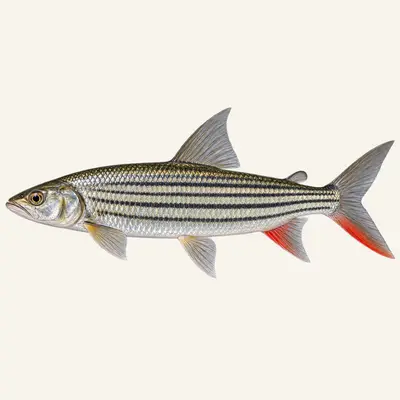
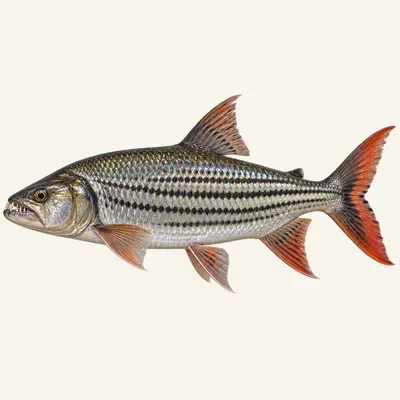
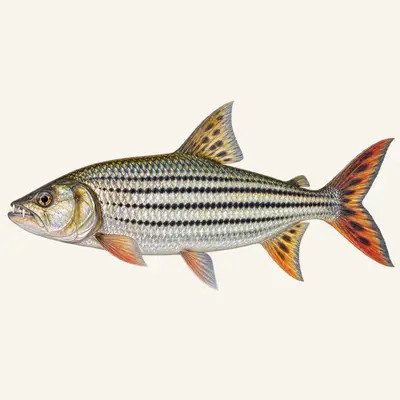
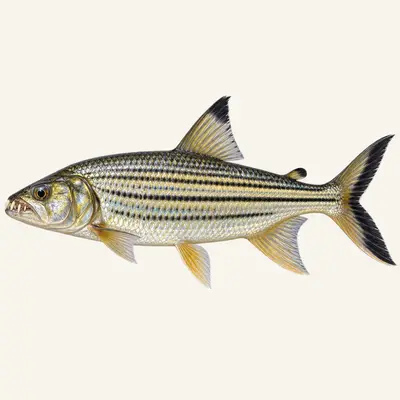
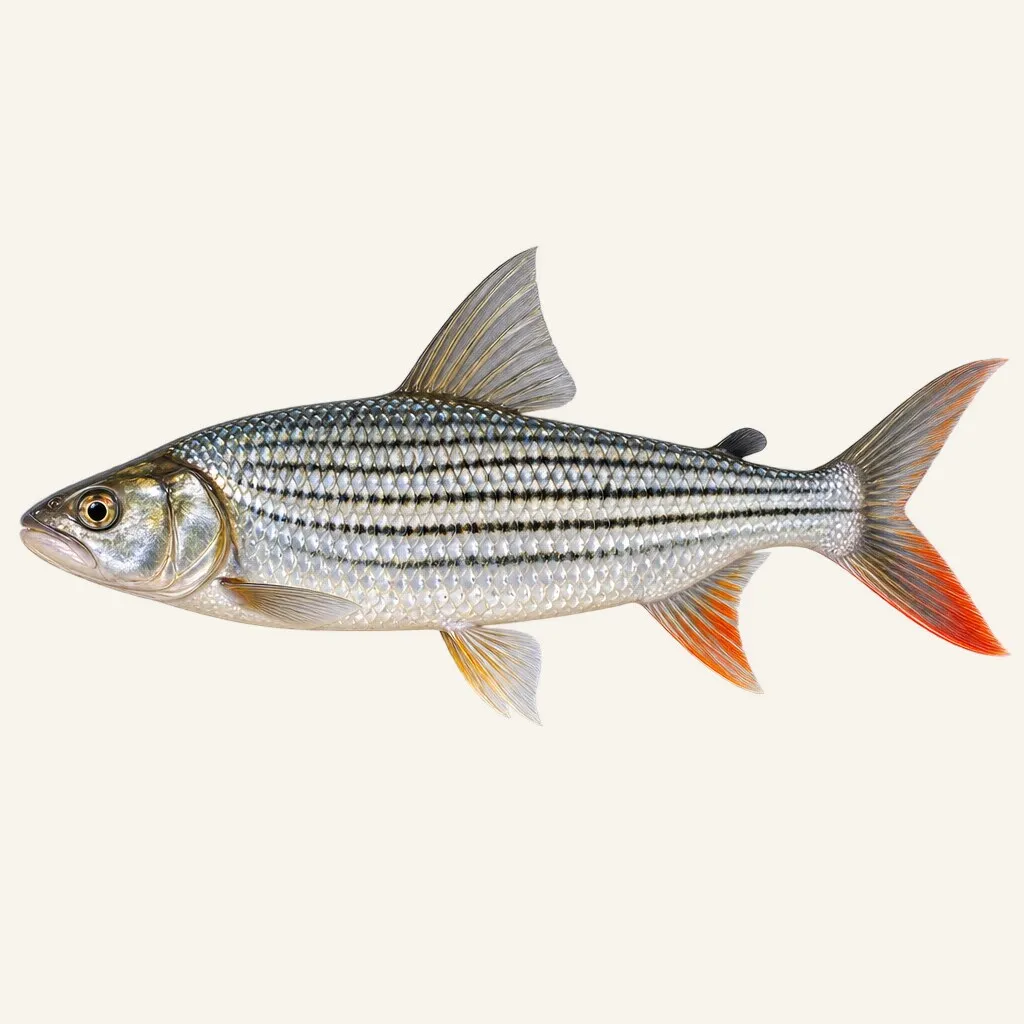
Medium-sized tigerfish with silver flanks adorned with dark stripes, characterized by a large mouth armed with sharp conical teeth.
Calendar
Recorded in 14 countries
Benin · Burkina Faso · Cameroon · Chad · Egypt · Gambia · Ghana · Guinea · Mali · Niger · Nigeria · Senegal · Sudan · Togo
GBIF occurrence records — native and introduced populations combined.
Its range
The species occurs only in the Sahelo-Sudanese basins: the Nile, the Chad basin, the Niger, the Volta, the Senegal and the Gambia.
That is the range of a climatic belt rather than of a river system. It follows the Sahel from west to east across rivers that have no present connection with one another, which implies an older hydrography — links that existed and no longer do. The fish did not cross the watersheds it now sits on either side of; the watersheds arrived after it.
Identifying it
Three rows of scales lie between the lateral line and the scaly process at the base of the pelvic fins, where the other two West African tigerfish have two. This is the character the literature explicitly retains for telling them apart, and it asks for nothing but a little patience with a wet fish.
The rakers of the first gill arch are poorly developed, which is the opposite of the African tigerfish, whose rakers match the length of the gill filaments.
Snout-to-dorsal length differs from snout-to-pelvic length, so the fins are set differently along the body than in its relatives — a proportion rather than a count, and one that needs the two measurements taken side by side.
Colour adds a useful mark: the lower lobe of the caudal fin and the front of the anal fin are red-orange. The adipose fin is grey or black and the body is fusiform.
Areas
- Moderate river currents
- River mouths
- Submerged sandy margins
- Deep open-water zones
Techniques
- Live-bait under float
- Casting with bright spoons
- Drifted dead-bait
- Animated surface lures
Baits
- Small live fish
- Metal spoons
- Fish-imitating soft lures
- Spinners
What it eats
Tigerfish are piscivorous, and they also take shrimps of the genus Caridina and insects.
The documentation goes no further for this species in particular, so what is reported holds at the level of the genus. Its poorly developed gill rakers nevertheless suggest a predator less inclined towards small prey than the African tigerfish, in which those rakers are long.
How to catch it
Telling the three species apart counts for more here than it would elsewhere, because all three swim in the same West African rivers. A tigerfish taken in the Niger or the Senegal deserves a scale count before it is given a name, and the row count below the lateral line is the only field character that reliably delivers one.
Weight is where this one falls short — well behind the African tigerfish at 28 kg, and in no way comparable to the Congo goliath. Tackle chosen for the genus in general is over-specified for this fish in everything except the link to the lure, which the fangs of the genus rule on regardless of the animal's weight.
Of the three West African tigerfish, this is the one whose entry carries no sport-fishing note at all, only a commercial fishery. Where it is caught, it is caught to be eaten.
Dangerous — Risky handling: gear, release, and safety practices must be adapted.
Conservation
A range confined to the Sahelo-Sudanese rivers exposes this species to whatever affects that particular belt: falling flows, abstraction for irrigation, and the variability of the rains. These are systems already under severe water stress, and the fish depends on them directly.
There is no refuge elsewhere. Its two West African relatives also occupy the Congo basin and the rivers of Lower Guinea, so a dry decade in the Sahel costs them part of a range; for this one it would cost the whole of it.
Regulations
Check the local regulations in force (legal size limits, closed seasons, bag limits).
For guidance only. Legal sizes, quotas and open seasons vary by location and season: always check the local regulations in force before fishing.
Other names
Sahelo-Sudanian tigerfish is the descriptive English name, but in practice the word tigerfish covers all three West African species indiscriminately, in reports as in markets.
The epithet brevis refers to the short snout, and the comparison only holds within the genus: measured against anything else, the snout is not short at all.
Sources: fishbase.se · api.gbif.org