Elongate tigerfish
Hydrocynus forskahlii · Alestidae
- Freshwater
- Predators
- Medium
- Dangerous
- Size
78 cm
- Weight
16 kg
- Lifespan
4 years
Where to fish
- Estuary
- River
Habitat icons: Flaticon
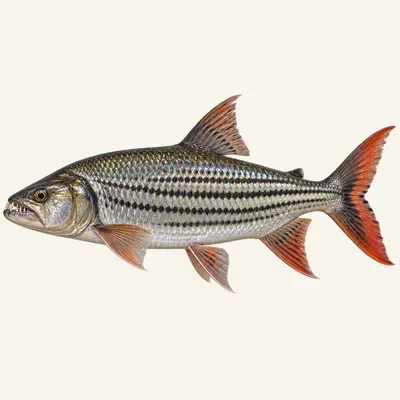
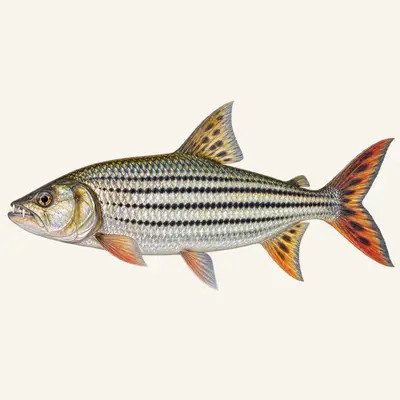
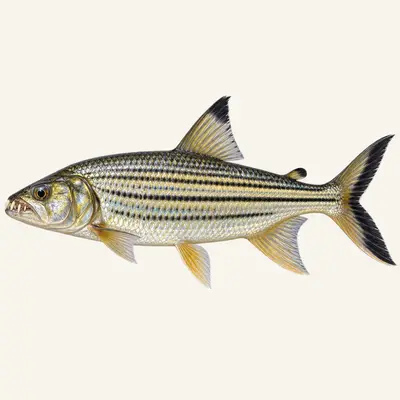
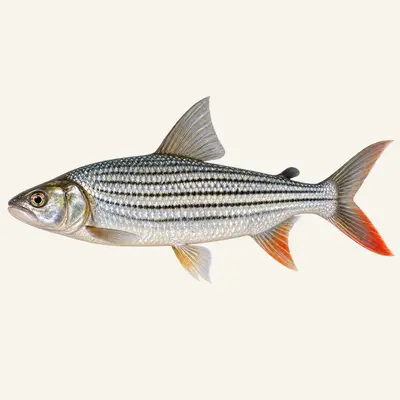
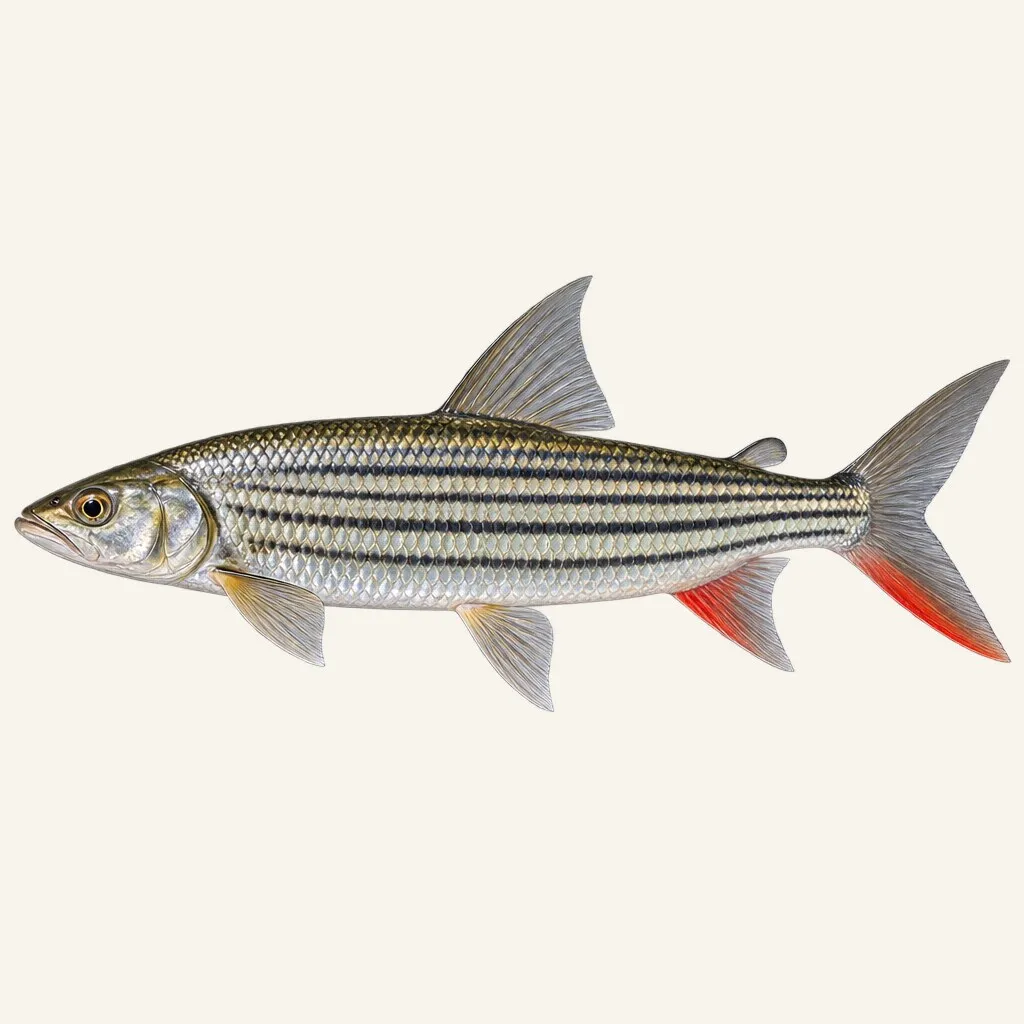
The elongated tigerfish is a slender predator of African rivers and lakes, recognizable by its tapered silvery body adorned with dark longitudinal streaks and the sharp teeth characteristic of the Alestidae family.
Calendar
Recorded in 7 countries
Cameroon · Central African Republic · Côte d’Ivoire · Guinea · Mali · Nigeria · Uganda
GBIF occurrence records — native and introduced populations combined.
Its range
The species occupies the Cross, Wouri and Sanaga basins in the Lower Guinea province; Chad, the Niger, the Ogun, the Ouémé, the Mono, the Volta, the Comoé, the Bandama, the Sassandra, the Nipoué, the St Paul, the Mano, the Little Scarcies, the Gambia and the Senegal in West Africa; the Nile, including Lake Albert; Lake Turkana and the Omo; and the Congo basin.
Occupying both the Nile and the Congo, plus the whole West African belt in between, puts this among the most widely distributed large predators in African fresh water.
Identifying it
Three details separate this fish from its West African relatives, and they have to be taken together.
The dorsal fin is uniformly greyish and its origin lies ahead of the pelvic fins. In the African tigerfish those two origins are level with one another, which makes the position of a single fin the quickest available check.
The adipose fin is greyish, and the caudal has no black edge — again the reverse of the African tigerfish, whose fin tips and forked caudal margin are marked with black.
Two scale rows separate the lateral line from the scaly process at the pelvic-fin bases. That count is worth making, because the short-snouted tigerfish sharing the same West African rivers has three there.
The body is elongate, more slender than that of the other members of the genus, and the English name was built on it.
Breeding
Breeding migrations have been reported up several tributaries of Lake Kariba during the rains.
The trigger is therefore hydrological and not calendrical. Rain and rising tributaries put the fish in motion, and the date shifts from year to year along with them, which means the run cannot be predicted from a month alone.
Maturity comes at about 20 cm, very early for a predator of this genus, and the maximum reported age is four years.
The water it needs
This is an open-water predator, frequently found near the surface, and it forms shoals.
Holding high in the water column is what distinguishes it from most tropical freshwater predators, and it is also what exposes it to the fish eagle: a fish that hunts in the top layer of a lake is hunted from above it.
Shoaling and hunting in open water go together in a fish that pursues rather than ambushes: there is no cover involved, so the group does the work that structure does for other predators.
Areas
- Rocky river rapids
- Edges of natural weirs
- River current zones
- Tributary mouths
Techniques
- Fast cast-and-retrieve with lures
- Live-bait drift fishing
- Light jigging in current
- Surface lures
Baits
- Light wobbling spoons
- Small live fish
- Colored soft plastic lures
- Spinners
What it eats
Fish, with a marked preference for long-bodied prey because they are easier to swallow. Insects, grass and snails appear as well, and the species is cannibalistic.
The preference is not a curiosity. It says that a predator swallowing prey whole selects on the cross-section of that prey before its length, and it is directly usable: slim, long lures answer this fish where deep-bodied ones do not, and that is a rare case of a diet dictating the silhouette of the tackle rather than merely its size.
The species is itself prey to the African fish eagle, Haliaeetus vocifer, which hunts it at the surface.
How to catch it
The surface and the open water. Unlike ambush predators that have to be presented with a lure at close range, this one is searched for high in the column, well away from structure, and floating or shallow-running lures are in their element there.
Shape matters more than usual because of the diet. Long and thin beats short and deep, and the reason is mechanical rather than aesthetic.
The rains set the season. Breeding migrations concentrate fish in tributaries, and that window moves with the hydrology of the year rather than sitting on a fixed date.
A fish that reaches its full size inside a maximum reported age of four years is one of the fastest-growing in the catalogue. As with every member of the genus, the fangs make an unabraidable link between line and lure a prerequisite.
Dangerous — Risky handling: gear, release, and safety practices must be adapted.
Conservation
Maturity at 20 cm and a four-year life span produce a stock that rebuilds in a season or two. Fishing is unlikely to be what threatens this species.
Its dependence is hydrological. Migrations triggered by rain, into tributaries, presuppose that those tributaries stay connected and that the flood pulse still happens. A dam that flattens the hydrograph removes the signal as well as the passage — the fish neither receives the cue to move nor has anywhere to move to.
Regulations
Check the local regulations in force (legal size limits, closed seasons, bag limits).
For guidance only. Legal sizes, quotas and open seasons vary by location and season: always check the local regulations in force before fishing.
Other names
Elongate tigerfish in English, after the slimmer outline that also serves to identify it. Nile tigerfish is used as well, and it describes only one end of a range that reaches the Atlantic coast.
The epithet honours Peter Forsskål, the eighteenth-century naturalist who died in Yemen during the Danish expedition to Arabia.
Sources: fishbase.se · api.gbif.org