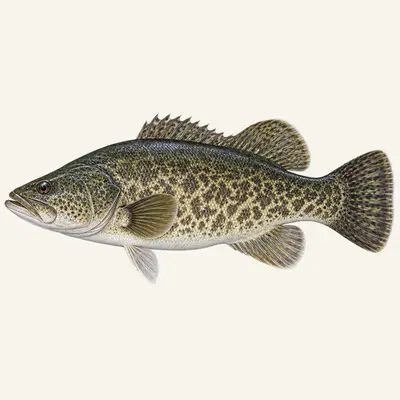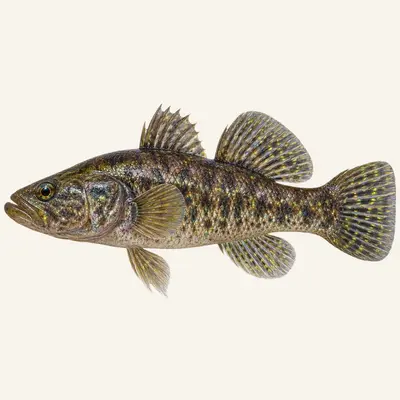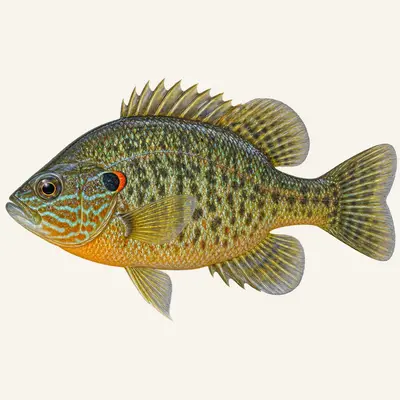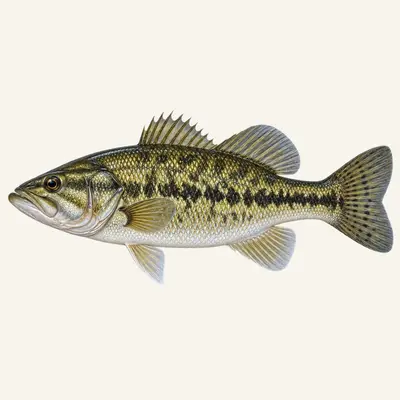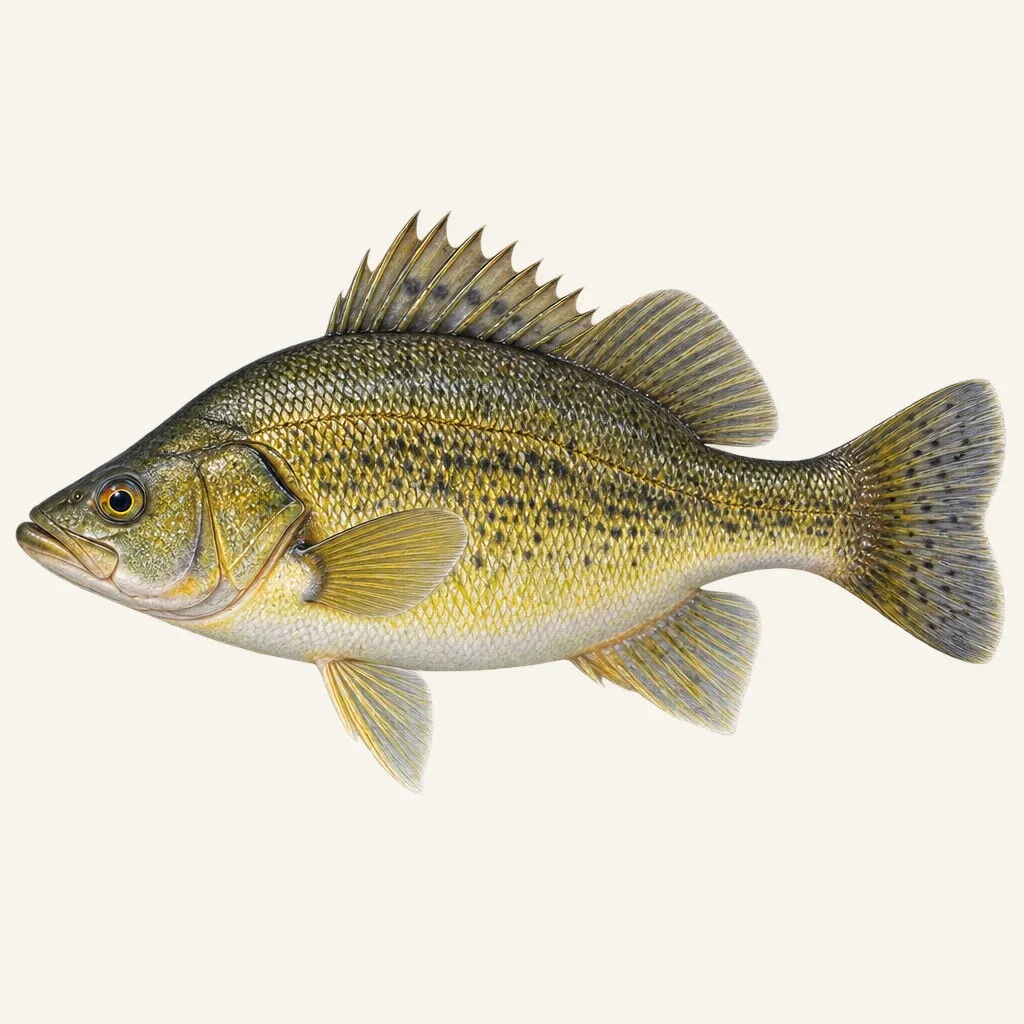
Golden perch
Macquaria ambigua · Percichthyidae
- Freshwater
- Predators
- Medium
- Size
45–76 cm
- Weight
2.0–8.0 kg
- Lifespan
20 years
- Water temp.
10–30 °C
Where to fish
- Lake
- Pond
- River
Habitat icons: Flaticon
Stocky, golden-hued Australian freshwater fish prized for its vigorous fight.
Calendar
Recorded in 1 country
GBIF occurrence records — native and introduced populations combined.
Its range
The Murray-Darling except the higher tributaries, the Dawson-Fitzroy of southeastern Queensland, the Lake Eyre and Bulloo drainages, and the floodplain lakes of western Victoria and New South Wales. Widely introduced to other coastal systems in Queensland and New South Wales.
The interior basins on that list explain the tolerances. Lake Eyre and the Bulloo dry back to disconnected waterholes and then flood enormously, and a fish that resorbs its eggs when the flood fails, survives 35 degrees and 35 parts per thousand while it waits, and then travels a long way when the water arrives is built for exactly that hydrology.
Which is the other half of this animal's reputation. It is described as Australia's most migratory freshwater fish, tagged individuals have been recorded moving 2,000 km, and the spawning migration is normally a long one, upstream.
Breeding
The trigger is a flood, and the alternative to a flood is not a delay — it is nothing at all. Without suitable environmental cues, females may fail to breed in a season, and the eggs are resorbed. Under favourable conditions the same female can spawn more than once in a year.
The cue is written down. Spawning happens in flooded backwaters, near the surface, at night, after heavy spring and summer rains. The eggs float near the surface and hatch in 24 to 36 hours. The nominal season runs from early spring to late autumn, which is a wide window around a narrow event.
Maturity is split by sex, and the split is large. Males mature at two to three years and 20 to 30 cm; females at four years and 40 cm. The combined figure given for the species is 45 cm, in a range of 40 to 50.
Put it together and the flood is not one requirement among several. It decides whether eggs are laid at all, it puts them in the right water when they are, and — see the diet below — it feeds what comes out of them.
The water it needs
The species holds whole river systems, from clear fast upper reaches to turbid slow lower ones, with the billabongs and backwaters that belong to them. Given the choice it takes the warm, slow, turbid sections. Deep pools with plenty of cover: fallen timber, rocky ledges, undercut banks.
Two tolerances are worth more than the preferences. It handles temperatures from 4 to 35 degrees, and salinity up to 35 parts per thousand — sea strength, in a fish that can live a thousand kilometres from the sea. Neither figure says where it usually is. Both say why it is still there after a drought has concentrated a waterhole into something nothing else in the pool can use.
It is solitary, and it also occupies flooded lakes, backwaters and impoundments.
Areas
- Murray-Darling Basin
- Inland impoundments
- Submerged timber and fallen trees
- Confluences and slow currents
Techniques
- Soft plastic casting
- Crankbait fishing
- Spinnerbait fishing
- Vertical jigging
- Bait fishing
Baits
- Worms
- Freshwater crayfish (yabbies)
- Soft plastics
- Crankbaits
- Spinnerbaits
What it eats
One animal dominates the diet: the yabby, Cherax destructor, with a variety of fish alongside it. Adults also take molluscs and crayfish generally.
Juveniles are on something else entirely, and it is the flood again. They disperse across the floodplain for food and cover, and what they eat out there is the zooplankton that blooms on recently inundated ground. The flood does not merely permit the spawning — it lays the table for the year class the spawning produced.
A diet led by a burrowing freshwater crayfish points at the bottom of the pool rather than at the surface, and it points at a slow presentation.
How to catch it
Fish the cover, deep. Fallen timber, rocky ledges, undercut banks, at the bottom of a pool: the list in the record is explicit and short.
Turbid water is a preference here rather than a handicap, which inverts the usual advice. A river running dirty is a river running the way this fish likes it.
The diet points at the yabby, and a crayfish imitation worked on the bottom is aimed at the animal that actually dominates the recorded stomach contents — a better guide than reasoning from what the fish looks like.
Timing works on two scales. Across the year, movement follows water: a rise brings fish upstream and a large rise moves them a very long way. Within the day, spawning is nocturnal, which matters in spring, when the fish that have gathered have gathered for that.
The maximum reported age is 20 years. Published lengths and weights disagree between sources, so the age is the figure that carries the argument.
Conservation
Egg resorption in the absence of a cue is the central mechanism, and it fails quietly.
A regulated river loses its floods. The females remain, in good condition, at adult size, and they do not breed. No count of adults reveals the problem, because nothing has died; it takes years of recruitment data to notice that a cohort is missing. That is the Murray-Darling, where abstraction and impoundment have flattened the flood regime this species responds to.
Stocking then covers the gap. Government and private hatcheries in Victoria, New South Wales and Queensland rear fry and fingerlings, and those go into public waters and farm dams. A dam full of golden perch is not evidence that golden perch are breeding, and nothing about the difference is visible from the bank.
Twenty years of life buys tolerance of a bad decade. It buys none at all of a river that has stopped flooding, because the adults go on being caught while the year classes behind them fail to appear.
Regulations
Legal size and bag limits vary by Australian state; follow local regulations.
For guidance only. Legal sizes, quotas and open seasons vary by location and season: always check the local regulations in force before fishing.
Other names
Golden perch is the English name and perch is the misleading half. The fish belongs to Percichthyidae, an Australian family, and has nothing to do with the European perch or the North American ones. The catalogue's other percichthyid is the Murray cod, which is called a cod for the same reason this one is called a perch: a settler naming a new fish after the nearest familiar one.
Macquaria comes from the Macquarie River. The epithet ambigua means ambiguous — and for a fish whose sexes mature at different sizes, whose published maxima disagree, and whose breeding depends on whether it rained, the name has aged well.
Sources: fishbase.se · api.gbif.org