Pink salmon
Oncorhynchus gorbuscha · Salmonidae
- Saltwater
- Salmonids
- Medium
- Size
51–76 cm
- Weight
2.1–7.0 kg
- Lifespan
3 years
- Depth
0–250 m
Where to fish
- Estuary
Habitat icons: Flaticon
The pink salmon is the smallest and most prolific Pacific salmon; males develop a distinctive humped back during spawning. This anadromous species follows a strict two-year life cycle along the North Pacific coast from California to Siberia, and has recently established populations in Northern Europe.
Calendar
Recorded in 6 countries
Canada · Japan · Norway · Russia · Sweden · United States
GBIF occurrence records — native and introduced populations combined.
Its range
A rigid two-year clock governs this species, and nothing else in the genus has one. It spends 16 to 18 months at sea, returns the following spring, spawns and dies; three years is the maximum age on record, which leaves no room for variation at all. Every river therefore carries two populations that never meet, an odd-year line and an even-year line, and abundance alternates according to which is the stronger.
The second trait explains how far the range reaches. Homing is loose here compared with the rest of the genus: a proportion of fish wander and settle elsewhere, in streams as much as 640 km from the one they came out of. That imprecision is expensive for an individual and works as a colonisation mechanism for the species — it is why the fish turns up in Arctic tributaries from the Mackenzie delta to the Lena estuary, and why an emptied drainage refills quickly.
It is also why introductions took hold. Breeding populations are now established in northern Europe, where the species had no presence at all.
One genetic note belongs here. It hybridises occasionally with chum salmon, and the offspring are fertile. Fertile crosses between two distinct salmonids are uncommon.
Identifying it
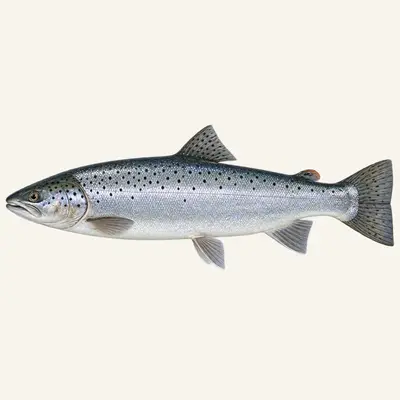
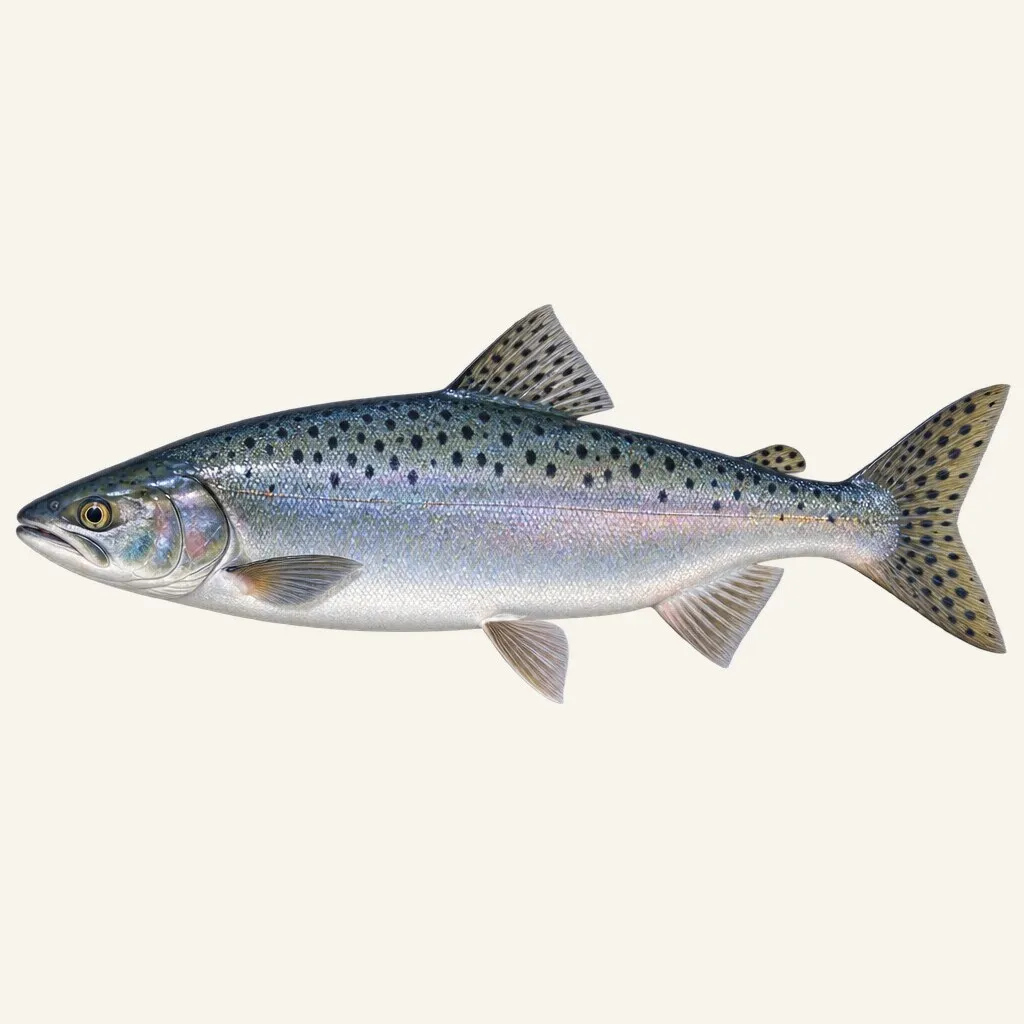
Large black ovals mark the back, the adipose fin and both lobes of the tail. The spotting is coarser than anything else in the genus and reads across a wet fish at arm's length.
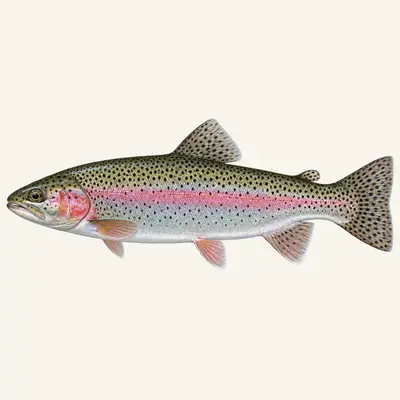
Juveniles are identified by something they lack: parr marks. A young salmonid in a north Pacific coastal stream showing no dark ovals down the flank has few other identities available. Rainbow trout, the likely confusion once both are silver, keep theirs and carry a pink to red stripe this fish never has.
The counts finish the separation: 177 to 240 scales in the midlateral row, 26 to 33 gill rakers, 11 to 15½ branched rays in the anal fin with 13½ the usual figure, and 63 to 72 vertebrae. The mouth is terminal and barely oblique on a fish fresh from the sea.
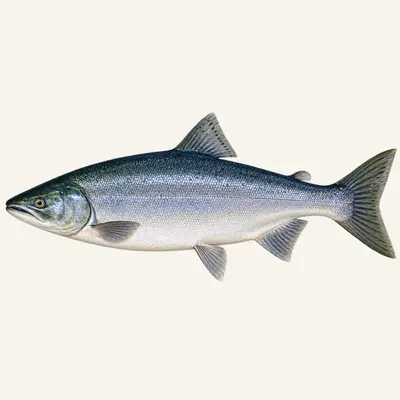
At sea the back is steel blue to blue-green, the sides silver, the belly white. Coming to spawn, the male darkens above and goes red on the flanks, blotched with brownish green; the female follows the same shift in a lower key.
This is the smallest of the true salmon. Maturity comes at 40 to 50 cm and the usual length is around 50.
Breeding
No other member of the genus deforms like the male of this one. Through the run his back rises into an enormous hump, his head enlarges, both jaws take heavy hooked teeth, and the lower jaw lengthens and turns up at the tip until the mouth will no longer close. A fish that cannot shut its mouth has stopped being an eating animal, and none of the change reverses.
The run itself is hydraulic. Fish move between June and late September depending on the region, and high water is what starts them.
On the gravel the female lies over on one side and beats with her tail, driving out fines and light stone until she has cut a deep trough; the male spends most of his effort on other males. She drops in when it is ready, he is on her immediately, and both release with mouths open and bodies vibrating. Several males sometimes join a single release. The next trough, cut just upstream, buries the one before it.
A female lays about 1,200 to 1,800 eggs, a modest number for a salmonid, and the species makes it up in the number of spawners. Survival measured on one Canadian river ranged between 1 and 25 per cent according to the year.
Death follows within 10 to 20 days of spawning.
The water it needs
In fresh water this is a fish of montane and piedmont rivers with moderate to fast current over gravel. Spawning happens in riffles or at the head of one, in shallow water, under current running up to 1.5 m per second, on clean coarse stone.
The rest of the life is marine and pelagic, between the surface and 250 m, in water no warmer than 21 °C.
The freshwater stay of the young is cut to a minimum. Fry leave the gravel and drop straight downstream, spend a few months in the coastal fringe, then head out. They may take insect nymphs and larvae on the way, or eat nothing whatever: the food is elsewhere, and this salmon asks the river for a bed of gravel and an open way down and for nothing more.
Areas
- River mouths and estuaries
- Shallow river rapids
- Coastal marine zones
- River holding pools
Techniques
- Lure fishing (pink spoons)
- Fly fishing (streamers)
- Bait fishing (shrimp)
- Drift fishing
Baits
- Pink shrimp
- Salmon eggs
- Pink-orange soft lures
- Colored spoons
What it eats
At sea the young start on copepods and larvacean tunicates, then move to amphipods, euphausiids and fish as they grow. Ostracods, decapod larvae, cirripedes, tunicates and dipteran insects fill in around those.
All the growth is packed into 18 months. A fry of a few centimetres goes out and comes back at half a metre. The bill for it is exposure: marine mammals and large fish take the adults, and the fry pay heavily to birds and small carnivores on the way down.
How to catch it
The calendar governs, and it has nothing in common with the calendar of any other salmonid. A given drainage produces a heavy run only every second year, according to which line dominates it. Working the wrong year means fishing a river close to empty, whatever the method.
Within a season the second signal is the freshet. Fish hold in coastal water and commit on rising flow; the days after a rise concentrate entry, and the window shuts as the level drops back.
The third fact is physiological. A jaw that no longer closes rules out feeding, so a fish taking a lure in the river is not eating. A humped, toothed, coloured male is at the end of his course: the flesh has lost what made the silver fish of a few weeks earlier worth keeping, and putting him back costs nobody anything.
Where the species has been introduced beyond its range, capture often answers to management rather than to sport, and local instructions come ahead of habit.
Conservation
One river holds two populations that cannot help each other. A line wiped out by a severe low flow, or by riffles silting at the wrong moment, will not be rebuilt by the following year's fish, because the two never interbreed. Relief can only arrive from outside, carried by strays — the loose homing that costs an individual is exactly what repairs a drainage.
Nothing points to a general retreat. Modest fecundity per female is offset by very large runs and by a complete turnover of the population every two years.
The question sits outside the native range instead. A prolific salmonid with a two-year generation and approximate homing, now breeding in rivers in northern Europe, is arriving in systems occupied by native species already in difficulty. What that establishment does is still being measured.
Regulations
Check the local regulations in force (legal size limits, closed seasons, bag limits).
For guidance only. Legal sizes, quotas and open seasons vary by location and season: always check the local regulations in force before fishing.
Other names
Pink salmon is the trade and field name, taken from the colour of the flesh. Humpback salmon, shortened to humpy on the fishing grounds, is the older North American term and points at the male's back; German keeps the same image in Buckellachs. Most of the catch is canned, with smaller outlets fresh, smoked and frozen, and the roe is sought after, particularly in Japan.
Sources: fishbase.se · api.gbif.org