Rebel's barbel
Barbus rebeli · Cyprinidae
- Freshwater
- Carp & coarse
- Hard
- Size
25 cm
Where to fish
- River
Habitat icons: Flaticon
Found in lakes and rivers. Prefers clear-water stretches and riffles in streams and rivers.
Calendar
Recorded in 1 country
North Macedonia
GBIF occurrence records — native and introduced populations combined.
Its range
The range runs down the Adriatic slope of the Dinarides from the Drin to the Aoos, across Montenegro, Albania, North Macedonia and Greece, and it takes in Lakes Skadar and Ohrid.
Those two lakes matter out of proportion to their area. They are the only large permanent bodies of water anywhere in the distribution, and the rest of it is a surface network that is not continuous — a scatter of small watercourses, many of which do not run for the whole year. Around the lakes the range fragments into brooks that are independent of one another.
Identifying it
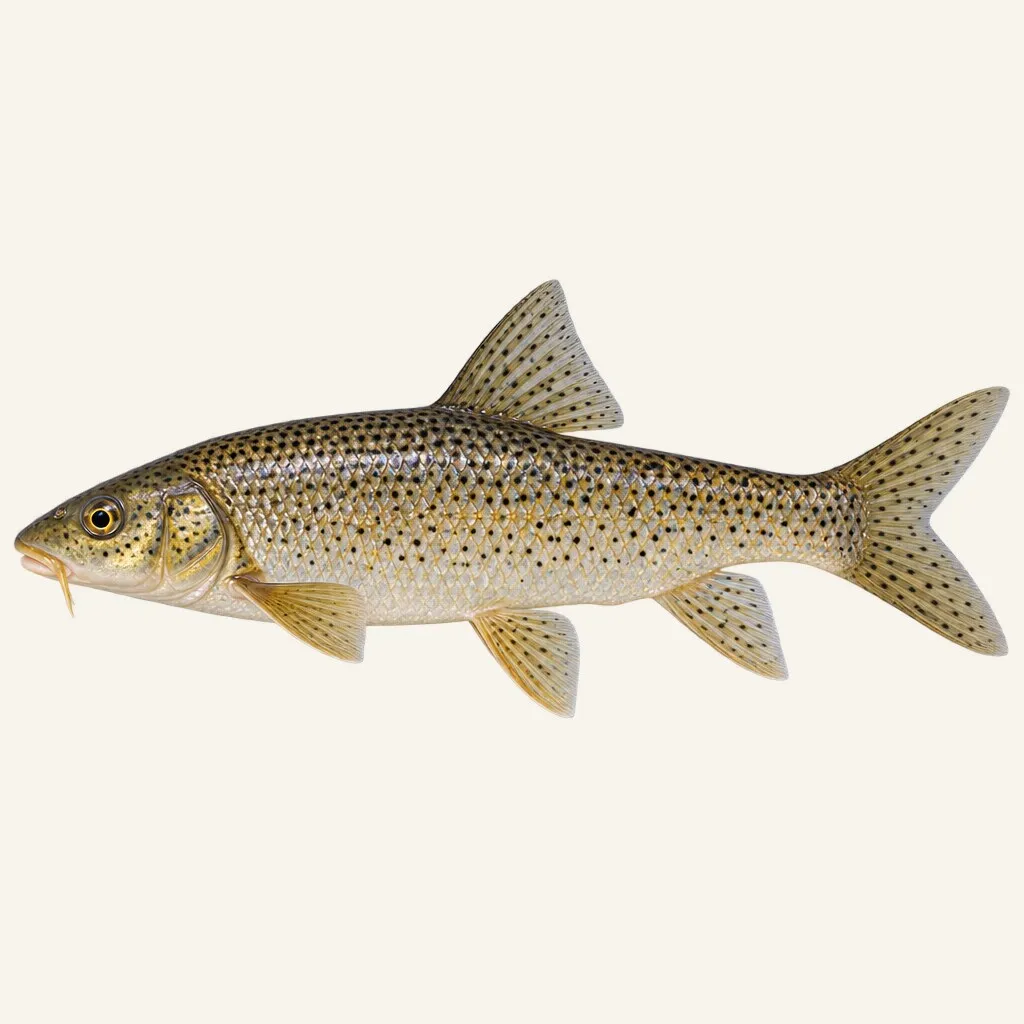
The character that matters most on this fish is one it does not have, and its own diagnosis says so: the last simple ray of the dorsal fin is weak, with no teeth along its rear edge.
Anyone who handles the common barbel of northern Europe will register the difference immediately. In that species the same ray is bony and sawn along its whole length, and it is the reason a barbel is lifted from underneath rather than gripped across the back. Here there is nothing to cut on. The rear margin of the fin runs straight to slightly concave rather than falling away in a deep curve.
Spotting is the second point of separation, and it works in the opposite direction to age. Head, body and fins carry numerous small black dots, larger and darker over the back, and they are diagnostic characters of the adult. The northern species carries fine spots as a juvenile and loses them as it grows, so on one fish the stippling is a stage and on this one it is the species.
Then the pelvic fin. Its simple ray is about as long as the second branched ray behind it — a proportion that reads as unremarkable until it is set against Barbus balcanicus, whose diagnosis records the same ray as clearly the shorter of the two. Two accounts, one measurement, opposite results.
The counts close it: 47 to 55 scales along the lateral line with two or three on the tail base, 10 to 12 rows up to the origin of the dorsal, seven to nine down to the pelvic.
The water it needs
It lives in lakes as readily as in rivers, and that dual capacity is what lets it occupy a landscape broken into so many pieces. In running water it takes the clear stretches and holds the riffles.
The station is the shallow seam between boulders and the open pool below a step in the gradient. The bed is rock rather than sand, the water cold and quick. A fish that can also winter in a lake is a fish that survives the failure of any one of those streams — provided it is in a stream connected to a lake.
Areas
- Rocky torrents
- Shallows between boulders
- Pools below waterfalls
- Fast-current zones
Techniques
- Nymph fishing
- Light bottom fishing
- Toc fishing
- Light float fishing
Baits
- Caddisfly larvae
- Bloodworms
- Maggots
- Small earthworms
- Blackfly larvae
How to catch it
Nothing about this fish requires care at the net beyond ordinary care. The dorsal ray is unarmed, so the handling problem that defines its northern relative simply is not present, and a small cold-water cyprinid asks for nothing more than wet hands and a short time out of the water.
The fishing is upland fishing. Caddis larvae, blackfly larvae, bloodworm, maggots and small worms all sit inside the diet of a riffle-dwelling barbel, drifted or held close to the bed in fast water with the lightest tackle that will hold bottom. Rocky runs between boulders, the pools under falls, the quick seams along a slab: it is water to be walked and covered, not water to be settled into.
The restraint that belongs here is local rather than technical. Each brook in this range holds its own population, and nothing restocks it from anywhere else, because the connections between those brooks are not permanent. What comes out of one stream is not replaced from the next valley.
Conservation · Near Threatened (IUCN) — This species is in decline. Release your catch quickly and handle it with care — wet hands, as little time out of the water as possible.
Conservation
The species is described as widely distributed and locally abundant, and its difficulty is not a shortage of individuals.
It is that the populations are severely fragmented, and that many of the small watercourses across its range go dry in summer. Abundance measured over a whole range says nothing about either problem: the fish can be numerous everywhere it is present and still be sitting in dozens of separate compartments, several of which lose their water every year.
Summer drying acts as a partition rather than as a mortality. It kills the fish caught in the reach that dries, and it also cuts the link between the reaches that survive, so what is isolated cannot be recolonised while the flow regime stays as it is. Recovery after a bad year depends on a route that the bad year has just closed.
The lakes stand outside that mechanism, which sharpens rather than softens the picture. The secure part of the range is the smallest part of it by area, and the most numerous fragments are the vulnerable ones. A distribution of this shape cannot be judged by how much of the map it covers.
Regulations
Check the local regulations in force (legal size limits, closed seasons, bag limits).
For guidance only. Legal sizes, quotas and open seasons vary by location and season: always check the local regulations in force before fishing.
Other names
The epithet honours a person. That is unusual in this group, where the names come from rivers, mountains and regions — the Tiber, the Peloponnese, the Balkans — and where an epithet normally tells a reader roughly where to look.
Because a surname does not translate, all six of the names this catalogue carries say exactly the same thing: Rebel's barbel in English, barbeau de Rebel, barbo de Rebel, Rebels Barbe, barbo di Rebel, barbo-de-Rebel. Six languages, one word, no information.
The English form carries a small extra hazard, which is that rebel is an ordinary English noun. The name looks as though it might be describing something about the animal, and it is not describing anything at all. There is no English angling literature on this fish to correct the impression, and no second common name in circulation to fall back on.
Sources: fishbase.se · api.gbif.org