Sichel
Pelecus cultratus · Cyprinidae
- Freshwater
- Carp & coarse
- Medium
- Size
25–60 cm
- Weight
0.2–2.0 kg
- Lifespan
11 years
- Water temp.
10–20 °C
Where to fish
- Estuary
- Lake
- River
Habitat icons: Flaticon
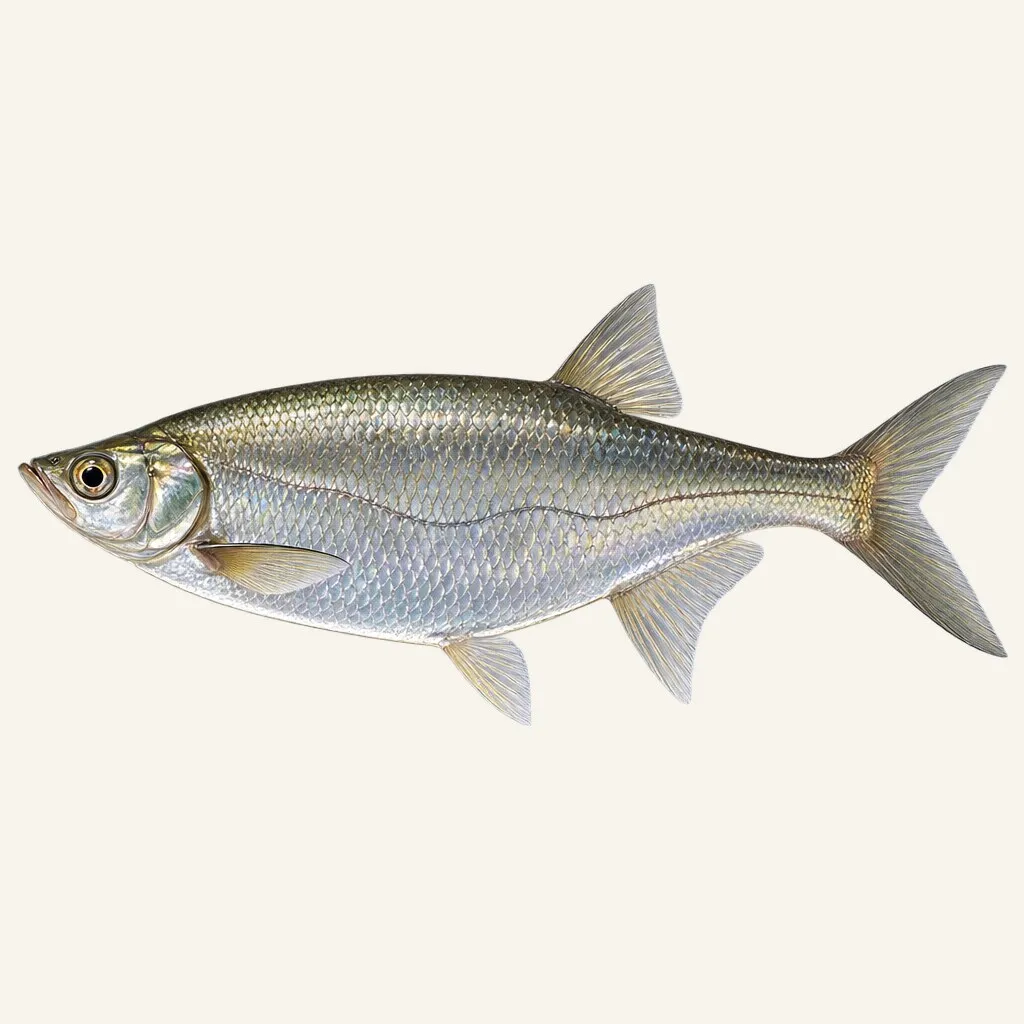
A cyprinid with a sabre-blade body, strongly elongated and laterally compressed, featuring a downward-curved lateral line and an upturned mouth directed toward the surface.
Calendar
Recorded in 3 countries
Finland · Russia · Ukraine
GBIF occurrence records — native and introduced populations combined.
Its range
The Black, Caspian and Aral basins, plus the Baltic from the Vistula east to the Neva, southern Sweden and Finland, and Lakes Ladoga and Onega. Along the Baltic coast west of the Vistula it turns up only occasionally, and on the Finnish coast it reaches past the 61st parallel.
The shape of that range is the shape of the habitat requirement. Large rivers with long lower courses, and enclosed or brackish seas at the end of them: the Caspian, the Aral, the eastern Baltic — bodies of water with low salinity and a great deal of open surface. A fish that spawns adrift in midstream and feeds pelagically has nothing to gain from a short steep coastal river, and it occupies none of them.
Identifying it
Find the lateral line and the identification is over. It does not follow the curve of the flank as it does on every other cyprinid in these rivers. It drops low, close to the belly, and it wanders — a shallow wave running the length of the fish instead of a clean arc. No count is needed and no comparison either; nothing else nearby carries a lateral line drawn like that.
The rest of the animal matches. The back runs almost straight from the nape to the tail while the belly is drawn down into a sharp edge, so the body is asymmetric in profile, deep-bellied and flat-backed, and flattened side to side until it is nearly a blade. The mouth is oblique, tilted hard upward at the front of the head. The pectoral fins are long and set low.
Read together those features describe one animal: a fish that cruises in open water below the surface, looks upward, and turns fast in the horizontal plane. It looks like nothing else in the family it belongs to, and a specimen laid beside any bream, roach or bleak is recognisable from across a room.
Breeding
The eggs are released into open water in midstream and left there. In a family that glues its eggs to weed, roots, stones or gravel almost without exception, this species is an open-water scatterer: nothing is attached, nothing is guarded, and the clutch drifts with the current until it hatches.
That single difference reorganises the risk. There is no substrate to be silted over and no shoreline vegetation to be cleared, so the pressures that end recruitment for the bottom-spawning cyprinids do not apply. What the strategy needs instead is a length of open, flowing river — enough distance for eggs and larvae to develop while they travel — and a way back down to the feeding grounds.
Spawning is in spring, in the middle of the channel, and the adults return to the estuaries to feed the moment it is finished. They do not linger and they do not defend anything.
The water it needs
Open water, in quantity. Adults shoal in the lower reaches of large rivers and in the eastern Baltic, the Caspian and the Aral, in temperatures between 10 and 20 degrees, and they are recorded well down as well as at the top — this is a pelagic fish rather than strictly a surface one, though its mouth says where it does most of its feeding.
The species is anadromous, so the sea and the river are two halves of one life rather than alternatives. Juveniles may already be dropping down to the estuaries in their first summer.
Areas
- Surface of large rivers
- Moderate current zones
- River mouths
- Open water of large lakes
Techniques
- Open-water float fishing
- Waggler fishing
- Dry fly fishing
- Surface pole fishing
Baits
- Maggot
- Bloodworm
- Artificial insect
- Floating bread
- Light paste
What it eats
Zooplankton, terrestrial invertebrates and small fish.
The middle item explains the mouth. Insects that fall onto open water are collected from below by a fish whose jaws are angled up, and a shoal working a wind lane or a fall of flying ants is doing exactly what the anatomy was built for. The two ends of the list — plankton at one end, small fish at the other — mean the same shoal can be feeding on particles one week and hunting fry the next, which is why it will take both a maggot and a small artificial.
How to catch it
Everything happens high in the water and away from the bank. This is open-water fishing with a long line: a small bait fished under a light float in the top layer, floating bread, a maggot or a bloodworm on fine wire, a small artificial insect, a dry fly. A rig weighted to reach the bottom is fishing for a different species.
The shoals move, so the fish is found by watching. Surface disturbance, a boil under falling insects, a shoal of fry breaking up — those are the signals, and they are more use than any swim chosen in advance.
Terminal tackle stays fine. Common length is 25 cm, the mouth is small and soft, and the fish is thin-flanked; recorded ages reach 11 years, so the largest specimens have spent a decade in open water.
The strike is worth thinking about in advance. A fish taking upward at the top of the water is hooked in a jaw that is already rising, and a hard strike into it pulls the hook out of a thin membrane more often than it sets one.
Regulations
Check the local regulations in force (legal size limits, closed seasons, bag limits).
For guidance only. Legal sizes, quotas and open seasons vary by location and season: always check the local regulations in force before fishing.
Other names
English has never settled on a name for this fish because it has never lived in an English river. Sichel and ziege are both used, both borrowed from German, and sabre carp, sabrefish and razorfish all appear in translated texts.
German gives Ziege and Sichling; Russian chekhon, a name in wide use around the Caspian and the Volga where the commercial fishery is.
The scientific name says the same thing twice in two languages. Pelecus is from the Greek for an axe, cultratus from the Latin for a knife blade. Both refer to the keeled, blade-like belly, and between them they are a fair description of the fish in outline.
Sources: fishbase.se · api.gbif.org