Schneider
Alburnoides bipunctatus · Cyprinidae
- Freshwater
- Carp & coarse
- Easy
- Size
9–15 cm
- Weight
0.0–0.0 kg
- Water temp.
10–18 °C
Where to fish
- River
Habitat icons: Flaticon
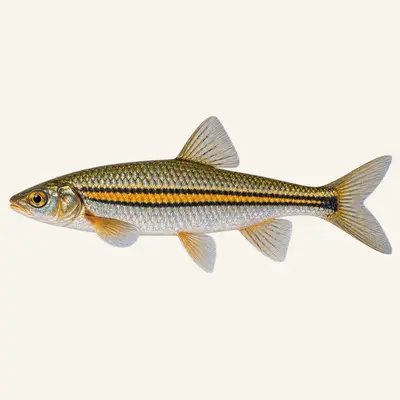
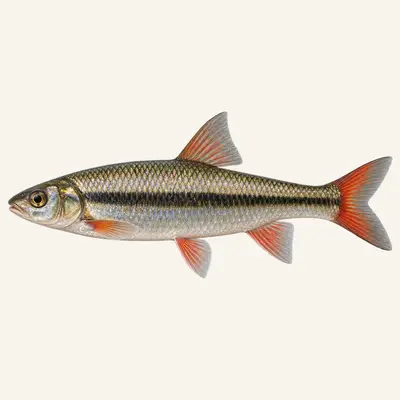
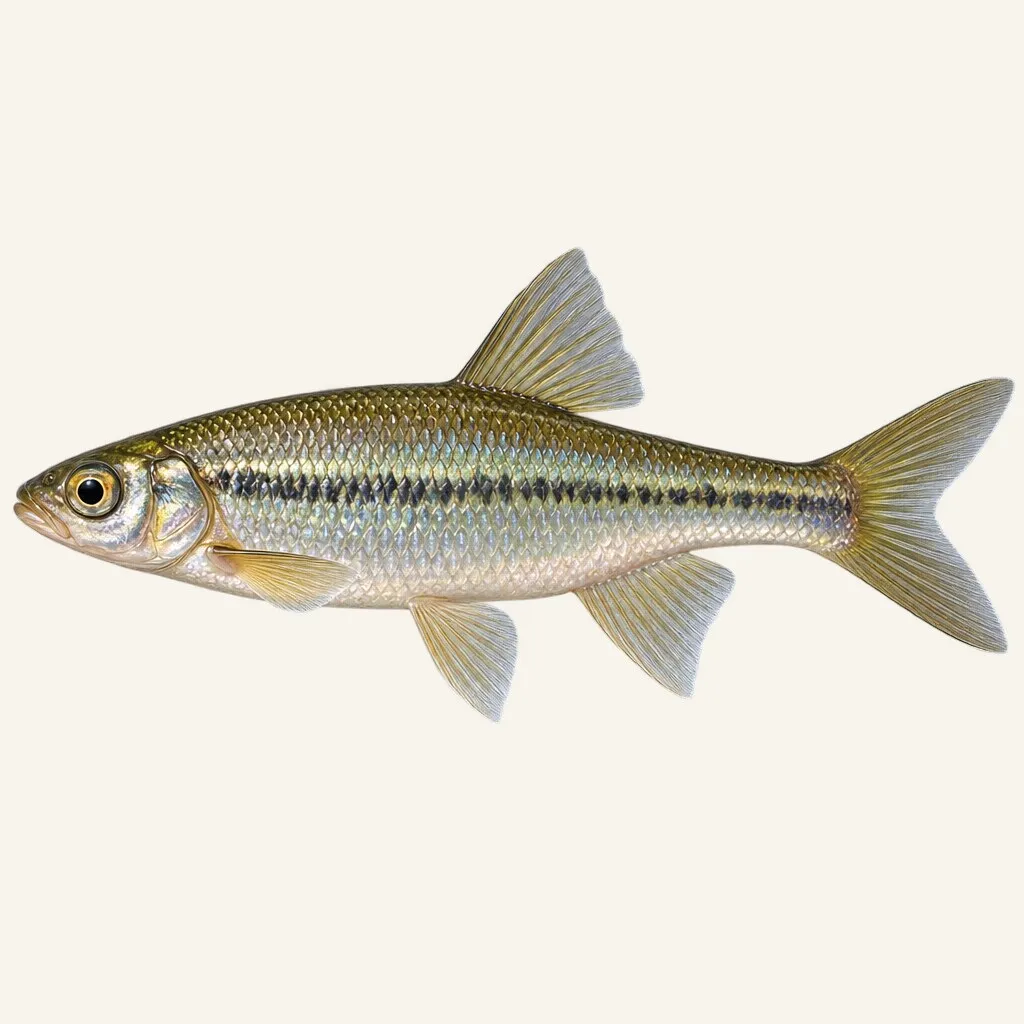
Small spindle-shaped silvery fish - Distinctive dark lateral band
Calendar
Recorded in 9 countries
Austria · Belgium · France · Germany · Luxembourg · Netherlands · Poland · Switzerland · Ukraine
GBIF occurrence records — native and introduced populations combined.
Its range
The range runs from the Loire eastward through nearly every river draining to the southern Baltic, the North Sea, the Black Sea and the Sea of Azov, then into the Caspian basin by the upper Volga and from the Kura southward into the Iranian tributaries, with the species widespread in Iran. In the Marmara basin and western Anatolia it reaches the Great Menderes, and it holds the upper Euphrates and Tigris. Eastward again there are populations in the Aral basin, in the upper Amu Darya and the Karakum drainages.
In the Mediterranean basin the picture contracts sharply. Only the Rhône, a few small coastal drainages from Provence east to Genoa, the Aoos, and western Greece as far south as the Sperchios. A fish tied to cool, fast, well-oxygenated foothill water has very little to work with on a Mediterranean coastline, and the range there is a set of islands rather than a band.
Identifying it
The species name records a pair of dark points, and on a live fish that is what the flank shows: small dark marks set in two lines, one just above the lateral line and one just below it, following the canal from the gill cover back towards the tail. On a hand-sized silver fish in a foothill stream the double row is the thing the eye catches first, and it is where the name came from.
It is worth knowing that the formal diagnosis does not use it. What the published description gives are three proportions and one position: the snout is equal to or shorter than the diameter of the eye, the eye is about as wide as the space between the two orbits, and the mouth is terminal, with 12 to 17 and a half branched rays in the anal fin. Nothing about spots. A pigment character on a small silver fish is a reasonable field mark and a poor determination, and the difference matters wherever this genus is being separated species by species.
The rest of the counts: three dorsal spines with seven or eight soft rays behind them, three anal spines with 13 to 18, 19 rays in the tail, and 38 to 40 vertebrae.
The scale of the animal governs everything else on this page. Common length is 9 cm — an adult fish that sits along one finger.
Breeding
Spawning happens in small groups, and the eggs go deep into gravel under a strong current. Not onto it, into it.
That is the central fact of the species. Eggs buried in the interstices of a gravel bed are out of reach of predators and washed continuously by oxygenated water — as long as the bed stays permeable. Fine sediment settling into those spaces suffocates a clutch without anything showing on the surface: the riffle looks identical, the water looks clean, and the year produces nothing. It is the same failure mode as a salmonid redd, in a fish nobody surveys.
The water it needs
Foothill streams and small rivers, with fast, well-oxygenated water. It also occurs in rivers running very slowly, so the optimum and the tolerance are some way apart, but the type locality of the imagination should be a brisk stony stream at the base of high ground.
One line in the biology separates it from almost everything else in the family: all age classes hold the open water of those streams. There is no division by size. Most cyprinids put their young in the margins and their adults out in the flow; here the shoal is mixed, fry to adult, in the same water at the same time.
That has a consequence for how a stream is read. The absence of a shallow nursery zone means the species does not need a structural margin to rear in, but it also means every stage of the life cycle is exposed to whatever hunts in the open channel.
Areas
- Swift currents
- oxygen-rich zones
- clear rivers
Techniques
- Ultra-light line
- Float fishing
Baits
- Maggots
- Micro-baits
What it eats
Insect larvae and dead insects, with crustaceans and diatoms behind them.
The dead insects are an unusual entry and a precise one. This is a fish feeding on drift — on what the current delivers, alive or not — rather than one hunting prey or sorting a substrate. It holds in the flow and takes what comes past, which is the same living a small trout makes in the same water.
How to catch it
This is bait and by-catch rather than a target, and the databases say so plainly — of no interest to fisheries, usually used as bait. Where it is fished for deliberately it takes tiny hooks, the finest line, and baits scaled to a mouth that is small even for a 9 cm fish.
Because the shoal mixes every age class, a first fish predicts nothing about the size of the next one. What it does confirm is the water: open flow, in a small stream at the foot of hills.
There is a diagnostic use for the catch as well. A fish that buries its eggs in gravel disappears when the gravel seals, so a stretch that used to produce these and no longer does has told you something about its bed before any survey has been commissioned.
Conservation
Three pressures are recorded, and one of them is not what an angler expects: stream regulation, pollution, and trout stocking.
The trout entry is worth taking seriously rather than reading as a curiosity. Stocked trout are put into precisely this water — brisk, oxygenated, foothill streams — and they make their living the same way, holding station and taking the drift. The stocked fish is larger, and every age class of this species is out in the open channel where it can be seen. Competition for the same food and exposure to a larger drift-feeder arrive together, in the reach where the whole population lives.
Stream regulation acts on the spawning. Smoothing a flow regime and silting a bed remove both the current that flushes the gravel and the permeability that lets water into it, and the eggs are inside that gravel. Recruitment stops well before the adult shoal looks any different.
Pollution compounds both, in a fish whose entire life is spent in the water column of small streams with no refuge to retreat into.
Regulations
Check the local regulations in force (legal size limits, closed seasons, bag limits).
For guidance only. Legal sizes, quotas and open seasons vary by location and season: always check the local regulations in force before fishing.
Other names
English uses two borrowed names and has none of its own. Schneider is the German word, meaning tailor, and spirlin comes through French; both appear in English keys and neither has any currency on a riverbank, because the fish has never lived in Britain.
The species name means two-spotted, after the pigment rows described above, and Alburnoides means bleak-like, from Alburnus. The whole name therefore reads as "the two-spotted thing that resembles a bleak", which is an accurate description and an admission that the fish was defined by comparison from the start.
Sources: fishbase.se · api.gbif.org