Silver barb
Barbonymus gonionotus · Cyprinidae
- Freshwater
- Carp & coarse
- Medium
- Size
43 cm
- Water temp.
22–28 °C
Where to fish
- Canal
- Lake
- River
Habitat icons: Flaticon
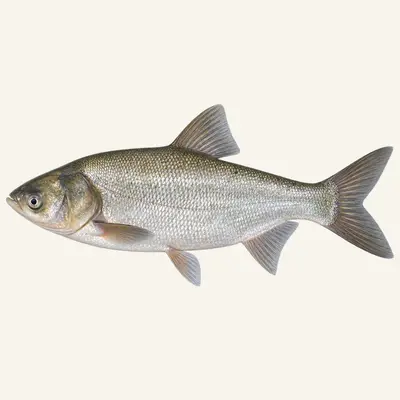
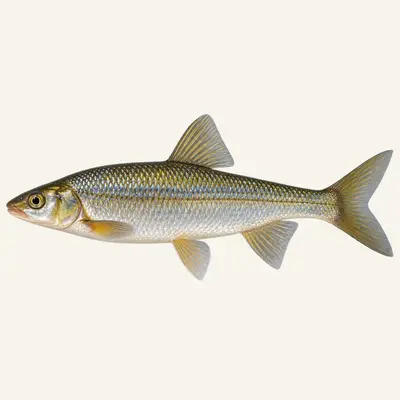
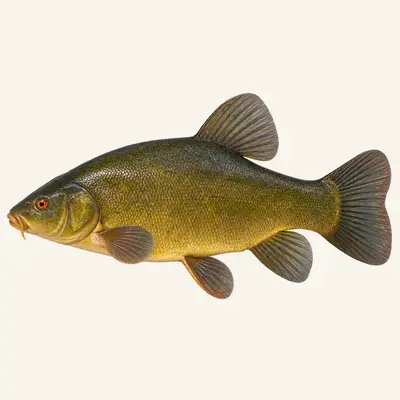
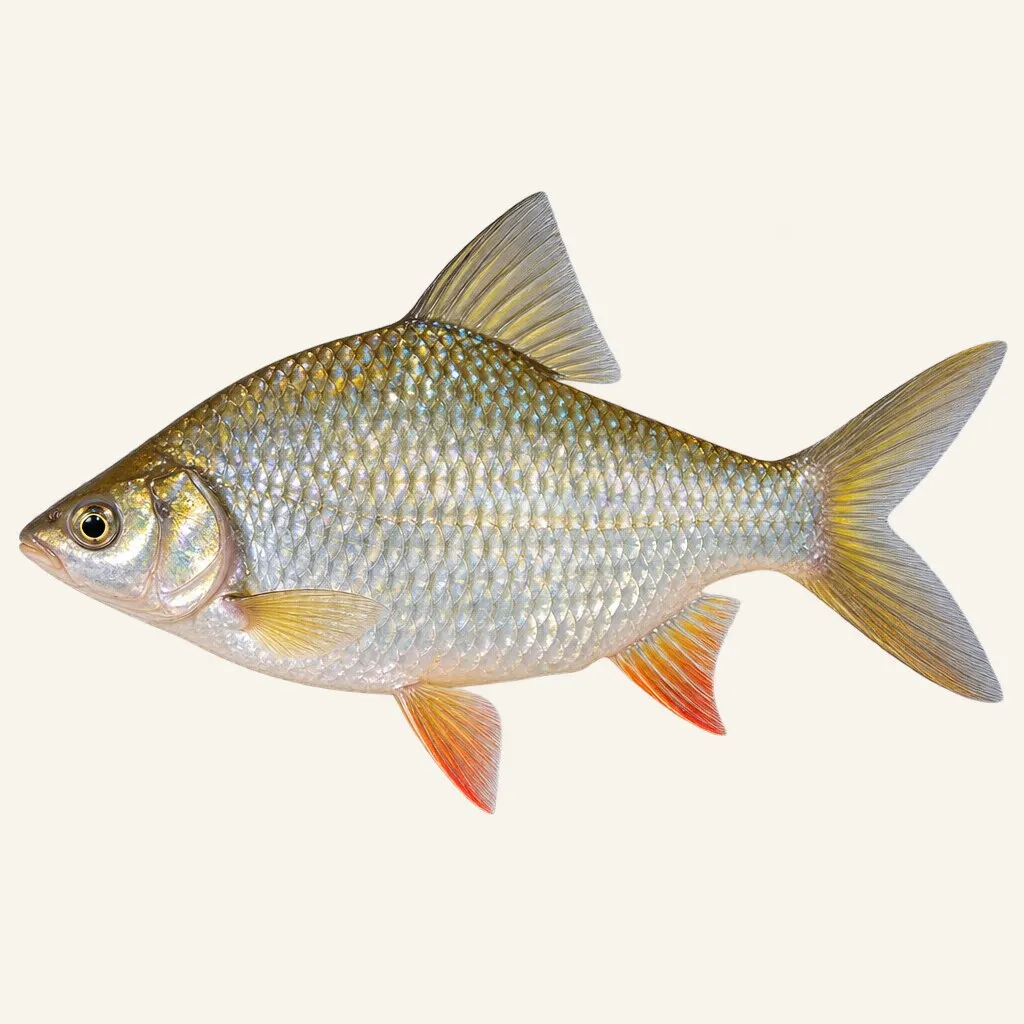
The Java barb is a medium-sized cyprinid with silvery flanks, a high dorsal fin and subtle golden reflections.
Calendar
Recorded in 9 countries
Cambodia · India · Indonesia · Laos · Malaysia · Singapore · Taiwan · Thailand · Vietnam
GBIF occurrence records — native and introduced populations combined.
Its range
Four blocks make up the native range — the Mekong and Chao Phraya basins, the Malay Peninsula, Sumatra and Java. What they have in common is not geography but hydrology: all of them are lowland systems with a violent annual swing in water level, which is the regime this fish is built around.
Within the Mekong the occupation is complete. The species is present along the entire accessible length of the river, from the delta at the edge of the saline intrusion zone up to Chiang Khong in northern Thailand. Few fishes hold a river of that size from one end to the other.
The range is no longer confined to those four blocks, and the reason is a gland. This fish is a standard pituitary donor for induced spawning in regional aquaculture, so hatcheries across Southeast Asia keep it in numbers whether or not they intend to sell it — it is farmed in part for an organ used to breed other species. Fish escaping from those installations have established themselves in rivers well outside the native range, and on several Southeast Asian islands those escaped populations now carry capture fisheries of their own.
Identifying it
The outline is what carries at distance, and it is broken rather than curved. The back rises steeply into an arch, but just above the nape the profile dips — often visibly concave there — so the line of the fish comes to an angle instead of a smooth dome. Seen from the side the body reads as a lozenge, tall and strongly flattened, with a small head and a pointed snout at the narrow end of it.
The mouth is terminal, set at the tip of the snout rather than beneath it, which is the first thing telling this fish apart from the bottom-oriented cyprinids it shares its water with.
The fins have real spines, and that is worth knowing for anyone whose reference points are European. There are four spines ahead of the eight soft rays of the dorsal and three ahead of the six or seven branched rays of the anal — a genuine spined dorsal, not the single hardened ray of a barbel or a carp.
The barbels, on a fish whose name in every language refers to them, are all but gone. What remains is minute or reduced to stumps, and the upper pair sometimes disappears altogether. The snout tubercles are equally faint: very few of them, and none visible without a lens.
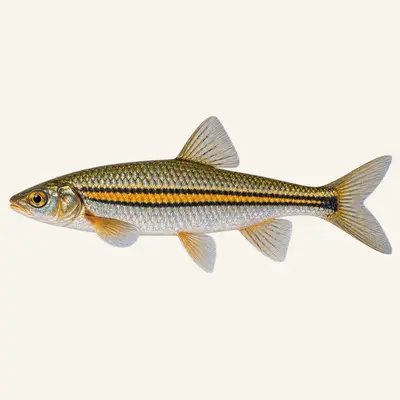
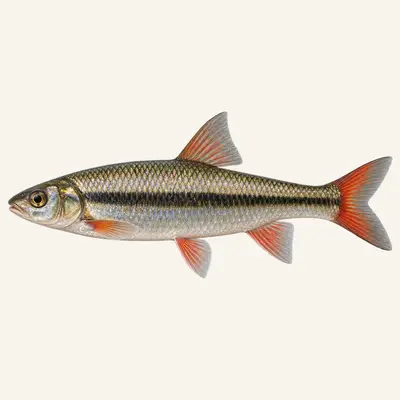
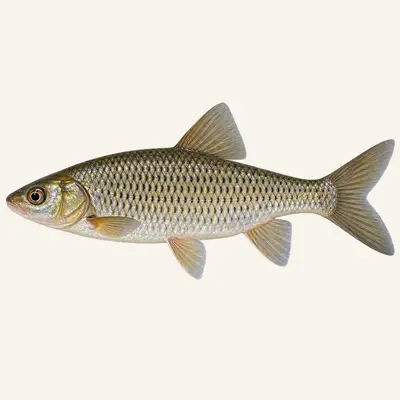
Fresh colour is silvery white, sometimes with a gold cast, and unmarked — no spot, no band, no marbling anywhere on the body. All the colour is in the fins. The dorsal and caudal are grey to grey-yellow; the anal and pelvics are pale orange with reddish tips; the pectorals run from colourless to a light yellow. That combination of a blank silver flank with orange-tipped lower fins is the identification.
The water it needs
It occupies mid-water and the bed of rivers, streams and floodplains, and occasionally reservoirs, in water of 22 to 28 degrees. One recorded preference contradicts the expectation for a fish of a great river: it appears to favour standing water over flowing.
Its year is governed by water level and not by season. The first rains and the rise they bring set the movement off: the fish leaves the main river, turns up a tributary, a canal or a stream, and works its way out onto the inundated ground. It spends the high-water months in the flooded forest. When the level falls it retraces the route and returns to the channel.
The distance involved is small. The species is classed as a local migrant rather than a long-distance one, and what it crosses is the width of the floodplain, not the length of the river. The movement is lateral. It leads from permanent water into water that will not exist in six months, and it exists because that temporary water is where the food is: a drowned forest offers a herbivore a standing crop that no river channel contains, and the flood is what puts it within reach.
Areas
- Vegetated river margins
- Floodplains and rice paddies
- Irrigation canals
- Shallow lakes
Techniques
- Edge match fishing
- Light pole fishing
- Bolognese fishing
- Light feeder fishing
Baits
- Glutinous rice paste
- Aquatic plant pieces
- White bread
- Rice grains
- Bran dough balls
What it eats
The diet is vegetation: leaves, weed, water spinach, Hydrilla. Invertebrates go down alongside it, but the bulk of what this fish converts into flesh is plant tissue.
That has been put to work. The species is stocked into reservoirs specifically to crop excessive vegetation, and in more than one place that service has counted for more in the decision to introduce it than anything about its flesh. A herbivore that reaches a useful size and takes soft plant material indiscriminately is a management instrument before it is a fish.
How to catch it
The calendar that governs this fishing is the water level. At high water the fish are in the canals, the streams and the inundated ground; at low water they are back in the main river. Fishing the right place at the wrong stage of the flood means fishing a compartment the species has left.
Inside the flooded ground its taste for still water narrows things usefully: the dead ends of the inundation, the pockets sheltered from any current, the interior of the drowned forest rather than the channels running through it.
Baits follow the diet, which makes this one of the very few sport fishes taken on vegetables as a matter of course. Tender leaves, aquatic shoots, rice and bran pastes are its ordinary food rather than a substitute for it, and animal baits are the marginal option here instead of the default. Maturity begins from around 16 centimetres, so nearly every fish of a size worth catching is an adult.
One recorded capture sets the ceiling of the possible. A fish taken from Dan Tchang reservoir in Thailand in July 2003 was longer than the published maximum for the species, and the location is not incidental: standing water with weed in it feeds a herbivore far better than a river channel does.
What happens to the catch is decided by anatomy. The flesh is threaded with a mass of fine bones, which is why it goes into lap pa, where the fish is chopped fine enough for the bones to be broken up with everything else, or onto a grill, or into som pa. Most of it is sold fresh.
Conservation
The threat to this fish is not a wall across the river. It is a wall along the river.
Its growth depends on a food supply that exists for a few months a year, on ground that is dry the rest of the time. Embankment, conversion of the floodplain to farmland, or regulation that suppresses the annual overflow cuts no migration route at all — the channel stays continuous, the adults keep moving up and down it — and yet it removes the pasture completely. The loss happens sideways, in the part of a river system least often examined for its effect on fish.
Outside the native range the situation is of a different order. The populations founded by escapes from fish farms are long established and now support commercial capture fisheries on several islands. Any decision about them has stopped being a question about an introduced species and become a question about the people whose income depends on it.
Regulations
Check the local regulations in force (legal size limits, closed seasons, bag limits).
For guidance only. Legal sizes, quotas and open seasons vary by location and season: always check the local regulations in force before fishing.
Other names
Silver barb is the English name in the trade and the one this catalogue uses; Java barb is the other. Both are unhelpful in their own way. The colour name is applied loosely to several unrelated Asian cyprinids, and the island name points at the smallest part of the story — Java is one of four sectors of the range, and the great bulk of the species lives in the Mekong and the Chao Phraya, two thousand kilometres away.
The names that carry real information are in the languages of the basin, and they attach to preparations rather than to specimens: lap pa, som pa. The fish is identified by the dish.
Gonionotus means angled back, after that broken dorsal profile — the scientific name and the silhouette say the same thing. One gap in the record is worth flagging while reading about this species: its reproduction has not been described directly, and what is published for it is assumed from Barbonymus schwanenfeldii, the tinfoil barb of the aquarium trade. For a fish farmed by the million across Southeast Asia, that is a striking absence.
Sources: fishbase.se · api.gbif.org