Rohu
Labeo rohita · Cyprinidae
- Freshwater
- Carp & coarse
- Medium
- Size
200 cm
- Weight
45 kg
- Lifespan
10 years
Where to fish
- Canal
- Lake
- River
Habitat icons: Flaticon
Spawns in flooded rivers. Fecundity ranges from 226,000 to 2,794,000 eggs depending on the length and weight of the fish and the weight of the ovary
Calendar
Recorded in 8 countries
Bangladesh · China · Hong Kong SAR China · India · Myanmar (Burma) · Sri Lanka · Thailand · Vietnam
GBIF occurrence records — native and introduced populations combined.
Its range
The recorded latitude band runs down to 21 degrees south. No river in South Asia reaches the southern hemisphere, so every part of that band below the equator is something a person put there.
The reason for the transfers is uniform: the species has been introduced widely to stock reservoirs and to be farmed. The resulting map therefore follows hatchery programmes rather than any biogeographic route, and it is discontinuous in a characteristic way — a scatter of impoundments and farm districts rather than a spread along connected basins.
Identifying it
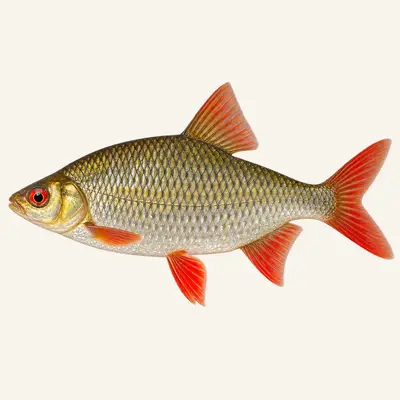
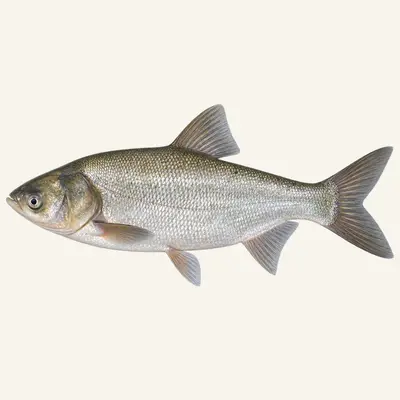
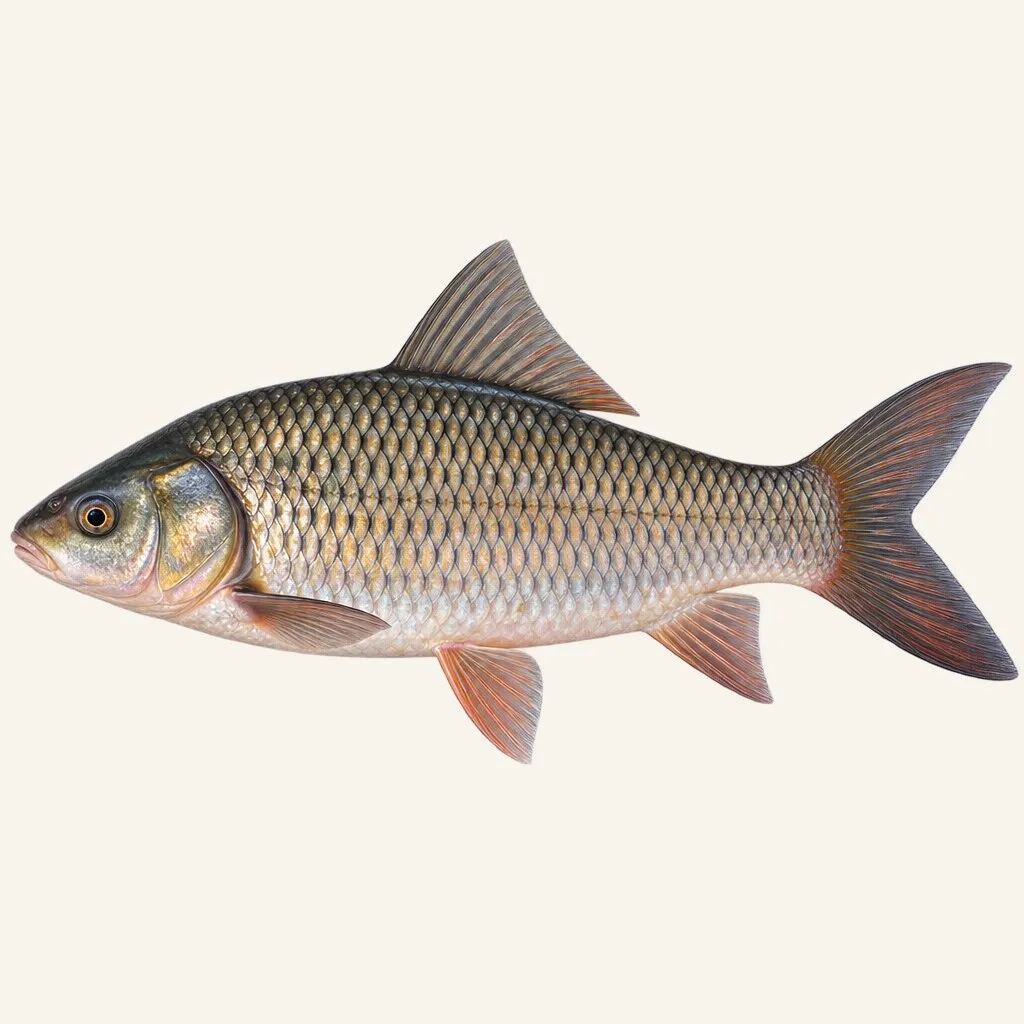
The underside of the head is conspicuously arched. Seen from the side, the line running from the snout back to the throat curves in a way no other part of the fish does, and that is the character the keys open with.
The dorsal fin is measured against the head rather than in absolute terms: it is short, and its front branched rays are shorter than the head itself. It carries 12 to 14 and a half branched rays, with 12 to 16 scales along the midline of the back in front of it.
The published description records no lateral lobe on the snout — an absence a key would not bother to state unless the ornament existed on something nearby. The body is fusiform and its cross-section oval.
Breeding
The spawning site is described with a precision almost nothing else in the record matches, and every clause of it is a condition.
Rohu spawn in the middle reaches of rivers, where flood water has spread out into shallows that are more or less clear, lying over fertile flats, and well above any reach the tide can touch. Not the estuary, not the headwater gorge, and not the channel itself — the fish requires the river to have left its banks and settled over ground that is dry for most of the year.
The trigger is a season rather than a date. Spawning generally coincides with the south-west monsoon and follows the flood; a river that does not rise does not produce a year class, however many adults it holds.
Fecundity runs from 226,000 eggs to nearly 2,794,000, and the record ties the spread directly to the length of the fish, its weight, and the weight of its ovary. A factor of twelve separates the two ends of that range. What a female contributes is therefore almost entirely a question of how big she is, which puts the whole of a season's output on the largest fish present.
Against that sits the calendar. Maturity arrives at 58 centimetres and the maximum reported age is ten years, so a rohu has only a handful of spawning seasons in it, and each of them is conditional on a flood arriving at the right time.
Reservoirs and bundh-type tanks are also recorded as spawning sites — engineered answers to a river that no longer floods, rather than evidence that the requirement has relaxed.
The water it needs
Adults are river fish, and two of their recorded habits are unexpected in an animal that spends most of its economic life in a pond.
The first is that they are diurnal. The second is that they are usually solitary. A fish stocked by the thousand into culture ponds, where it takes the middle of the water column, behaves in a river as a single animal that feeds by day — which is not the picture the aquaculture literature leaves.
They burrow occasionally, which is an odd thing for a cyprinid of this size to do and is recorded without further comment. The species is benthopelagic, working close to the bed without lying on it, with a depth range beginning at five metres. It is potamodromous and tolerant of brackish water, so it can drop a long way down a delta — while the spawning requirement pulls in exactly the opposite direction, to a reach the tide never reaches.
Areas
- Large moderately flowing rivers
- Lowland reservoirs
- Silty bottom areas
- Irrigation canals
Techniques
- Bottom feeder fishing
- Bolognese fishing
- Pole fishing
- Match fishing
Baits
- Wheat bran dough balls
- Groundnut cake
- Cooked rice
- Cornmeal paste
- Mustard seeds
What it eats
The recorded diet is one word: plants.
For a cyprinid that reaches the size this one does, that is thin fuel, and it implies an intake by volume that a predator never has to manage. It is also the whole of the species' economic case. An animal that converts vegetation costs almost nothing to feed, and in a stocked pond it works a layer that the surface feeder above it and the bottom grazer below it both leave alone.
How to catch it
Rohu is a recognised sport fish as well as a heavily commercial one, and three of its recorded traits shape how it is fished.
It eats plants, which removes worm, maggot and every imitation of prey from consideration at the outset. Dough balls of wheat bran, groundnut cake, cooked rice, cornmeal paste and mustard seed are what the diet actually describes, and they work by smell and texture rather than by movement.
It is active by day, which is a rare convenience in a bottom-oriented fish of this size — there is no night session to plan around.
It is usually alone, and that is the expensive one. A swim that gives a rohu does not go on giving them; there is no shoal to hold on the bait, and a day is assembled one fish at a time.
The monsoon moves the target off the map entirely. While the river is up, the adults are out over flooded flats in the middle reaches, in shallow water that does not exist for the rest of the year. And 58 centimetres is the figure to carry to the net: below it, a fish has not yet bred.
Conservation
What presses on this species is the flow regime, not the rod.
Its spawning depends on a flood spreading over ground outside the channel. A river whose peaks have been flattened by regulation, and whose flats have been cut off by embankments, keeps every adult it had and quietly stops producing young. Nothing visible marks the change: the fish are still there, still caught, still sold.
The life history removes the margin for error. Ten years, first spawning at 58 centimetres, one conditional attempt a year. A run of dry seasons cannot be made up later, because the missing year classes were never born, and there is no store of older fish deep enough to cover the gap.
The hatchery and the bundh tank keep production going, and they should not be read as a repair. They substitute for the flood; they do not restore it, and they leave wild populations dependent on rivers that no longer do the one thing the species needs from them.
Regulations
Check the local regulations in force (legal size limits, closed seasons, bag limits).
For guidance only. Legal sizes, quotas and open seasons vary by location and season: always check the local regulations in force before fishing.
Other names
Rohu is written the same way in all six languages this catalogue carries. Not one of those markets coined a name of its own — the Indian word travelled with the fish into every basin it was stocked into, and it arrived before any European name could form.
The scientific epithet is the same word again. Labeo rohita is a Latin genus attached to a vernacular that was already in use, so the binomial, the English name and the five other common names are one South Asian word repeated in different scripts. Rui in Bengali and rohu or rohi in Hindi are the forms behind it.
That is a strong indication of how old the fish's place in these fisheries is. Names imposed from outside describe colour, shape or a river. Names that survive translation unchanged are the ones the people who ate the fish were already using.
Sources: fishbase.se · api.gbif.org