Baikal black grayling
Thymallus baicalensis · Salmonidae
- Freshwater
- Salmonids
- Hard
- Size
38 cm
- Weight
1.2 kg
Where to fish
- Lake
- River
Habitat icons: Flaticon
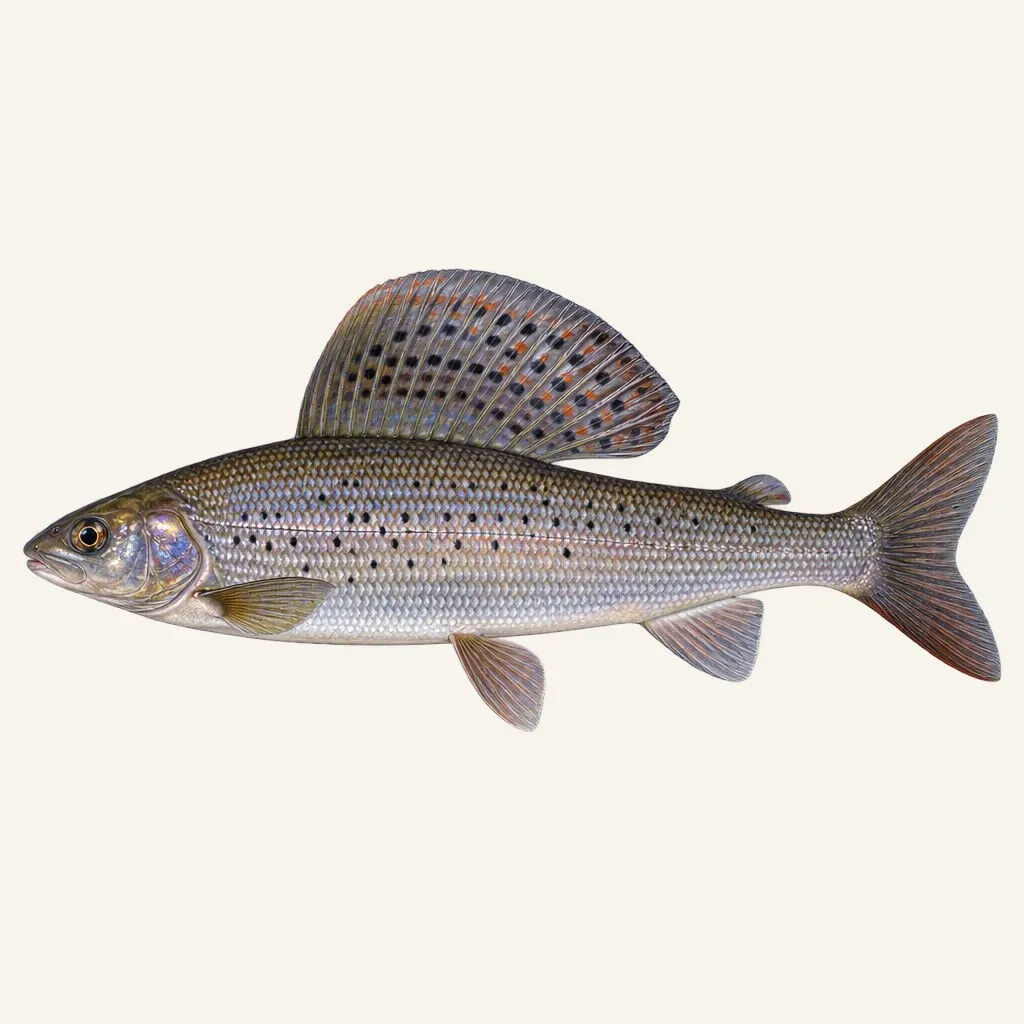
The Baikal black grayling is a salmonid endemic to the Lake Baikal basin in Siberia, characterized by its overall dark coloration, almost black on the back, contrasting with silvery flanks with metallic reflections. Its large, slightly spotted dorsal fin is typical of the Thymallus genus.
Calendar
Recorded in 2 countries
Poland · Russia
GBIF occurrence records — native and introduced populations combined.
Its range
The species holds the Nizhnyaya Angara, the whole of Lake Baikal, the Selenga and the lake's other tributaries.
One lake and its feeder network — an area small enough to fit on a regional map, which is unusual for a grayling.
The water it needs
It stays mainly in shallow water over stony bottom. That is a margin position, where coarse substrate and light meet, and where the insect larvae it lives on are concentrated.
Areas
- Baikal tributary rivers
- Stony riffles
- Clear current flats
- Confluence zones
Techniques
- Dry fly fishing
- Euro nymphing
- Toc fishing
- Small spoon
Baits
- Local dry flies
- Nymphs
- Insect larvae
- Bloodworms
- Small spoons
What it eats
The diet is recorded with unusual precision: caddis and stonefly larvae, amphipods, and the eggs of sculpin and lenok.
That last item deserves attention. A grayling that regularly takes the eggs of two other fish in its own lake occupies a role the genus does not fill elsewhere, and it ties the species directly to its neighbours' spawning calendar.
How to catch it
Two facts frame the search: the fish holds shallow stony ground, and it eats aquatic larvae, amphipods and eggs.
The consequence is direct. Caddis and stonefly imitations work close to the stony bottom, and the spawning periods of sculpin and lenok concentrate grayling wherever those eggs are drifting.
The fish itself is small; what makes the session is the ground and the calendar, not the gear.
Regulations
Check the local regulations in force (legal size limits, closed seasons, bag limits).
For guidance only. Legal sizes, quotas and open seasons vary by location and season: always check the local regulations in force before fishing.
Other names
Baikal grayling in English, and in Russian one of several khariuz of the lake — Baikal carries both a black and a white grayling in local usage, a distinction the scientific names have not settled comfortably.
Sources: fishbase.se · api.gbif.org