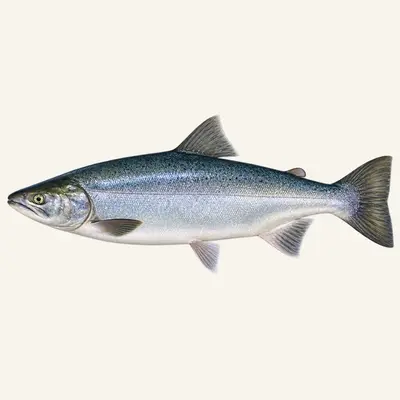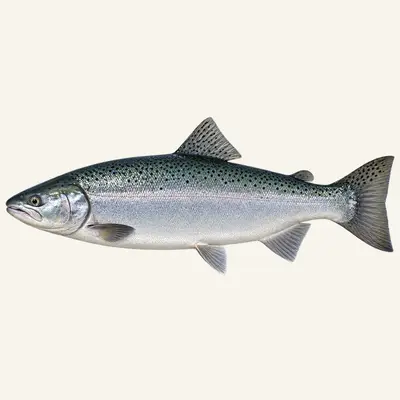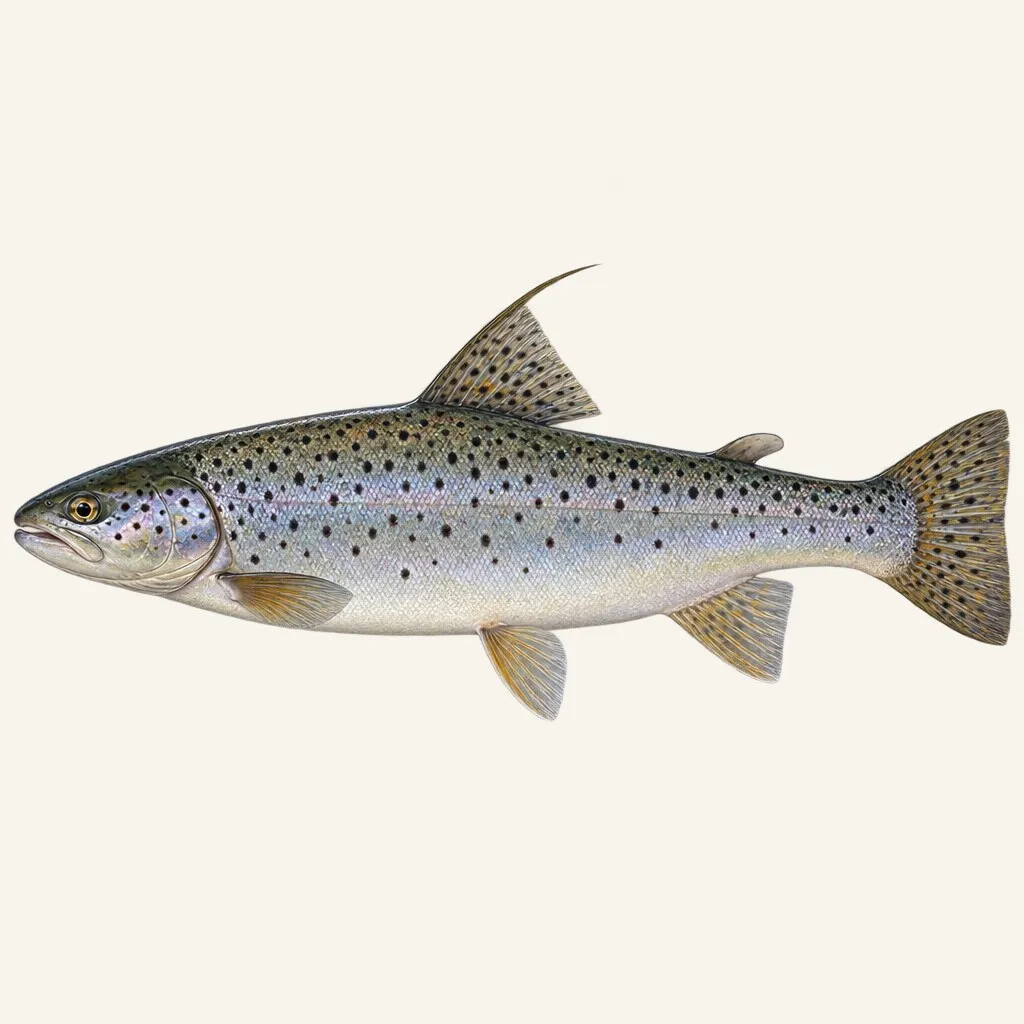
Black Sea trout
Salmo labrax · Salmonidae
- Saltwater
- Salmonids
- Hard
- Size
80 cm
Where to fish
- Estuary
Habitat icons: Flaticon
The Black Sea trout is an anadromous salmonid of the Pontic coast, with a silver body dotted with black spots, which ascends rivers of Turkey, Bulgaria and Georgia to spawn.
Calendar
Recorded in 12 countries
Bosnia & Herzegovina · Bulgaria · Croatia · Georgia · Montenegro · Romania · Russia · Slovakia · Slovenia · Switzerland · Türkiye · Ukraine
GBIF occurrence records — native and introduced populations combined.
Its range
The range follows the rivers that empty into the Black Sea. This is a trout of one coastline rather than of a drainage system, and the outline to picture is the Pontic littoral, not a river network.
One population breaks the rule, and it is the informative one. The Lipkovska stream, in the upper Vardar in North Macedonia, holds the species — and the Vardar runs to the Aegean, not to the Black Sea. A trout sitting on the wrong side of a watershed cannot be explained by anything it did itself. It records a drainage arrangement older than the one on the map.
Identifying it
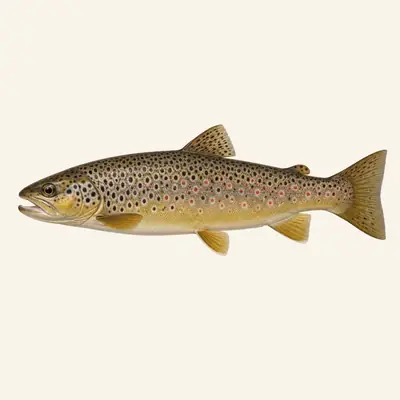
The tail names it. Its caudal fin is only slightly emarginate, close to straight across, where the other trout of the Pontic drainages carry a plainly forked one. That is the single unique character used to separate it from its congeners on this coast.
The eggs supply a second, usable only on a ripe female: yellow to orange, and about five millimetres across, which is large.
Counting cuts finer than either. This fish has 16 to 18 gill rakers, usually 18, against 13 to 18 in Salmo trutta with a usual value of 16. The ranges overlap almost completely, so what differs is the mode, not the limits. The character reads well across a series of fish from one river and means very little on a single specimen in the hand.
Breeding
Spawning falls between October and January, high in the catchment where the current runs fastest. It happens in fresh water without exception, whichever of the three life histories the parent fish came from.
The freshwater half of the cycle is long. Parr hold in the river for two to four years before smolting. Those that go down then spend two to four years in salt water; the others ripen where they are and never see it at all.
That fork is taken individually, inside a single brood. A river is therefore producing both strategies at all times, and the ratio between them reflects what each one currently pays in that particular catchment rather than any inherited allegiance.
The water it needs
Three forms share the species: anadromous, lacustrine and resident. At sea it works along the coast down to about 50 m. The resident fraction takes the brooks and the uppermost reaches, in fast current over stone or gravel, in cold clear water.
That plurality is commonplace among trout and has an uncommon consequence here. Where a structure has cut the road to the sea, the population persists through its stationary part. It survives the amputation of its most productive form, which makes its condition very hard to judge: the fish visible in the river say nothing at all about the fate of the migrants.
Areas
- Black Sea estuaries
- Coastal rivers
- River mouths
Techniques
- Fly fishing (streamer)
- Light lure fishing
- Toc fishing in rivers
Baits
- Streamer
- Spinner
- Small dead fish
What it eats
The diet reads at two ages. Parr and resident adults live on aquatic and terrestrial invertebrates. Sea-run fish and the large lake individuals feed mainly on fish and on large crustaceans.
The point worth keeping is that the migrants do not fast once they are back in fresh water. That is exceptional in this group, and it changes how a fish on its upstream run reacts to whatever passes in front of it.
How to catch it
One difference from the Atlantic salmon governs the whole approach: anadromous individuals go on feeding during their stay in the river. Appetite is therefore still a lever, and a bait or a lure is working on hunger rather than on reflex alone.
Lure size is chosen by which fraction is being targeted, not by which reach is being fished. Parr and resident adults are looking for invertebrates; sea-run fish and large lake fish are hunting prey fish and sizeable crustaceans. The two categories frequently share the same pool, and a nymph and a streamer will not take the same fish out of it.
Access to the gravel then decides where the fish are. Since dams stop the majority of ascending adults, they pile up below the structures, which is also where the pressure on them is heaviest. Conditions of fishing vary a great deal from one riparian state to the next and are held by the relevant national administration.
Conservation
Damming is the pressure named first, and it works without killing anything: it prevents most ascending adults from reaching their spawning sites. A population loses its anadromous fraction that way — the part that grows at sea and comes back with the weight — while keeping every appearance of health through its residents.
The mechanism is harder to correct than a local one because the species is spread along an entire coastline divided between several states, each managing its own short coastal rivers. There is no single basin on which to concentrate the effort, and no authority whose decisions would cover the species.
Regulations
Check the local regulations in force (legal size limits, closed seasons, bag limits).
For guidance only. Legal sizes, quotas and open seasons vary by location and season: always check the local regulations in force before fishing.
Other names
Black Sea trout is the name in English, and Schwarzmeerforelle in German says the same. Like most of the regional names, it points at the sea rather than at the fish, which suits a species defined by one coastline. It was long handled as a subspecies of the brown trout, and whether the separation holds depends on which author is being read.
The epithet sets a trap that is worth knowing about. Labrax is Greek for a voracious fish, and nomenclature has used it twice: Dicentrarchus labrax is the European sea bass, no relation to any salmonid, and a search on the bare species word returns both.
Sources: fishbase.se · api.gbif.org