Chinook salmon
Oncorhynchus tshawytscha · Salmonidae
- Saltwater
- Salmonids
- Medium
- Size
70–150 cm
- Weight
4.3–61 kg
- Lifespan
9 years
- Water temp.
0–25 °C
- Depth
0–375 m
Where to fish
- Estuary
Habitat icons: Flaticon
Ranges to the Coppermine River in the Arctic. Several countries report adverse ecological impacts following its introduction
Calendar
Recorded in 5 countries
Australia · Canada · Chile · New Zealand · United States
GBIF occurrence records — native and introduced populations combined.
Its range
What makes this species hard to summarise from one river to the next is the freshwater phase of the young. Some go down after three months, some stay three years, most spend a year in the stream. A single river can therefore hold several juvenile year classes at once and receive several adult waves spread through the year.
Marine life divides in the same way. Part of the population never leaves the coastal band; part makes long oceanic movements and uses the water column down to 375 m. Lake populations exist as well.
The native range is lopsided. It covers most of the north Pacific, reaches the Coppermine in the Canadian Arctic, and runs down the American side to the San Joaquin and Kings rivers in California; on the Asian side it takes in Honshu, the Sea of Japan, the Bering Sea and the Sea of Okhotsk.
Beyond that, several countries report adverse ecological effects following introduction, and the species carries a potential-pest flag where it has been planted. Self-sustaining populations now run in the southern hemisphere, in systems that held nothing comparable before it arrived.
Identifying it
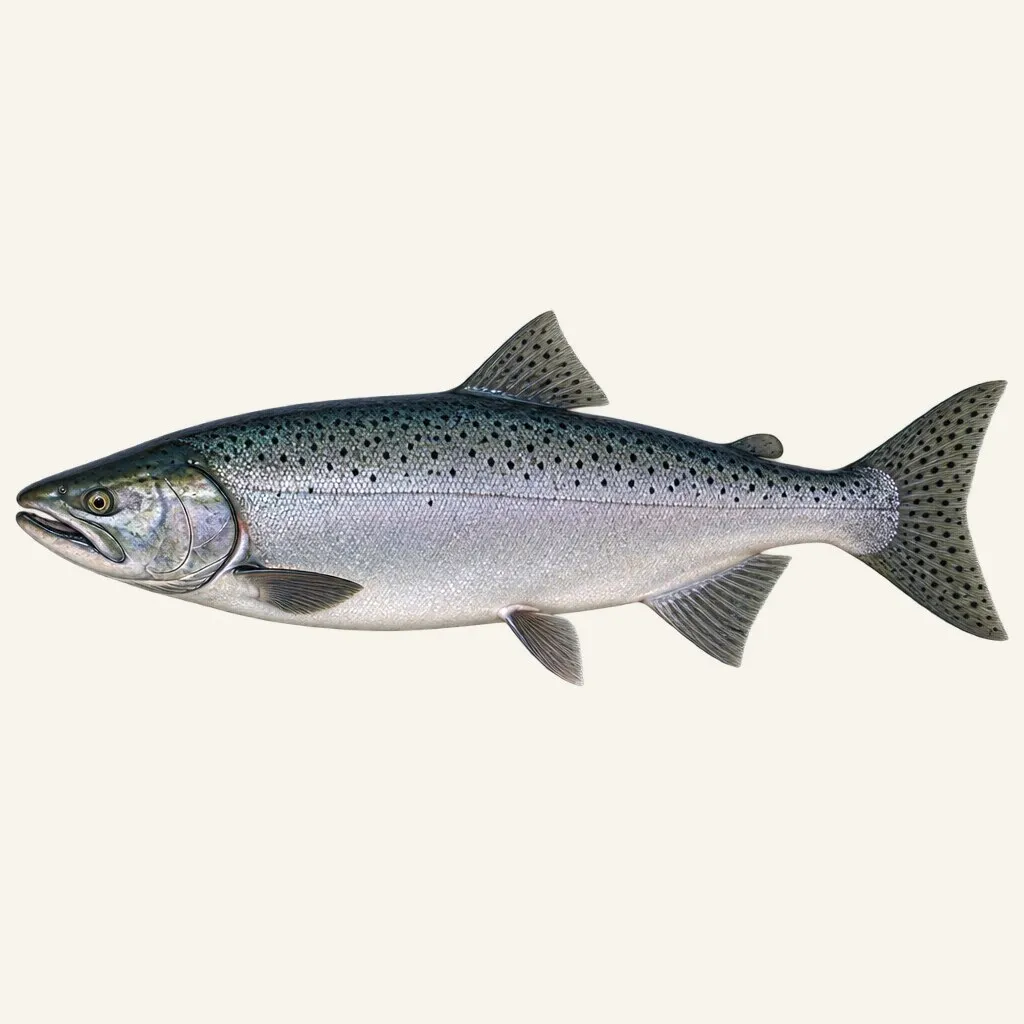
The gum line of the lower jaw is black. Reaching it means opening the fish's mouth, but the character holds regardless of season and of sexual condition, and on its own it settles the confusion with coho, whose gums stay pale.
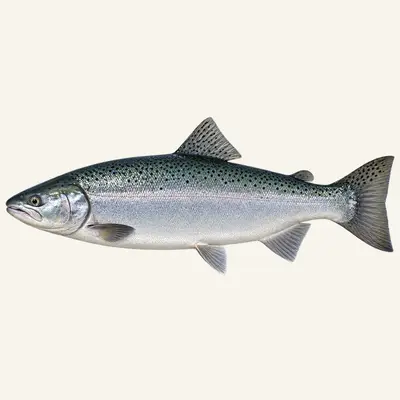
Spotting is the second check: small black points over the back and upper sides, and on the upper and lower lobes of the caudal fin alike. A clean lower lobe means a different species.
The body is fusiform and becomes markedly compressed in large adults, somewhat deeper than in the rest of the genus. The gill rakers are rough and widely spaced — a predator's fitting, not a filter's. Ten to 14 soft rays in the dorsal, 13 to 19 in the anal, and 67 to 75 vertebrae, the highest count among the Pacific salmons.
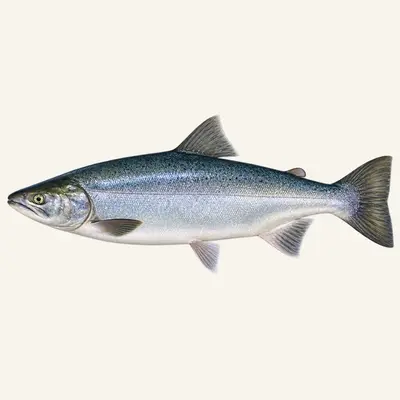
At sea, head and back are dark green to blue-black, the lower sides and belly silvery to white. In fresh water, as breeding approaches, the whole fish turns olive brown, red or purplish, more strongly in males than in females.
Size separates it from everything else in the genus by a wide margin: a sockeye at its heaviest, 7.7 kg, is nowhere near it. Maturity is not reached until about 82 cm, and the oldest recorded fish was nine.
Breeding
No migratory fish goes further inland. Runs of 4,827 km have been measured, which means reserves laid down at sea must cover the distance, the ripening of the gonads and the spawning itself, with no chance of topping up along the way.
Departure is correspondingly early. Fish leave the sea from December, and the first of them are off the river mouths by spring.
On the spawning ground the female selects, digs, and keeps other females away. She is attended by one large dominant male and several smaller ones occupied with driving off rivals. The dominant's courtship is worked out in detail: he comes to rest beside her and quivers, swims over her, touches her dorsal fin with his body and his fins, and now and then nudges her flank with his snout. With the pit finished she drops in, he joins her at once, both gape and vibrate, and the small males dart into the nest to release as well. The sequence restarts upstream and runs for several days until she is empty.
The male then leaves, possibly for another female. She does not. She guards the nest for as long as she is able — the only parental care in the group — and it ends when she does, a few days after spawning.
The water it needs
The range of depths used runs from the surface to 375 m, in water from 0 to 25 °C, over the bottom as readily as in open water. That is the widest vertical span in the genus.
In the river the young hold in gravel-bedded water and feed at the surface as much as in the drift. The estuarine passage is not the quick crossing it is for some of its congeners: because the timing of descent varies so much, juveniles of very different sizes are using the estuary at the same moment.
That flexibility has a management consequence. A drainage losing its upper rearing habitat does not lose the species outright, since fish that left at three months can still complete a cycle; what it loses is the part of the population that produced the largest individuals.
Areas
- Large pools in coastal rivers
- River mouths
- Coastal sea zones
- Downstream of rapids during upstream run
Techniques
- Heavy river spinner
- Artificial eggs under float
- Spoon trolling at sea
- Wet fly fishing
Baits
- Artificial salmon eggs
- Heavy spinners
- Chrome spoons
- Large streamers
What it eats
In the stream the young live mainly on terrestrial insects that fall in and on small crustaceans. At sea the diet becomes properly piscivorous, with crustaceans and other invertebrates alongside.
That switch to fish, earlier and more complete than in the fine-rakered species, is the key to the growth. The cost is the position the salmon occupies itself: fish and diving birds — mergansers, kingfishers — take the young, and large mammals and large birds take the adults.
The flesh is usually red and occasionally white, without the difference answering to any taxonomic split; the red sells for more. The viscera carry enough vitamin A to have been used successfully as feed in hatcheries.
How to catch it
Mass changes everything, beginning with tackle. A fish whose common length is around 70 cm calls for line, hooks and drags of a different order from a trout's, and a fight in current on that scale is judged by the room available downstream rather than by the power of the rod.
Timing is the second point. Because the fish begin leaving the sea in December and entries then spread out, a river receives successive waves rather than one run, and knowing local dates is worth more than any general rule.
The third belongs to the end of the season. The female of this species is the only salmonid in the genus that guards her eggs; lifting her off the nest leaves the batch unprotected while she is still alive and still working at it. A male already coloured has finished his part.
Then identification, which matters because several species commonly run together. The black gum line and the spotting on both tail lobes take seconds to verify with the fish in hand, and they prevent a decision being made about the wrong animal. Rules on retention change from one river system to the next and sit with the body that manages the water.
Conservation
The length of the migration makes each population hostage to an entire river. An obstruction placed halfway up does not remove a portion of the range: it cancels everything above it, which can mean thousands of kilometres of spawning water no other species reached.
The second point is less visible. The spread of juvenile strategies — three months for some, three years for others — is what absorbs a bad freshwater year. It is the first thing to go when river habitat simplifies, and its loss shows up neither in a run count nor in an assessment made at the scale of the whole range.
Where the fish has been planted the question inverts. What is being measured there is what a large anadromous predator takes out of communities that had never carried one, and several countries have documented unfavourable effects on that account.
Regulations
Check the local regulations in force (legal size limits, closed seasons, bag limits).
For guidance only. Legal sizes, quotas and open seasons vary by location and season: always check the local regulations in force before fishing.
Other names
Chinook, after the Chinookan peoples of the lower Columbia, is the standard name in the trade and in management. King salmon is the ordinary term in Alaska; spring salmon, or springer, applies to early fish on the British Columbia coast, where tyee is reserved for large ones. New Zealand, where the species was established a century ago and where it is the only Pacific salmon to have taken, calls it quinnat. German has Königslachs, Italian salmone reale. Every one of those names belongs to the same fish.
Sources: fishbase.se · api.gbif.org