Brook trout
Salvelinus fontinalis · Salmonidae
- Freshwater
- Salmonids
- Medium
- Size
26–60 cm
- Weight
0.2–6.6 kg
- Lifespan
24 years
- Water temp.
0–25 °C
- Depth
15–27 m
Where to fish
- Lake
- River
Habitat icons: Flaticon
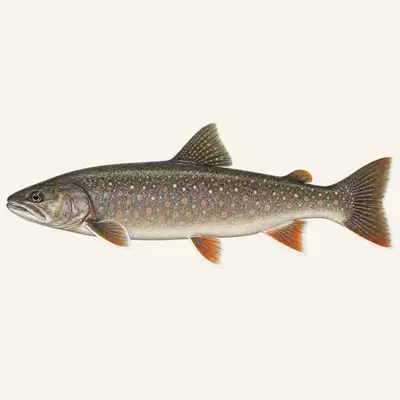
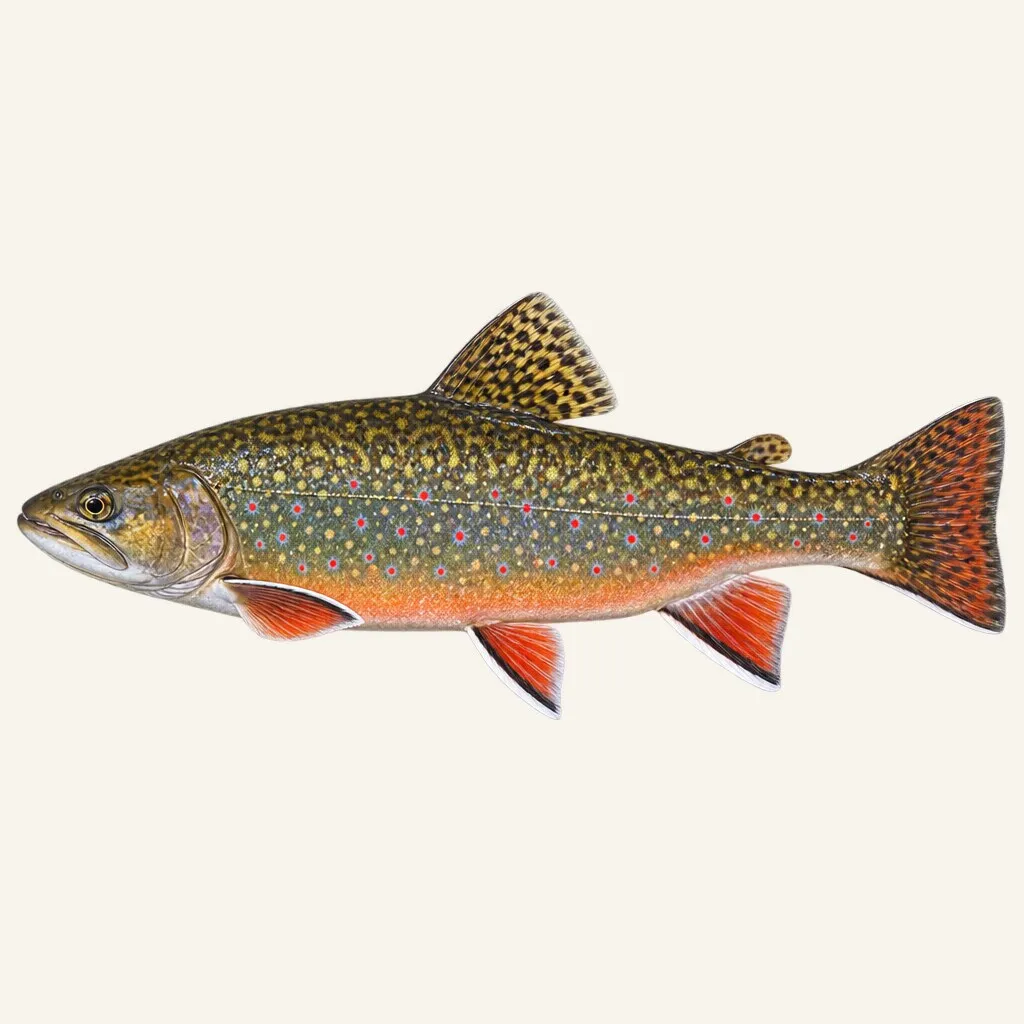
Spectacular coloring (blue-ringed red spots, red belly) - Native to America
Calendar
Recorded in 24 countries
Argentina · Australia · Austria · Belgium · Bosnia & Herzegovina · Canada · Chile · Czechia · Denmark · Finland · France · Germany · Italy · Japan · Mexico · Netherlands · New Zealand · Norway · Poland · Spain · Sweden · Switzerland · United Kingdom · United States
GBIF occurrence records — native and introduced populations combined.
Its range
Native to eastern North America — most of eastern Canada from Newfoundland and Labrador west to the shore of Hudson Bay, and south through the Atlantic, Great Lakes and Mississippi basins to Minnesota and northern Georgia, with an outlying population in the headwaters of the Chattahoochee.
The southern end of that range repays a careful look, because it is not a latitude but an altitude. Northern Georgia sits at the same latitude as rivers full of warm-water fish; the brook char there lives in Appalachian mountain headwaters and nowhere else in the state. The map is a map of cold water, drawn along the spine of the mountains.
It has since been moved across North America outside its range and into the temperate zone of every other continent. In Europe it occupies high torrents and mountain lakes it was stocked into from the nineteenth century on. Ecological harm has been reported by more than one of the countries that took it: dropped into cold water already holding a native trout, it works the same niche and can displace the resident, particularly at the top of a catchment.
Identifying it
Pale marks on a dark ground. That is the char pattern, and it is the quickest way to separate this fish from any trout, which wears dark marks on a pale ground. The back is green to brownish and worked over with vermiculations — wandering, worm-like lines rather than spots — and the pattern runs out onto the dorsal fin and sometimes onto the tail.
The flanks give the second signature: pale spots, and among them red ones, each red spot ringed by a blue halo. Nothing else in European water shows that combination.
The fins give the third. The leading edge of the anal, pelvic and pectoral fins is white, immediately backed by a dark stripe, with the rest of the fin reddish. That white-dark-red edging is what most people learn first and forget last. There is an axillary process at the base of each pelvic fin, and the tail is nearly straight, with at most a shallow notch, where a trout's is plainly forked.
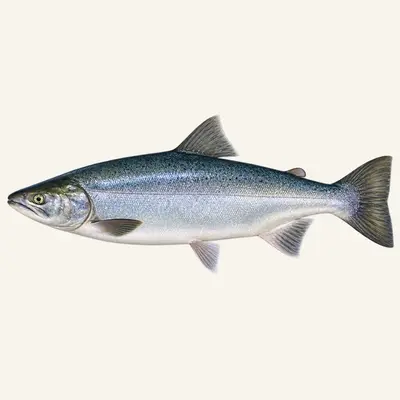
Fish in breeding condition turn red along the lower flank and through the fins. Fish that have been to sea look like another animal altogether: dark green above, silver on the sides, white below, the red spots faded to the palest pink.
Breeding
Courtship begins as a shove. The male pushes the female towards gravel he judges suitable; a receptive female then chooses her own spot and starts to dig. While she works he keeps up the display — darting alongside her and quivering, passing over and under her, brushing her with his fins — though most of his effort goes on chasing away other males rather than on her.
When the pit is ready the pair drop into it together and release eggs and milt. She covers the nest in a particular way, sweeping pebbles forward from the downstream lip over the eggs, and once they are buried she moves to the upstream end and cuts a fresh redd. The sequence repeats from there.
The mechanics match a trout's and impose the same condition: stones with water circulating between them. Where fine material has filled the spaces, the eggs suffocate, and the number of adults holding in the pool above makes no difference to that.
The water it needs
Clear, cool, strongly oxygenated creeks, small and medium rivers, and lakes. On paper the species spans 0 to 25 °C, the widest span in this group, but it only prospers in the lower half of that, which is what confines it in Europe to water where even a brown trout struggles.
Its other tolerance is chemical, and it explains more of the native range than temperature does. This char holds on in soft, acidic, peat-stained headwaters — the bog-fed brooks of eastern Canada, the granite streams of the Appalachians — where salmonids needing buffered water fail outright. The tolerance has a floor: acid deposition has emptied southern Appalachian streams that were inside it a century ago. But a fish able to live in water that thin and that sour has a great deal of country to itself.
Movements at home follow a seasonal pattern: upstream in early spring, again in summer and in late autumn; downstream in late spring and in autumn. Some fish take it further. Known as salters, they run to the sea in spring as the stream warms, stay no more than three months, and never go more than a few kilometres from the river mouth.
Areas
- Cold mountain streams
- high-altitude lakes
Techniques
- Lures
- Flies
- Worms
- Waxworms
Baits
- Spoon
- Flies
- Crankbaits
What it eats
The list of what has been found inside this fish is longer than for anything else in the group: worms, leeches, crustaceans, molluscs, fish and amphibians, insects of every order an angler recognises — chironomids, caddis, blackfly, mayfly, stonefly, dragonfly — and small mammals. Traces of plant material turn up too.
An animal that eats mice is an animal watching the surface, and that one item on the list says more about how these fish are caught than the rest of it together. The same appetite is why it settles so readily abroad: it does not need to recognise the fauna it is dropped into.
How to catch it
Brook char have a name for taking freely, and in unpressured water it is deserved. They rise willingly, commit hard and refuse little, which is what makes them the fish that teaches mountain stream work to a beginner.
The reputation comes with a bill attached. A population stands pressure badly for exactly the reason it fishes well. A small stream that gave fish easily can go quiet inside a season under regular attention, and it recovers slowly, since water of this kind never held many fish to begin with.
The setting imposes its own discipline. A high torrent is fished upstream, under cover, on fine lines and short casts. The clarity is extreme, the flight distance short, and a heavy footfall on the bank empties a pool before anything lands in it.
Size sets the tackle. In most European water this is a fish of 20 to 30 cm and calls for light gear. Lake fish are another proposition — the species reaches 86 cm and 8 kg, and one was aged at 24 years — but they are not caught in the streams that gave it its name.
Conservation
Two opposite problems attach to the same fish, and which one applies depends on where you are standing. In the Appalachians the native populations are contracting under warming water and acid deposition, and they are watched closely because of it. Outside the native range this char is the pressure rather than the casualty, displacing resident salmonids from headwater streams, and stocking policy in several regions has been reversed on that account.
The requirements that make it fragile also make it useful. A fish needing cold water and a clean bed is among the first to go when a catchment degrades, so on its home ground its presence or absence reads as a measurement rather than an accident.
Handling follows from the same fragility. These are small fish in thin, cold, exposed water, often at the very top of a system where nothing will recolonise from above, and a stream fished hard has no reserve to draw on.
Regulations
Check the local regulations in force (legal size limits, closed seasons, bag limits).
For guidance only. Legal sizes, quotas and open seasons vary by location and season: always check the local regulations in force before fishing.
Other names
Brook trout is the accepted English name, and it is wrong twice over. The fish is not a trout but a char, in the genus Salvelinus with the Arctic char and the lake trout — that second name being a misnomer of its own, since the lake trout is another char. Trout and char parted a long way back, and the reversed spot pattern is the visible trace of it.
Speckled trout is common in Canada, particularly in Quebec, where this is the fishing species. On the Gulf coast of the United States those same two words mean the spotted seatrout, a marine drum with no connection to anything here. Squaretail, an older New England name, at least describes the animal: it comes from the almost unnotched tail. Sea-run fish are salters; Great Lakes fish that run the shoreline are coasters. The species name, fontinalis, means of springs.
Sources: fishbase.se · api.gbif.org