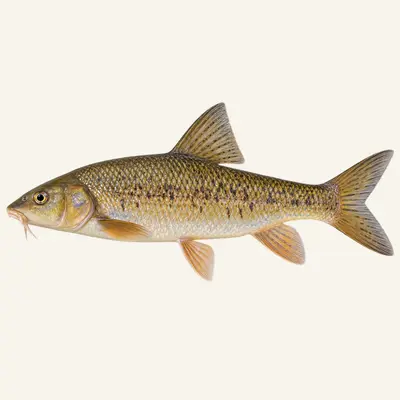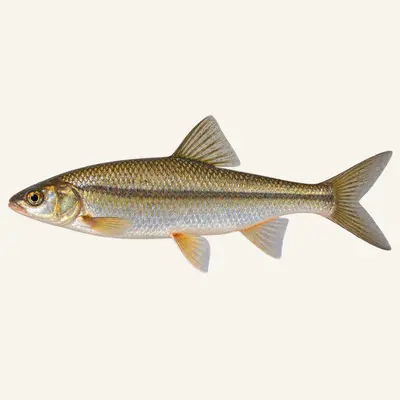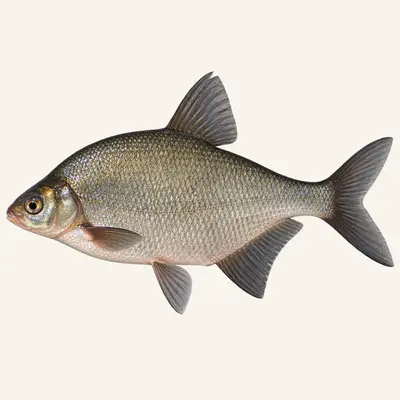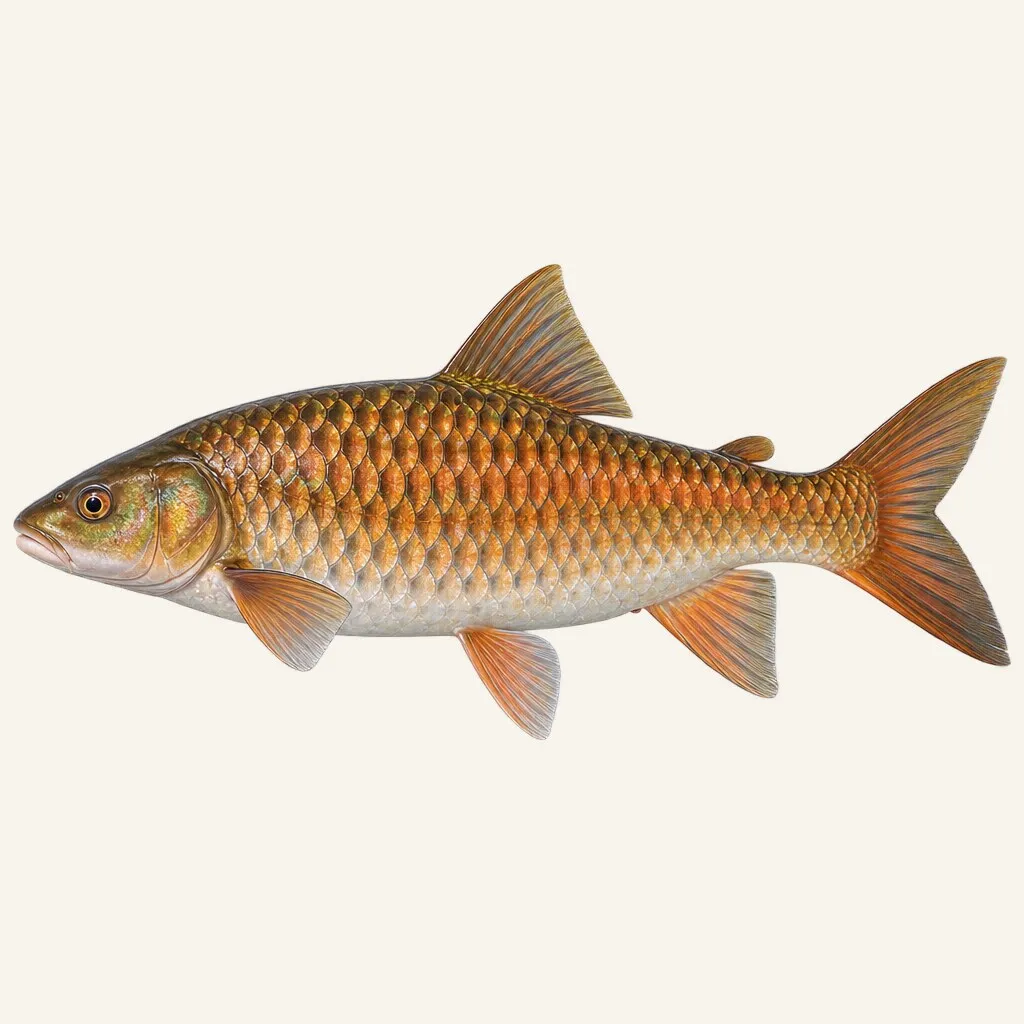
Copper mahseer
Neolissochilus hexagonolepis · Cyprinidae
- Freshwater
- Carp & coarse
- Medium
- Size
120 cm
- Weight
12 kg
Where to fish
- River
Habitat icons: Flaticon
Copper mahseer - coarse fish, Southeast Asia
Calendar
Recorded in 1 country
Malaysia
GBIF occurrence records — native and introduced populations combined.
Its range
Ten countries hold this species: India, Bangladesh, Nepal, Myanmar, Thailand, Malaysia, Indonesia and China, with records from Bhutan, Pakistan and Vietnam as well. That list crosses several unconnected river basins on both sides of the Bay of Bengal.
What unifies it is not drainage but slope. The range is the hill-stream belt that runs along the southern flank of the Himalaya, around the rim of the Bay of Bengal and down the mountain spines of the peninsula and the islands. The species follows a gradient, not a river system, which is why it turns up in a dozen national checklists and in no lowland anywhere.
Breeding
The spawning season is seven months long. Spawning runs from April to October, with the peak in August and September — which is to say it opens with the pre-monsoon rains, continues through the monsoon and closes after it. In a river fed by a monsoon, the reproductive window is the wet half of the year rather than a few weeks of it.
The fish move upstream to breed and lay on stones and gravel. That is a two-part requirement: a route up, and clean coarse substrate at the top of it.
Maturity is where the numbers become strange. The recorded range of first maturity for the species starts at 23 centimetres, but males have been found mature at nine. A male can therefore be breeding while it is still a small fish by any standard, and a fish's size says very little about whether it is contributing to the population — the assumption that only large individuals spawn does not hold here.
The water it needs
Fast water over a rocky bed, and specifically the middle of the stream. That last detail is the one to act on. This is not a fish of the undercut bank or the slack margin; the adults hold out in the body of the current, over rock, where the flow is strongest and the algae grow.
Everything about the species assumes gradient. It belongs to streams and rivers that fall steeply enough to keep stone clean, and it is absent from the still and silted water that most large cyprinids in the region occupy.
Areas
- Fast mountain rivers
- Pools below rapids
- Torrent confluences
- Rocky and gravelly bottoms
Techniques
- Bottom fishing with dough balls
- Wet fly fishing
- Natural drift fishing
- River feeder fishing
Baits
- Barley flour dough balls
- Freshwater crustaceans
- Maggots
- Earthworms
- Hemp seeds
What it eats
Filamentous green algae are the main food of the adults. Chironomid larvae, crustaceans and water beetles come second, and well behind.
For a fish with the reputation this one has, that is worth sitting with. The mahseers are pursued as hard as any freshwater fish in Asia, and this member of the group spends most of its feeding life rasping green filaments off wet rock. Omnivorous is the honest description, but the weighting is not even: the animal matter is a supplement to a vegetarian base rather than the other way round.
Two consequences follow directly. The first is that the fish is tied to hard substrate, because filamentous algae grow on stone in current and nowhere else in a river of this type. The second is that the natural bait for it is not a bait at all in the usual sense — dough and paste belong to its diet, while an insect larva or a small crustacean represents the minority fraction of it. Both work, for different reasons, and knowing which is which explains a great many blank days.
How to catch it
The fish is in the current, over rock, in mid-stream. Presentation has to hold there, which means enough weight to stay on a rough bed in real flow, and a bait that will not be stripped off in the first seconds.
The split diet opens two distinct approaches. Dough and flour baits address the vegetarian bulk of the diet and fish on or close to the bottom. A sunk fly, or a natural invertebrate drifted through the current thread, addresses the minor animal component — a smaller share of the fish's intake, but presented in the exact place the fish is holding. Neither is a substitute for the other, and a river that refuses one will often give the other.
The seven-month spawning season overlaps almost the whole of the fishable year, and the upstream movement concentrates fish that are on their way to breed. A large fish taken between the first rains and the end of the monsoon should be treated as one of those, handled in the water and sent back into the current head first, rather than lifted and carried.
Conservation · Near Threatened (IUCN) — This species is in decline. Release your catch quickly and handle it with care — wet hands, as little time out of the water as possible.
Conservation
Two pressures act on this fish and they meet at the same moment of its year.
The first is physical. It must climb to reproduce, and it must find clean stone and gravel when it gets there. Anything placed across a hill stream stops the climb, and anything that loads the stream with fine sediment fills the spaces between the stones where the eggs are laid. Neither has to be large to be decisive: a hill tributary is a small watercourse, and a small obstruction closes it.
The second is demand. The flesh is highly regarded and the market for it is strong, so there is a commercial fishery on the species as well as an angling one. That demand falls hardest on the largest fish, and the upstream run gathers those fish into a predictable place at a predictable time of year. A migration is an opportunity for a fishery in exactly the way it is a necessity for the fish.
Aquaculture has taken the species on, which changes the economics without changing any of the above. A farmed supply does not restore a run.
Regulations
Check the local regulations in force (legal size limits, closed seasons, bag limits).
For guidance only. Legal sizes, quotas and open seasons vary by location and season: always check the local regulations in force before fishing.
Other names
Copper mahseer is the name this catalogue uses; chocolate mahseer is the other in common circulation. Both describe the same brownish sheen, neither is exclusive to this species, and which one appears depends largely on which country's literature is being read.
Mahseer itself is a group word, not a species name. It covers the large barbs of southern Asia across several genera — Tor, Neolissochilus and their neighbours — so the word establishes a body plan and a region and stops there. Anyone comparing catch records from India, Nepal and Malaysia is comparing fish that may not be the same animal.
The generic name marks a taxonomic separation: Neolissochilus is assembled from the Greek for new, smooth and lip, and it replaced an earlier name for the same smooth-lipped group; older references file this fish under Barbus. The epithet is more descriptive than any of the common names — hexagonolepis, six-angled scale, after the shape of the scales on the flank.
Sources: fishbase.se · api.gbif.org