Ebro barbel
Luciobarbus graellsii · Cyprinidae
- Freshwater
- Carp & coarse
- Medium
- Size
80 cm
- Lifespan
16 years
Where to fish
- River
Habitat icons: Flaticon
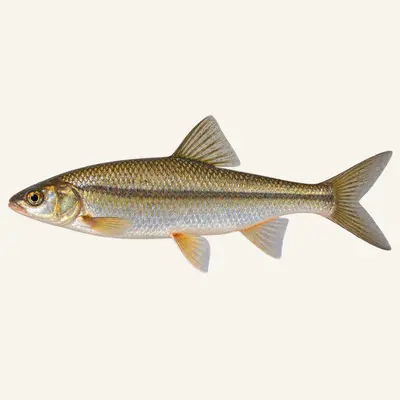
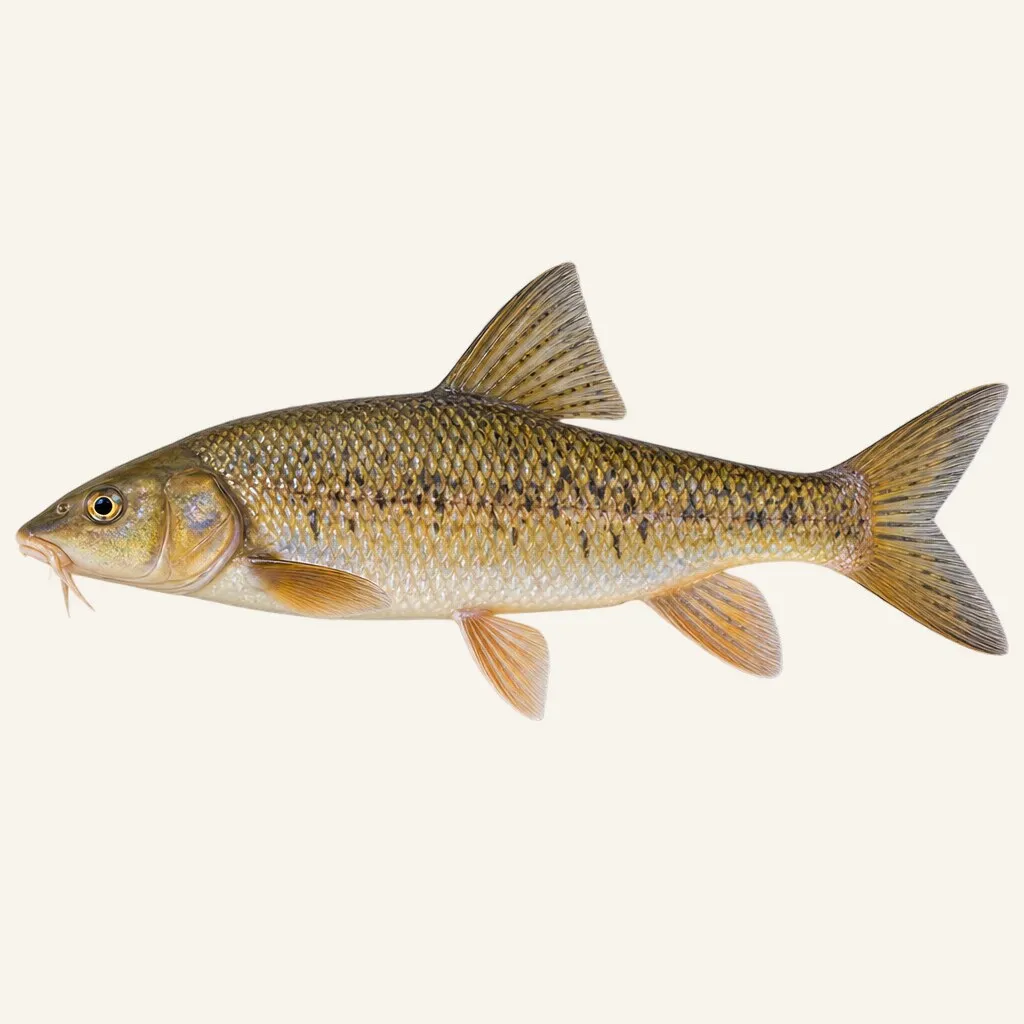
Graells' barbel is a large Iberian cyprinid with a streamlined, brownish-olive body found mainly in the Ebro basin and other rivers of the Spanish Mediterranean slope. This bottom-dwelling, omnivorous fish favours wide, deep, cool watercourses with clean gravel substrates.
Calendar
Its range
Two slopes, one fish. On the Mediterranean side it runs from the Ebro east to the Ter; on the Atlantic side it reaches west as far as the Asón. A strictly freshwater species does not cross a continental divide without help from geology, and this one made the crossing where the crossing is cheapest: along the northern edge of the peninsula, where the two seas come nearest to each other and the headwaters of both interlock.
The other half of the map is not Spanish. Stock has been established in central Italy, in the Fiora, the Ombrone and the Albegna. An Iberian Luciobarbus now lives on the Tyrrhenian slope, in drainages that belong by descent to an Italian endemic of the genus Barbus.
Identifying it
The leading ray of the dorsal fin is smooth. Check that first, because the four Iberian species of this group are told apart largely by what that ray does, and this one does almost nothing with it: slender, unarmed in adults, with at most a few small widely spaced points left on fish under about 15 cm standard length. A hand drawn up the front edge of a grown fish's dorsal comes away untouched.
The next character is a proportion, and it can be read on a living fish held in two hands. The rear barbel extends past the back margin of the eye. Nothing else on the peninsula is described by that reach.
The lower lip is thick, with no lobe running through the middle of it, and it wraps the tip of the lower jaw out of sight. Scale counts run 43 to 48 along the lateral line, with two or three more onto the tail base.
Maturity comes at about 17.5 cm, within a span of 15 to 20, and the species is known to live 16 years.
Breeding
Breeding means moving. Adults abandon the slack water they hold for most of the year and push up into sections where the current quickens and the bed turns to gravel and stone, then drop back down afterwards.
Measured against the length of a river, that is a short trip. It is also not optional, because the substrate the eggs need does not occur where the adults feed. Anything set between the two — a weir, a mill sill, a reach emptied by abstraction — cuts a population off from its spawning bed while leaving both ends of the journey in perfectly good order.
The water it needs
Grown fish hold the middle and lower river where the flow is slow, and they favour weed and bank cover strongly enough for it to be treated as a rule. That address applies from summer through autumn. In spring the same animals are elsewhere, upstream, over stone.
So one fish answers to two descriptions of habitat that contradict each other, and the calendar decides which is true. Searching the wrong half of the river in the wrong month is the standard error on this species, and no change of bait repairs it.
Areas
- Gravelly shallows
- Deep pools below rapids
- Current edges
- Confluences
Techniques
- Heavy feeder fishing
- Bottom fishing
- Float fishing
- Pole fishing
Baits
- Earthworms
- Maggots
- Corn paste
- Pellets
- Crayfish
What it eats
Invertebrates, plant material and algae. The vegetable share is not incidental, and it makes maize paste and pellets as reasonable a starting point as a worm — which is not true of every large cyprinid that works a river bed.
Crayfish belong on the bait list as well, and they raise the ceiling at the other end. Past a certain size this fish accepts mouthfuls of a calibre nobody bothers to offer a small bottom-feeding cyprinid.
How to catch it
The month picks the water before the rig picks anything. Through the spawning period the fish are up in the quick lanes over stone; for the rest of the season they are back down in the quiet water, tight against weed and under the banks.
Tackle scales with the river rather than with the fish. A heavy feeder holds bottom in the big Ebro flows; float tackle and short-range bottom fishing cover the smaller reaches. The productive lies are the pools below rapids, the seams where fast water meets slow, and confluences.
Then the detail that changes handling. Most barbels of this size carry a cutting edge along the back, and this one does not: a grown fish can be gripped anywhere without consequence. Of the Iberian group it is the only one where nothing about the animal has to be guarded against.
Conservation · Near Threatened (IUCN) — This species is in decline. Release your catch quickly and handle it with care — wet hands, as little time out of the water as possible.
Conservation
The pressure on this species is a distance. A sedentary fish tolerates an obstruction; this one does not, because its gravel is upstream and its adult life is downstream, and a structure placed between the two cancels reproduction without harming a single fish. Nothing looks wrong until a decade of missing year classes shows up in the size distribution.
The second point is not about Spain at all. Established in three central Italian rivers, it now shares water with an Italian endemic whose range is narrower and whose condition is worse than its own. The same animal is a species under watch in one country and an arrival in the other, and only the location separates the two roles.
Regulations
Check the local regulations in force (legal size limits, closed seasons, bag limits).
For guidance only. Legal sizes, quotas and open seasons vary by location and season: always check the local regulations in force before fishing.
Other names
Ebro barbel is what the databases carry, and English has nothing older to offer: the name was assembled rather than inherited, because no English-speaking fishery ever worked these rivers. It is a fair assembly, since the Ebro really is the core of the range.
It also falls short at both ends. The distribution reaches east to the Ter and west over the divide to the Asón, and the Italian populations are on another peninsula entirely. The epithet honours Graells, a Spanish naturalist, and it once denoted a subspecies of the southern barbel — the revision that raised it to full species also moved it into a different genus, so the small Catalan mountain fish and the large Ebro one no longer even share a name at genus level.
Sources: fishbase.se · api.gbif.org