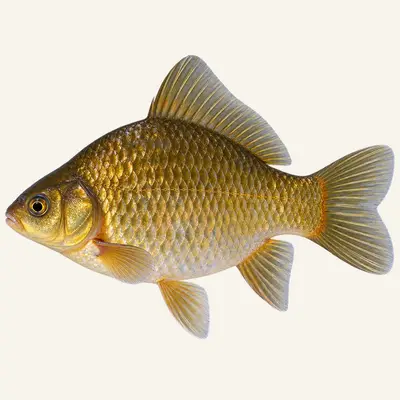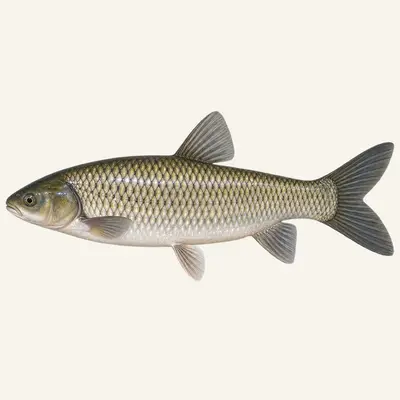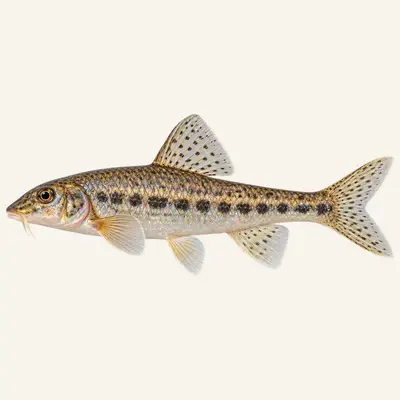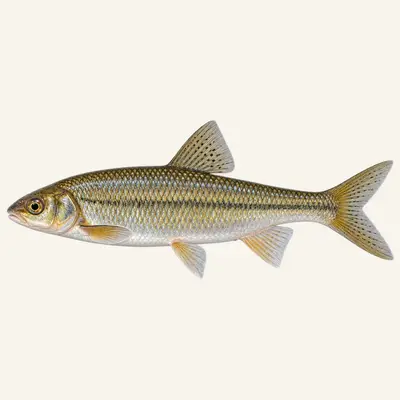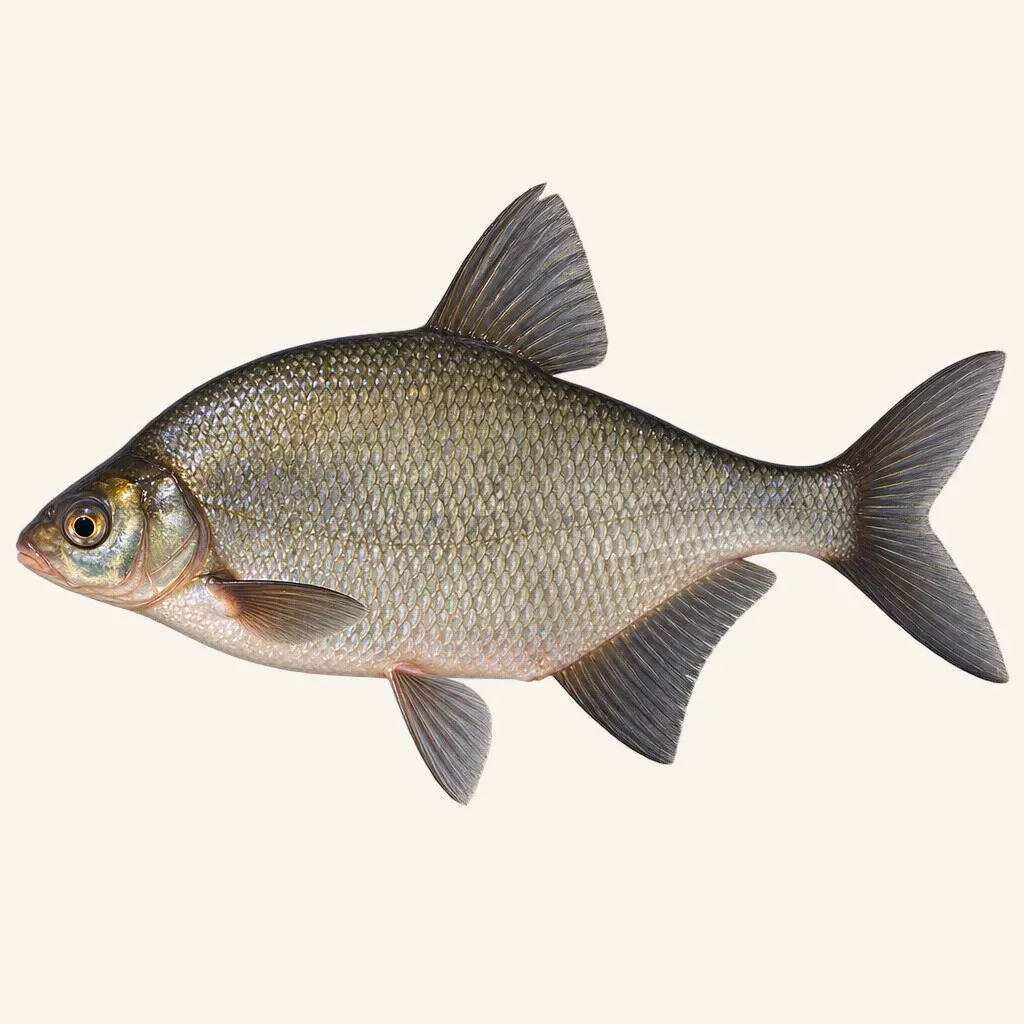
Freshwater bream
Abramis brama · Cyprinidae
- Freshwater
- Carp & coarse
- Medium
- Size
25–82 cm
- Weight
0.2–6.0 kg
- Lifespan
23 years
- Water temp.
10–24 °C
Where to fish
- River
- Lake
- Pond
- Canal
Habitat icons: Flaticon
Strongly laterally compressed body - forms large shoals - poor fighter
Calendar
Recorded in 23 countries
Austria · Belarus · Belgium · Czechia · Denmark · Estonia · Finland · France · Germany · Hungary · Ireland · Italy · Lithuania · Luxembourg · Netherlands · Norway · Poland · Russia · Slovakia · Sweden · Switzerland · Ukraine · United Kingdom
GBIF occurrence records — native and introduced populations combined.
Its range
The native range runs from the Adour across to the Pechora, taking in most European drainages, and reappears in the Aegean basin in Lake Volvi and in the Struma and Maritsa systems. In Asia it extends from the Marmara basin east to the Aral.
The gaps in that map are consistent with each other. This is not a native fish in Iberia, in the Adriatic basin and Italy, in Scotland, or in Scandinavia above Bergen and above 67°N in Finland. Those are the regions of short, steep, mountain-fed rivers, and of summers too cool for an animal that wants water between 10 and 24 degrees. A species whose young depend on warm, still, vegetated backwaters cannot colonise a country that has few of them.
Introductions have since put bream into Ireland, Spain and north-eastern Italy, and — a considerably longer journey — into Lake Baikal and the upper Ob and Yenisei.
Identifying it
The anal fin is the character. It runs 23 to 30½ branched rays, on a base twice the length of the dorsal's — a long low skirt under the rear half of the fish that no other cyprinid in these waters carries.
The outline is what is seen first. A bream is tall and flattened almost to two dimensions head-on, which is the shape of an animal that works over soft bottom and manoeuvres through weed rather than one that holds station in current.
The mouth is sub-inferior and protrusible. It telescopes downwards into a tube to reach into silt and retracts flush when it is not in use. Above 10 cm the eye measures about two thirds the length of the snout, and that ratio is what separates this species from white bream when both are small enough for shape to be inconclusive.
Colour changes with age and is a reasonable guess rather than a shortcut: young fish are bright silver, old ones go deep bronze with markedly darkened fins. The lateral line carries 51 to 60 scales, the pharyngeal teeth sit in a single row of five each side, the bases of the paired fins are clear or grey, and there are 43 to 45 vertebrae.
Breeding
The run begins in autumn for a spawning that happens in spring. Many populations, the semi-anadromous ones especially, start moving upriver as the year closes, stall through the winter and finish the journey when the water warms. On the Dnieper that journey covers a hundred kilometres.
On the spawning ground the males take and hold territories along the shoreline. Eggs are sticky and go onto dense vegetation in backwaters, on floodplains, or along vegetated lake shores. Their diameter increases with the age of the female, so an old fish contributes not only more eggs but larger ones, with more yolk behind each larva.
This species crosses readily with roach, and the offspring are fertile. That last word is what turns a curiosity into a lasting problem: in a water holding both in numbers, the hybrids breed on, and a spread of intermediate fish establishes itself with intermediate fin counts and intermediate mouths. Anyone who has tried to put a name to a silver fish with a slightly-too-long anal fin has met the result.
The water it needs
Adults use a wide spread of lakes and medium to large rivers, but they concentrate in a narrow subset: backwaters, the lower slow reaches, brackish estuaries, warm shallow lakes. They move through that water in big shoals, and the size of those shoals is a fact with consequences at every stage of the fishing.
The early life history is worth following, because it explains a common kind of water. Larvae and juveniles live in still water and feed on plankton. At one or two years old they move out of the backwaters into the river to feed. Where that move is impossible — a cut-off oxbow, a landlocked pit — they do not die out. They adapt, growing more slowly and maturing at a smaller size. Stunted bream populations are that adaptation working, not failing.
In the lower reaches of large rivers there is a further movement. When flooded ground drains and levels drop, juveniles drift down into brackish estuaries to feed, then come back into fresh water to overwinter. Salinity is a feeding excursion for this fish, never a place to live. The water chemistry it prefers is fairly specific: a pH between 7.0 and 7.5, and hardness on the high side.
Areas
- Muddy bottoms
- calm deep zones
- canals
- lakes
Techniques
- Feeder
- Waggler
- Pole carp fishing
Baits
- Worms
- Maggots
- Seeds
- Pellets
What it eats
Chironomid larvae come first, with other insects, small crustaceans, molluscs and plant material behind them. Big fish will take small fish. Juveniles start on zooplankton.
The tube mouth does the work. A feeding bream tilts nose-down, extends the mouth into the silt, draws in a mouthful and sorts it, and a shoal doing this leaves the bed pitted with craters and the surface prickling with bubbles. It is one of the most legible feeding signs in fresh water, and it gives away depth and direction as well as presence.
One trick sets the species apart from other bottom feeders. Where zooplankton is abundant enough to be worth it, bream switch to particle feeding and even to filter feeding, taking the bloom straight out of the water column. An animal that can eat both the mud and the plankton above it has very little to fear from a lake going green, and that is a large part of why bream come to dominate enriched water.
How to catch it
Finding the shoal is the first half of the job. A single bream is an accident; where there is one there are thirty, and the difference between a blank day and a heavy net is whether the shoal is in front of you.
The second half is holding it. This discipline leans on bait more heavily than almost any other in fresh water, because a shoal feeding on a carpet of it stays put and one that is not moves on within minutes. A swim fed the night before regularly beats one fed at dawn, and a shoal is lost to a heavy footfall or a badly judged top-up as easily as it was gained.
The bite is the classic problem. A bream picks the bait off the bottom and levels out to swallow it, which lifts the terminal tackle instead of pulling it, so the float rises and lies flat rather than going under. Waiting for it to disappear is waiting for something that will not happen.
Warm settled conditions in late spring and summer produce best, first thing and last. In rivers the fish are in the slow deep glides and on the inside of bends, not in the streamy water.
Bream survive out of water for a surprisingly long time, which is a mercy rather than a licence: a fish that will tolerate a slow unhooking is still coated in slime that a dry surface takes straight off. The flesh is bony, soft and dull in any case, so nearly all of them go back.
Conservation
The exposure is in the young, not in the adults, and that is what makes the damage difficult to see. Bream need vegetated backwaters and floodplains to spawn in, and a route out of those into the river for one- and two-year-old fish to grow on. Cut the floodplain off from the channel and both requirements fail at once, while the adult shoals go on being visible and catchable for years afterwards. By the time a shoal thins, recruitment has been failing for a decade.
Where the backwaters survive but the connection is severed, the population does not disappear. It shrinks in body size and stays, which is a genuine resilience and also an excellent disguise for a broken life cycle.
Against that, very little else troubles the species. It is fished commercially on a large scale and farmed as well, and a broad tolerance for warm, turbid, enriched, mildly saline water absorbs the pressure without much sign of strain.
Regulations
Check the local regulations in force (legal size limits, closed seasons, bag limits).
For guidance only. Legal sizes, quotas and open seasons vary by location and season: always check the local regulations in force before fishing.
Other names
Common bream is the full name, and English has a set of informal ones for the same fish at different sizes: skimmers for the small silver ones, bronze bream or slabs for the big dark ones. All of them mean Abramis brama.
Other fish complicate it. White bream, also sold and spoken of as silver bream, is Blicca bjoerkna — a separate, smaller species that overlaps almost everywhere this one lives. Further east, Ballerus and Vimba species carry bream-derived names of their own. And in salt water the word belongs to an entirely unrelated family, which is why fishmonger's usage and angling usage never quite meet.
Sources: fishbase.se · api.gbif.org