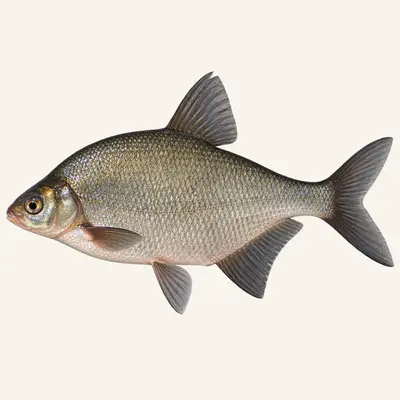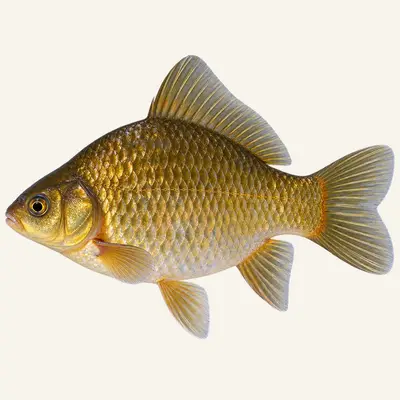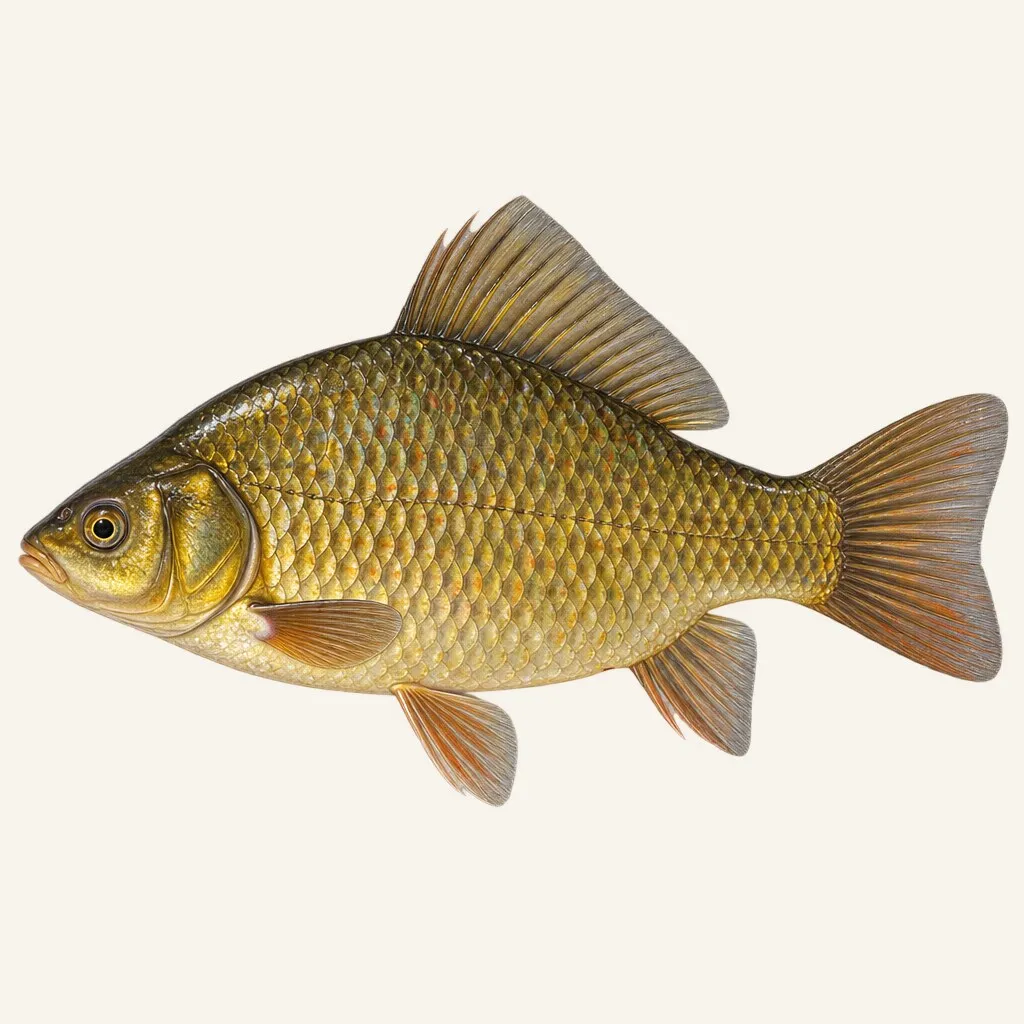
Crucian carp
Carassius carassius · Cyprinidae
- Freshwater
- Carp & coarse
- Medium
- Size
20–64 cm
- Weight
0.1–3.0 kg
- Lifespan
10 years
- Water temp.
2–22 °C
Where to fish
- Pond
Habitat icons: Flaticon
Ancestor of the goldfish - Highly resistant to extreme conditions (frost, drought)
Calendar
Recorded in 17 countries
Austria · Belgium · Denmark · Estonia · Finland · France · Germany · Hungary · Italy · Netherlands · Norway · Poland · Russia · Sweden · Switzerland · Ukraine · United Kingdom
GBIF occurrence records — native and introduced populations combined.
Its range
The eastern limit is the one to look at. The range reaches the Kolyma in Siberia and holds the White Sea and Barents basins, running north to about 66 degrees in the Baltic; westward it stops at the Rhine and the eastern drainages of England. A working band of 2 to 22 degrees, and the ability to sit out a frozen winter, put this fish further into the subarctic than almost any other cyprinid.
The gaps are informative in the other direction. The North Sea basin in Sweden and Norway is empty, and on the Aegean side only the Maritza drainage holds it. Those are edges of colonisation rather than edges of tolerance: a fish that does not migrate arrives where post-glacial drainage connections allowed it to, and nowhere else.
Which is where the map has to be read with caution. Introductions to Italy, England and France are on record, but the reports were routinely made without separating this species from the gibel carp, so a share of the plotted points carries its name without being it. The true range is narrower than the mapped one.
Identifying it
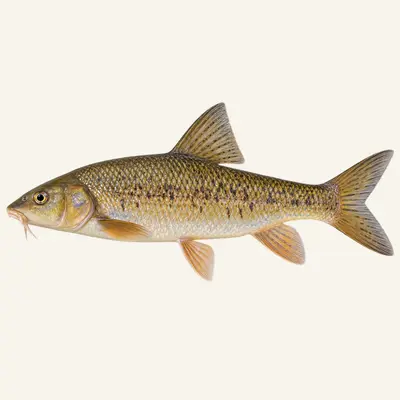
The outer edge of the dorsal fin bows outwards. That silhouette, readable on a fish held clear of the water, is the best place to start, because on the gibel carp the same edge is straight or hollowed. Colour supports it: a shining golden-green here, silvery-brown there.
Confirmation is taken on the gill arch. This species carries 23 to 33 gill rakers; the gibel carp never has fewer than 37, and the two ranges do not touch. The lateral line holds 31 to 36 scales, the anal fin usually six and a half branched rays, the tail 18 to 20 rays, the spine 32 vertebrae. The peritoneum — the membrane lining the body cavity — stays white, where its relative's is black. That character is the most reliable of the lot and the only one that requires opening the fish.
The last simple ray of the dorsal and of the anal is serrated, but weakly: the saw is there without biting, whereas on the gibel carp it is coarse enough to catch a fingertip.
Body shape proves nothing at all, which is worth knowing before it misleads. Depth of body in this species responds to what else is swimming nearby — fish raised under predation pressure grow noticeably deeper-backed than fish of the same age from a pond without pike, depth being what makes a mouthful awkward. Two neighbouring waters can therefore show two builds without holding two species. The absence of barbels, meanwhile, settles nothing except the question of carp.
Breeding
The whole cycle fits into a few square metres of shallow water. May and June, dense submerged plants, ripe females pursued noisily by several males at once. A female carries 130,000 to 250,000 eggs, they adhere to the vegetation, they hatch in four to eight days, and the output is spread over several bouts through the season rather than committed at once.
What matters here is not the fecundity but the absence of any requirement. No current, no gravel, no spawning ground to reach, no migration of any kind. A population shut in behind an embankment for a century has never needed to leave, which is why crucian carp turn up in ornamental waters and field ponds with no connection to a watercourse at all.
The water it needs
This fish occupies the water nothing else wants. Shallow ponds, heavily vegetated lakes, the cut-off backwaters and oxbows of lowland rivers: it does well in them, often in very high numbers, and specifically when no other species can hold on. Where the fish community is rich and predators are numerous it is generally absent. Its fine-scale distribution therefore reads as a map of refuges rather than a map of good water.
The reason for that division is a rare piece of physiology. Under a lid of ice, a closed pond uses up its oxygen within weeks — light stops, exchange with the air is cut off, and decomposition finishes the job. Any vertebrate deprived of oxygen switches to a metabolism that produces lactate, which accumulates and turns lethal within hours. The crucian carp converts that lactate into ethanol and passes it out across the gills into the surrounding water. It crosses months of near-total anoxia this way, in ponds where a carp or a pike would be dead by morning. Almost no other vertebrate does it.
The rest of its tolerance belongs to the same register: cold, organic pollution, high summer temperatures over a depleted oxygen supply. Through winter or a dry spell it burrows into the mud and waits.
The practical consequence is sharp. A pond that killed every fish in it in February gives its crucians back in April, and that asymmetry, repeated season after season, is what hands the species the extreme waters outright.
Areas
- Low-oxygen ponds
- muddy areas
- backwaters
Techniques
- Float
- Feeder
- Pole
Baits
- Worms
- Bread
- Corn
- Boilies
What it eats
Plankton, bottom invertebrates, plant material, detritus. Feeding continues all day but peaks after dark, which puts the activity of this fish out of step with most of the pond cyprinids it might be found beside.
How to catch it
Finding the right water is worth more here than any rig. A lake with a good head of predators and large cyprinids will not produce them; a forgotten pond behind a farm, a sealed-off backwater, an unnamed hole in a wood will, sometimes in quantity. The search is done on a map and on foot before it is done at the water's edge.
Once the spot is found the fishing is close in, in the vegetation or hard against it, with small baits laid on a soft bed. The dark hours match the feeding peak.
Large fish call for a warning. Reported records run far beyond the common length of the species, which is about 15 cm, and big golden pond fish are very often gibel carp or hybrids. Checking the dorsal profile and counting gill rakers is worth more than putting the fish on the scales. A crucian carp of remarkable size is an exception even where the species is abundant, and the maximum reported age is only about ten years.
Conservation
The species is disappearing slowly from a long list of waters, particularly in the Danube drainage and across central Europe, and the movement has not stopped. The best-supported cause is the arrival of the gibel carp, introduced and then spread, which takes the upper hand everywhere that is not an extreme refuge.
The mechanism deserves following to the end, because it is not accidental. The crucian carp wins on one ground only, that of uninhabitable water; everywhere else it is simply the weaker competitor. Its rival tolerates nearly as much, reproduces without males of its own kind, and travels in the same containers as the carp being stocked across the continent. Every pond stocking is thus an opportunity for it to arrive, and once it has, the resident species is left with the hardest fraction of its former range.
Land use does the rest: ponds filled in, side waters disconnected, dredging that strips out mud and vegetation in a single operation. And this fish does not migrate. A water that loses its crucians has no way of getting them back on its own, and the population that went out was often one that had been isolated for a very long time.
Regulations
Check the local regulations in force (legal size limits, closed seasons, bag limits).
For guidance only. Legal sizes, quotas and open seasons vary by location and season: always check the local regulations in force before fishing.
Other names
Crucian carp in English, sometimes just crucian; Karausche in German, karusse in Danish. The genus name comes from an old European vernacular term, and it now covers three fish that ordinary speech continues to call the same thing.
In ordinary use the name is applied to any small golden fish in a pond, and most of those are something else — gibel carp, goldfish, or a cross. The epithet simply repeats the genus, so the binomial carries no information beyond the vernacular it was built from.
Sources: fishbase.se · api.gbif.org · fishbase.se