Danube barbel
Barbus balcanicus · Cyprinidae
- Freshwater
- Carp & coarse
- Medium
- Size
18 cm
Where to fish
- River
Habitat icons: Flaticon
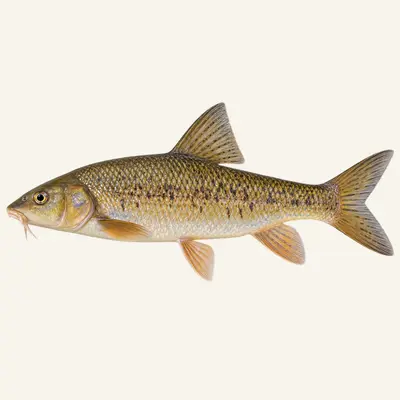
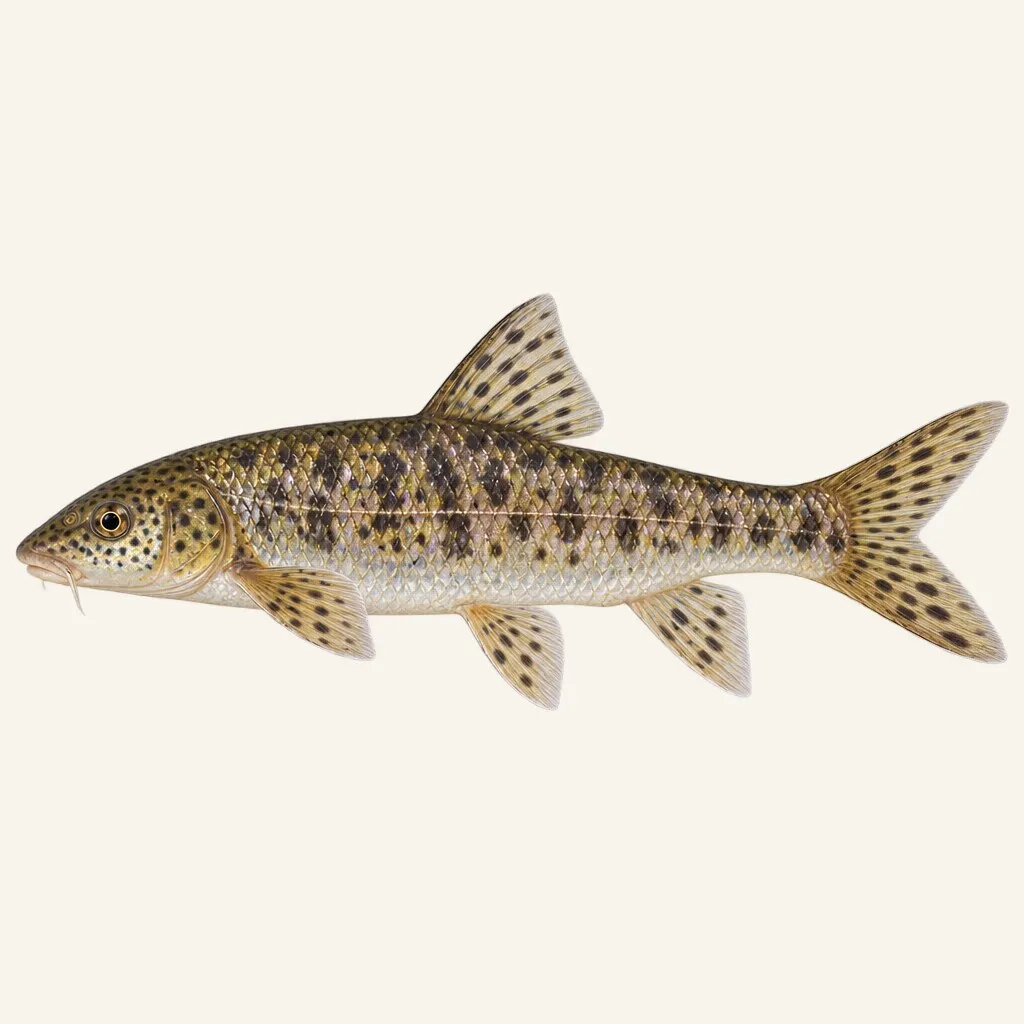
The Balkan barbel is a small, bottom-dwelling cyprinid with four well-developed barbels, endemic to the clear, stony rivers of the western Balkans and some Adriatic tributaries. Its stocky, golden-tinged body with a faintly speckled pattern sets it apart from other European barbels.
Calendar
Recorded in 9 countries
Austria · Bosnia & Herzegovina · Croatia · Greece · Montenegro · North Macedonia · Romania · Serbia · Slovenia
GBIF occurrence records — native and introduced populations combined.
Its range
Three seas take its rivers. The Adriatic, by way of the Soča basin in Italy and Slovenia; the Black Sea, by way of the Danube — upper Sava, Archar, Krupaja, Vlasinsko and Nera systems, and probably more widely in the upper drainage than that; the Aegean, by the Gallikos, the Vardar, the Loudias and the Aliakmon in Greece and North Macedonia.
A brook fish does not cross a watershed. A range spread over three slopes therefore tells you nothing about where the animal has travelled and everything about the history of the divides themselves: the basins changed shape around a fish that stayed where it was, and its distribution is a record of that rearrangement.
The Aegean end of the range is also where the definition of the species comes apart. Populations in the Gallikos, the Aliakmon and the lower Vardar have a longer dorsal with a slightly concave margin, a front ray roughened along part of its length, a longer anal fin and pointed tail lobes. They represent either introgression with Barbus strumicae or a different species again. Nobody has settled which, and a fish from those rivers cannot honestly be given a name.
Identifying it
This is a species that genetics described and that the eye does not resolve. Molecular characters are the primary diagnosis, and telling it apart on the bank from Barbus carpathicus or Barbus petenyi is acknowledged in the literature as difficult. Worth knowing before starting to count scales: what follows narrows the field, it does not decide it.
The spotting is read against the pupil. The top of the head bears conspicuous black dots roughly the diameter of the eye's pupil; the cheek and gill cover carry finer ones; the tail shows elongated marks longer than a pupil. The body is sown with dots and blotches distinctly darker than the ground they sit on.
The paired fins are spotted, the pigment gathering along the rays until it forms one or two dark bars across them. One proportion is worth more than any of the colour: the simple ray of the pelvic fin is clearly shorter than the second branched ray behind it.
The rest is three counts — 49 to 57 scales on the lateral line with three or four more on the tail base, usually nine to twelve rows between the line and the start of the dorsal, eight to ten down to the pelvic. The lower lip is thick and runs back into a short median lobe, and the front ray of the dorsal is weak and has no teeth on it. All of it belongs to a small fish, and it has to be read with the animal in the hand.
The water it needs
It occupies premontane and montane brooks and small rivers, with moderate to fast current over a gravel bed. Its densities are highest in the rapids and riffles, and that is where it is found in the daytime.
That last point is rarer than it sounds in this genus, much of which stays under cover while the light lasts. Here the shallow quick seam is the daytime station, and it is also the spawning ground. One square metre of gravel does both jobs, which concentrates everything that matters into a short season and a small area — and makes the state of the riffles, rather than the length of the river, the measure of what a stream can hold.
Areas
- Small mountain torrents
- Stony shallows
- Rocky margins
- Deep holes under banks
Techniques
- Light bottom fishing
- Nymph fishing
- Light float fishing
- Toc fishing
Baits
- Aquatic insect larvae
- Maggots
- Bloodworms
- Small earthworms
- Bread crumbs
How to catch it
A fish this small, stationed in daylight in a clear rapid, is spotted before it is fished for. Approach counts for more than the rig: work upstream, keep low on the bank, and read the gravel before wetting a line, because a fish that has seen the angler will not be in that seam a minute later.
Tackle scales down accordingly — lightened bottom fishing, a light running line, a fixed line held in the current, or a nymph. Aquatic larvae, maggots, bloodworm and small worms are enough, on hooks proportioned to the mouth of a cold-river cyprinid rather than to the name of the genus.
The calendar asks for restraint. The riffles where the fish shows itself in spring are the riffles it lays its eggs in; wading through them or working them hard at the wrong moment costs more than a missed bite. For the rest of the year the same seam can be fished without any second thought.
Regulations
Check the local regulations in force (legal size limits, closed seasons, bag limits).
For guidance only. Legal sizes, quotas and open seasons vary by location and season: always check the local regulations in force before fishing.
Other names
English says Danube barbel, German Donaubarbe, Spanish barbo del Danubio, Italian barbo danubiano. Four languages tie the fish to one river system, when it also holds the Adriatic and Aegean slopes — the name is accurate for perhaps a third of the range.
The scientific name points at the whole peninsula instead, which describes the real distribution better. The mismatch comes from the order of discovery: the Danubian populations were described and named first, and the vernacular names never followed the range as it widened. Since the species is diagnosed on molecules anyway, any common name applied in the field is a guess wearing a label.
Sources: fishbase.se · api.gbif.org