Danube bleak
Alburnus chalcoides · Cyprinidae
- Freshwater
- Carp & coarse
- Medium
- Size
20–40 cm
- Weight
0.1 kg
- Water temp.
5–20 °C
Where to fish
- Estuary
- Lake
- River
Habitat icons: Flaticon
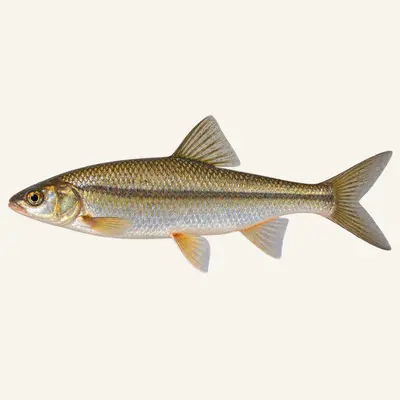
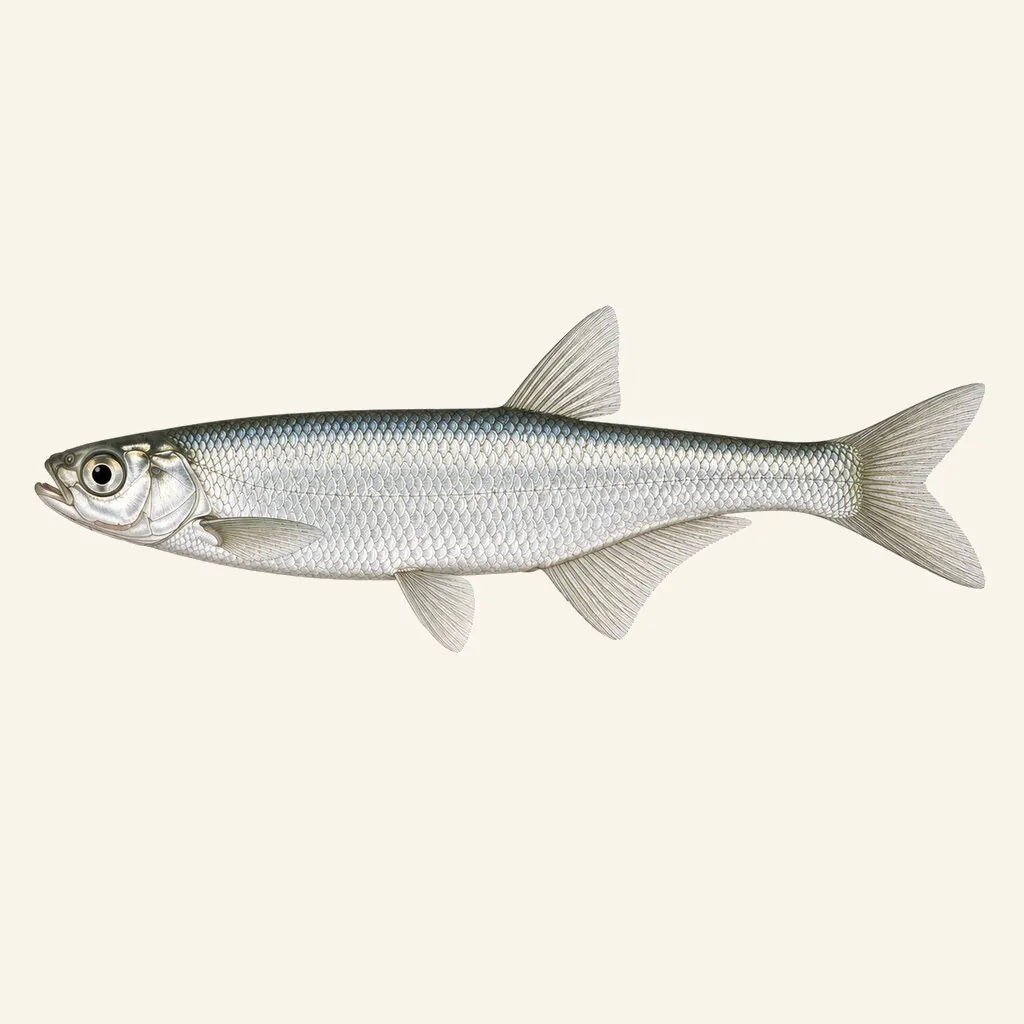
A large, slender bleak from the Danube basin, with a silvery and streamlined body, a slightly upturned mouth and the fine scales characteristic of pelagic cyprinids.
Calendar
Recorded in 3 countries
Russia · Tajikistan · Uzbekistan
GBIF occurrence records — native and introduced populations combined.
Its range
The centre of the range is the Caspian, chiefly the western and southern coasts, with the fish only rarely recorded in the Ural and the Volga. Populations in the Aral basin may or may not belong to this species. The Black Sea basin is reported.
That map should be read as provisional, and the reason is taxonomic rather than biological. The name has covered forms that are now being separated, so the outline drawn around it mixes this species with whatever else has been filed under it. The English name compounds the problem: "Danube bleak" points at a basin that is not at the core of the distribution above.
Identifying it
The belly carries a scaleless ridge, and how far forward it runs is the first thing to measure. Here it is exposed across eight to 12 scales ahead of the vent, reaching up to about 80 per cent of the way towards the base of the pelvic fins — a long keel, but not a complete one. The common bleak's published description gives a keel bare along its entire length between those two points. The difference is a fraction of a centimetre on a real fish and it is one of the few characters that can be checked without a key in hand.
Beyond that the determination is arithmetic, because there is no colour to work with: the flank carries no dark band along its middle, and the fish is plain silver over a greenish back.
The anal fin begins one and a half to two and a half scales behind the last branched ray of the dorsal. The lateral line holds 54 to 65 scales with four or five more onto the tail. The anal fin has 13 to 15 and a half branched rays, there are 18 to 23 gill rakers and 42 to 45 vertebrae. The head takes 20 to 24 per cent of standard length, the predorsal distance 52 to 56, and the wrist of the tail is between 1.9 and 2.4 times as long as it is deep.
Spawning males are covered in breeding tubercles of an unusual pattern — few of them, and large, where most cyprinids raise a dense scatter of small ones over the head.
One caution belongs in this section rather than at the end. The shape of the fish varies a great deal from place to place. That variation was long read as adaptation to different habitats; the current reading is that several species have been confused under this one name. A specimen identified on silhouette alone therefore proves very little, and the counts above are doing more than confirming an impression.
Breeding
The males go first and wait. They assemble on the gravel before any ripe female arrives, which inverts the usual order of a cyprinid spawning: the timing is set by the fish that fertilise rather than by the fish that lay.
Spawning needs small watercourses with heavy current and a gravel bed. The eggs are adhesive and fix to pebbles and stones. Embryonic development takes two to three days — very fast — but the larvae then stay down among the gravel for another eight to 11 days before working their way out to the shallows and backwaters.
The adults do not stay for any of it. They drop back to the sea, the lake or the estuary to feed as soon as spawning is over. The young make their own descent later, in the autumn of the same year or the following spring.
Every stage of that sequence assumes a river passable in both directions. Adults up and down within days, juveniles down within months: the fish is not resident anywhere it breeds, and the gravel it needs is often a long way above the water it lives in.
Landlocked populations in reservoirs run a scaled-down version of the same programme, ascending the reservoir's tributaries instead of a river system.
The water it needs
The fish lives near the surface, which is not what the classification of a benthopelagic species suggests, and it lives in the lower valleys of rivers, in coastal lakes, in estuaries and in the freshened parts of the sea, between five and 20 degrees.
Salinity tolerance reaches 14 parts per thousand. That figure is what opens the Caspian to it — a sea only partly salt — and it is the reason a cyprinid can occupy an inland sea at all. It also means the boundary between the feeding habitat and the spawning habitat is not the salt front but the current speed and the bed material.
Areas
- Rocky lake shores
- Fast current zones
- Stream mouths
- Vegetated margins
Techniques
- Waggler fishing
- Pole fishing
- Fly fishing
- Light float fishing
Baits
- Maggot
- Bloodworm
- Fine paste
- Caster
- Pinkies
What it eats
Adults take planktonic crustaceans, terrestrial insects and small fish. Larvae and young juveniles restrict themselves to zooplankton, algae and insect larvae.
The terrestrial insects are the practical item. A fish holding the top of the water column and taking what lands on it is responsive to events on the bank rather than on the bed: a hatch, a wind loading the surface, a line of trees dropping their passengers. That is a different way of finding fish from reading a river bottom.
How to catch it
Fish the upper layer or do not fish for this species at all. It holds high in the water, feeds on plankton and on fallen insects, and a rig that reaches the bed passes underneath it. Fine baits, dry flies and small offerings on or just under the surface match what it is already eating.
Depth discipline is what separates a catch from a blank. The species is gregarious, so once the right layer is found the shoal produces steadily; two metres lower there is nothing at all.
The spawning ascent is the one predictable concentration of the year, and the strangest fishing it offers: an estuary and lake fish, in numbers, in a small stream with a hard current over gravel. Males are in position before the females arrive, so the first wave taken from a run will be male.
Sizes are those of a large bleak. Common length is 20 cm, but for females it is 28 — the sexes differ enough that a big fish is, as a rule, a female carrying the year's eggs, on a stock whose spawning access is already the limiting factor.
Conservation
Almost every long-distance migratory population has gone, and the cause is single: dams. The mechanism is worth stating precisely, because it does not look like a decline while it is happening. The fish feeds in a sea, a lake or an estuary and breeds only on swift gravel, sometimes far upstream. Cut that corridor and the adults are unharmed — they feed, they grow, they are caught. They simply produce nothing. The population does not crash, it ages out.
What survives does so in two situations: small watercourses where the journey between feeding and spawning ground is short, and reservoirs where a landlocked stock has rebuilt the whole cycle inside the impoundment. Both are refuges rather than a restoration.
Further loss is expected for two reasons at once. Hydroelectric development continues to spread across the region, and the Caspian itself is under heavy ecological strain that reaches every fish in it.
The taxonomy adds an uncertainty underneath all of that. If several species really are hidden under this name, then what is being lost in any given river may not be a marginal population of a widespread fish but an entire form that nobody has described yet.
Regulations
Check the local regulations in force (legal size limits, closed seasons, bag limits).
For guidance only. Legal sizes, quotas and open seasons vary by location and season: always check the local regulations in force before fishing.
Other names
Danube bleak and shemaya are both used in English, the second from Russian, and the second is the more accurate of the two given where the fish actually lives.
The genus has moved. Older texts write Chalcalburnus chalcoides and current ones Alburnus chalcoides; they are the same animal, and both spellings remain in circulation in fisheries records. The species name is built on the Greek for copper, after the metallic cast of the flank. German uses Seelaube, lake bleak, which describes the landlocked populations rather than the migratory ones.
Sources: fishbase.se · api.gbif.org