Iberian arched-mouth nase
Iberochondrostoma lemmingii · Cyprinidae
- Freshwater
- Carp & coarse
- Medium
- Size
15–25 cm
- Weight
0.0 kg
Where to fish
- River
Habitat icons: Flaticon
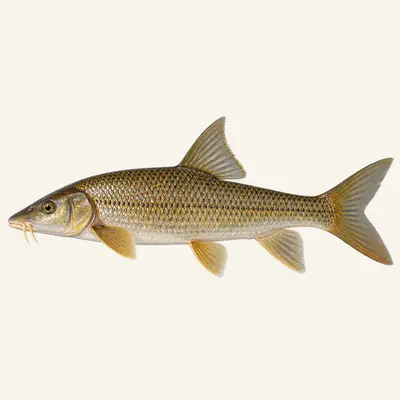
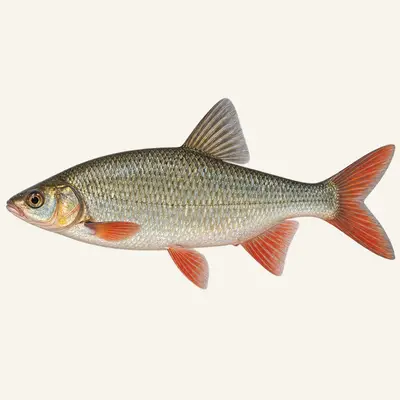
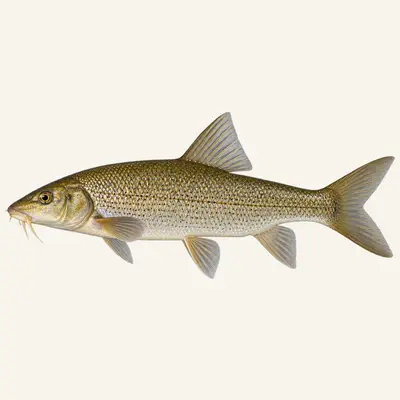
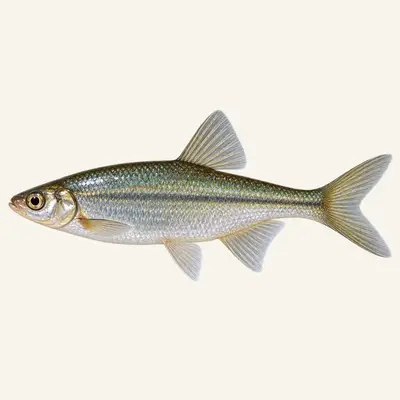
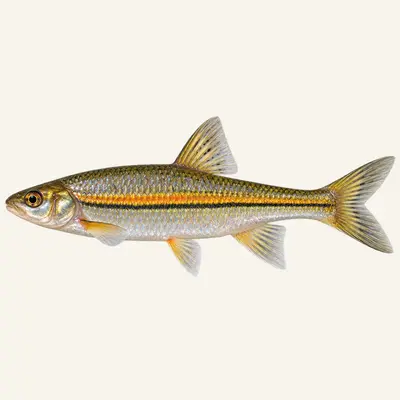
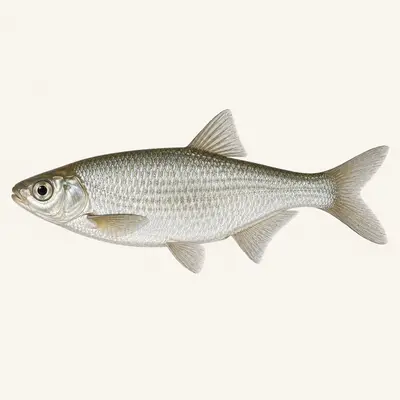
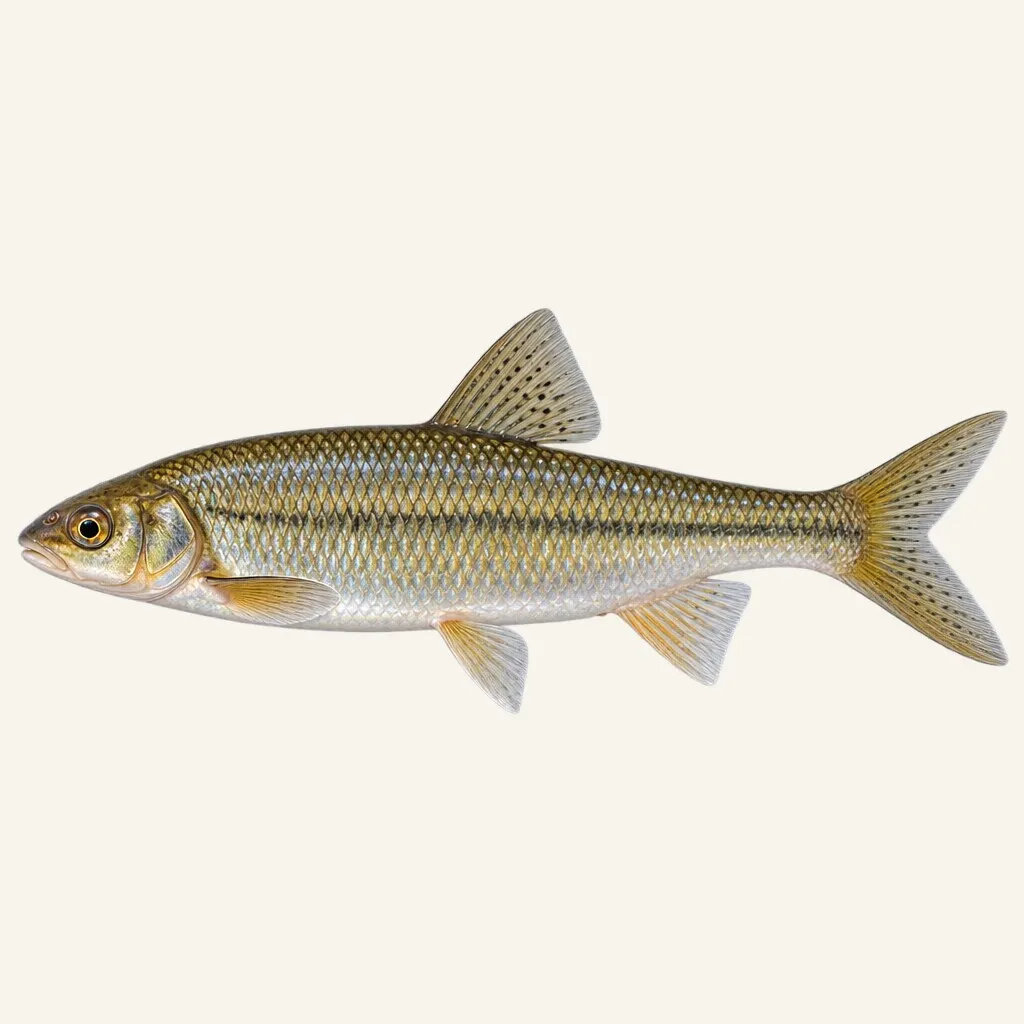
A small cyprinid endemic to the Iberian Peninsula with a streamlined body, identifiable by its distinctive arched inferior mouth and silvery coloration with golden tints on the flanks.
Calendar
Its range
The range statement carries a hole in it, and the hole is the informative part. The species holds the Tagus, the Guadiana, the Odiel, the Guadalquivir and the south-western corner of the Douro — except the Jándula, a tributary system inside the Guadalquivir, which is explicitly excluded.
Nobody arrives at a gap that size by drawing an outline. An exception named at the level of a single sub-basin comes out of survey work, and it is worth carrying before drawing conclusions elsewhere: a blank on the Jándula is the recorded condition of that system, not the sign of a local extinction.
What the whole range has in common is the climate rather than the drainage. These are Mediterranean rivers between the 36th and 42nd parallels, all of them losing most of their flow every summer, and none of them connected to each other. The species is potamodromous inside each one, which means every population moves within its own basin and none can reach the next.
Identifying it
The published diagnosis separates this species from its congeners on three measurements and nothing else: 49 to 59 lateral-line scales with two or three more on the tail base, four and a half to seven scale rows between the lateral line and the origin of the pelvic fin, and the eye at one to one and a half times snout length.
The transverse scale count is the one that does the work, and it is also the one that needs a fish in the hand under decent light. Half a row decides it.
Two characters that the catalogue's own description supplies do not appear in that diagnosis at all: an arched inferior mouth, and silvery flanks with a golden cast. Both are useful in the field precisely because they can be seen without counting anything. Neither is written into the published separation from the congeners, which is a reason to lead with them and settle with the scales.
Breeding
It breeds at four and a half centimetres.
Length at first maturity is recorded as 4.3 centimetres, within a bracket of four to four and a half, on a species whose common length is 15. Almost nothing in that ratio behaves the way a river fish is expected to behave.
The practical consequence is that a population contains hardly any immature fish. What looks like a year's fry, netted in a plant bed in April, is a stock of adults, and an individual the length of a minnow may already have spawned in several successive seasons. Spawning runs from March to May.
The water it needs
Adults hold two reaches that could hardly be less alike in flow, and one thing is present in both.
The first is the middle course, with moderate current, where aquatic vegetation is abundant. The second is the lower course, with slow current, where submerged plants are abundant. Current varies from brisk to almost none between those two descriptions. Weed does not.
So the feature to read on a river is the plant bed, not the speed of the water. A vegetated margin in a fast reach and a weedy backwater in a slow one are, for this fish, the same address.
Areas
- Shallow rocky riffles
- Fast-current streams
- Gravel margins
Techniques
- Light float fishing
- Trotting
- Pole fishing
Baits
- Filamentous algae
- Fine maggots
- Cereal paste
- Small nymphs
What it eats
Invertebrates, plants and zooplankton — three resources gathered in and around the same stems.
The third one carries a piece of information the first two do not. Taking zooplankton means catching individual organisms a millimetre or two across, suspended in open water between the stems, rather than picking them off a surface. The eye fits the job: its diameter is one to one and a half times the length of the snout, so this is a fish whose eye is as long as its face is, in a family better known for muzzles that overhang the mouth.
How to catch it
There is no fishery on this species and no reason to build one. What there is instead is a rule of thumb that follows from the maturity figure: on this fish, size tells you nothing about whether an individual is breeding, so every one that comes to hand is handled as a spawner.
Where it is met, it is met on fine tackle — a light float, a pole, a bait trotted through — with small maggots, nymphs, cereal paste or filamentous algae covering both halves of a mixed diet. The water to work is the edge of a plant bed rather than open channel, in the moderate current of a middle reach or the slack of a lower one.
Conservation · Near Threatened (IUCN) — This species is in decline. Release your catch quickly and handle it with care — wet hands, as little time out of the water as possible.
Conservation
Water abstraction is named first, and the way it acts on this species is worse than proportional.
When a Mediterranean river drops, the water it loses is not taken evenly out of the channel. The shallow margins go first, and the shallow margins are where submerged plants grow. A fall in level therefore does not remove a share of the habitat — it removes the vegetated part, which is the only part this fish uses. A reach can keep most of its water and lose all of its cover in the same season.
The introduction of other species is the second pressure named, and it lands on a fish that has no refuge to withdraw into: weed beds in a shrinking river are also where everything else concentrates.
Against that stands one genuine advantage, and it is the maturity figure. A species breeding at four and a half centimetres rebuilds a population within a few seasons of conditions improving. What this animal is short of is not reproductive capacity. It is water, and plants to put the eggs among.
Regulations
Check the local regulations in force (legal size limits, closed seasons, bag limits).
For guidance only. Legal sizes, quotas and open seasons vary by location and season: always check the local regulations in force before fishing.
Other names
Spanish says pardilla. Portuguese says boga. English needs four words — Iberian arched-mouth nase — and one of them names a character that the published diagnosis of the species does not record. The mouth is in the catalogue's description and in the common name; it is not among the characters the literature uses to separate this fish from its relatives.
The Portuguese name has its own trap. Boga is applied to more than one of these grazers on the peninsula, including species in other genera altogether, so it works as a group word rather than as a species name, and a Portuguese record needs its river before it can be read.
Iberochondrostoma is the unusual half of the binomial. When Chondrostoma was broken up, most of the resulting genera took a Greek prefix of position — before, beside, false — and said nothing about where the fish live. This one took the peninsula instead, and in doing so committed itself: every species it contains is confined to Iberia, and the name would have to be wrong for that to change.
Sources: fishbase.se · api.gbif.org