Italian barbel
Barbus plebejus · Cyprinidae
- Freshwater
- Carp & coarse
- Medium
- Size
70 cm
- Weight
6.0 kg
Where to fish
- River
Habitat icons: Flaticon
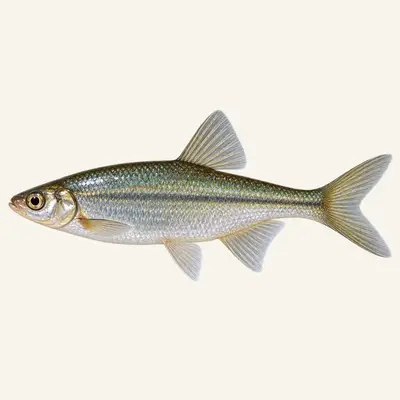
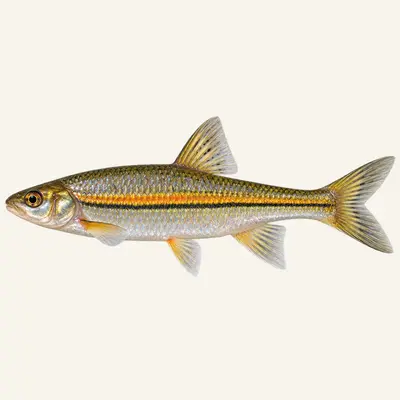
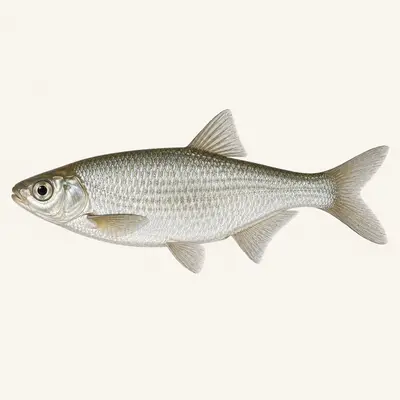
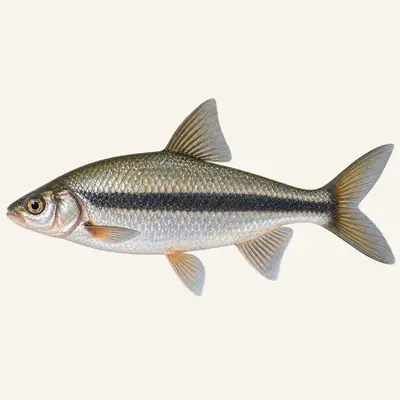
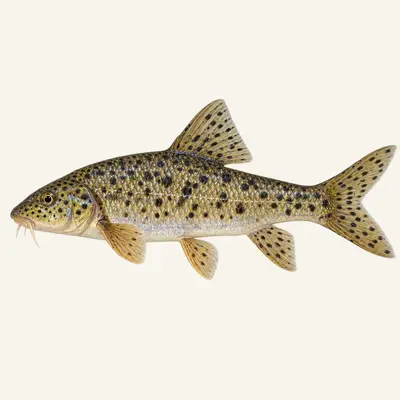
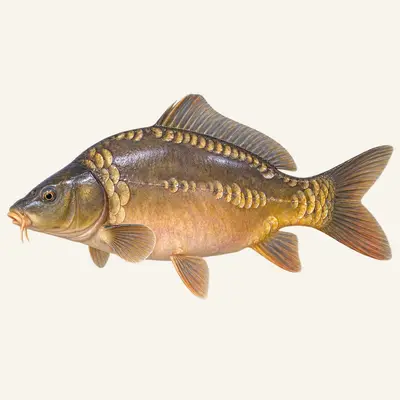
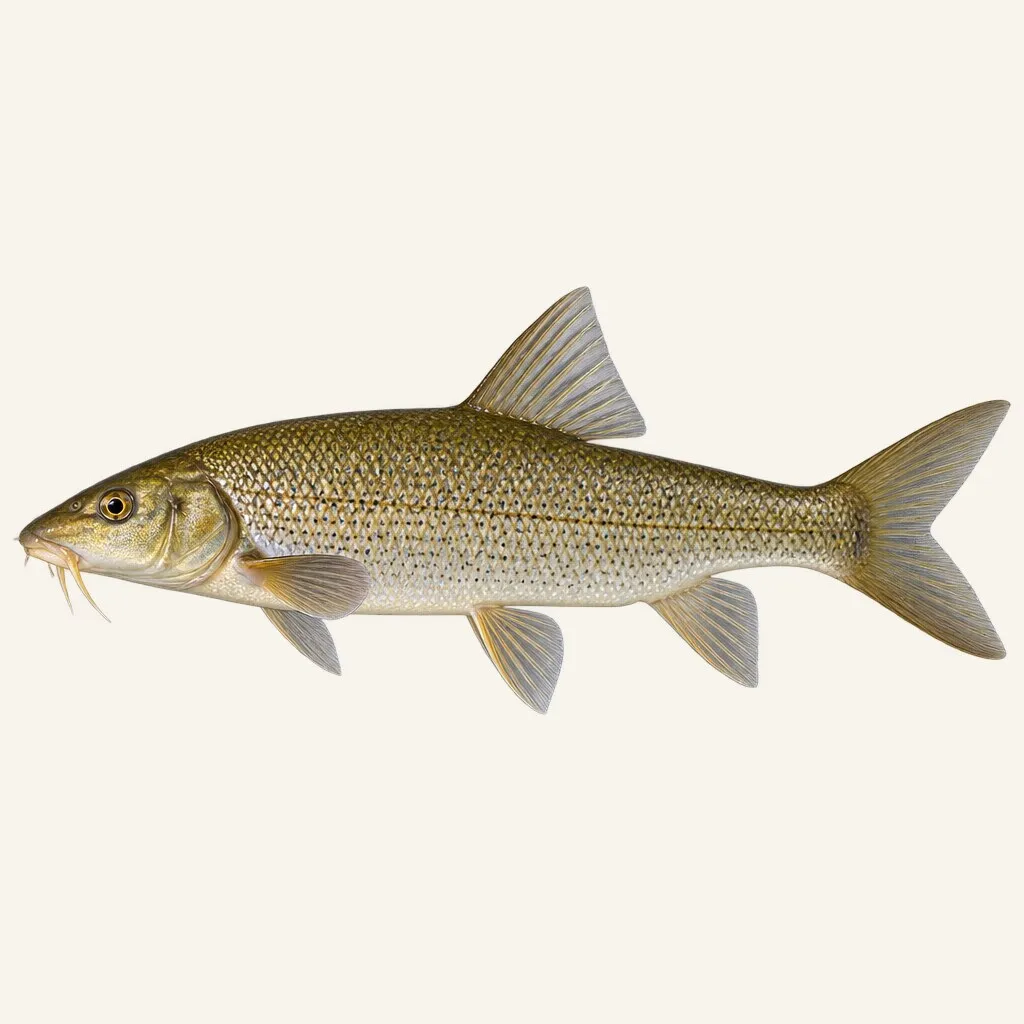
The Italian barbel is a bottom-dwelling cyprinid with four distinctive barbels, endemic to the river systems of northern and central Italy and some Balkan watercourses. Its robust, golden-tinged body is well adapted to moderate to fast currents over gravel and rocky riverbeds.
Calendar
Recorded in 5 countries
Croatia · Italy · Slovenia · Switzerland · Türkiye
GBIF occurrence records — native and introduced populations combined.
Its range
The Adriatic slope, from the Tronto to the Krka: Italy, Switzerland, Slovenia, Croatia. The Apennine chain closes that range off to the west, and for a river fish a mountain range is an efficient border — the basins on either side of it do not communicate.
It has been crossed by hand. The species was introduced to the Tyrrhenian slope of central Italy, which is to say into the drainages of the Tiber barbel, the endemic of that slope. Two species separated by a mountain chain for the whole of their history now meet in the same rivers, and the one that arrived is the larger and the more adaptable of the two.
Identifying it
It carries more scales than any other barbel of the Italian peninsula: 58 to 77 along the lateral line, plus three or four on the base of the tail. Barbus tyberinus has 47 to 62 and Barbus caninus 36 to 47. The three series barely overlap, and counting remains the surest method available on a live fish.
On a fish in the hand the quickest indication is a negative one. Its paired fins are washed with grey and carry no conspicuous spots, where those of the other two are speckled. The back stays plain and the flanks pick up a fine stippling past about 15 cm — never the coarse black blotching of the alpine species.
A third character is excellent and expensive: the peritoneum, the lining of the body cavity, is white here, grey in the Tiber barbel and black in the brook barbel. It separates the three without ambiguity and can only be seen in a fish that has been opened, which rules it out for anything that is going back in the water.
The front ray of the dorsal is feebly spinous, flexible, and finely toothed along its rear margin. The lower lip carries a median lobe. Eight soft rays in the dorsal.
Breeding
The mechanics are those of the common barbel: males massing on the shallows, ripe females escorted in, a good deal of noise, and non-adhesive eggs dropped into hollows worked out of the gravel. Nothing in the sequence distinguishes this species from its northern relative.
What does distinguish it is the ratio between the size it breeds at and the size it can reach. Maturity arrives at about 15 cm, within a narrow bracket of 14 to 16. At that length the fish is nowhere near finished growing.
So the great majority of its length is added after the first spawning, over a long life. A big individual is not a growth performance but an accumulation of breeding seasons — thirty or forty centimetres of fish that has already put eggs into the gravel many times over.
The water it needs
It occupies running water through the hill and lowland zones, and it also turns up in lakes. That is a wide amplitude, and it is why the species reaches the dimensions of a big-river fish where its Italian congeners stay torrent-sized: it is the only one of the three with access to the productive lower reaches.
Areas
- Gravelly shallows
- Vegetated margins
- Deep holes under banks
- Stream confluences
Techniques
- Bottom fishing (feeder)
- Float fishing
- Pole fishing
- Nymphing
Baits
- Earthworms
- Maggots
- Bread pieces
- Barbel paste
- Freshwater shrimps
What it eats
Its diet is the broadest of the Italian barbels — benthic invertebrates, small fish and algae. The fish component appears only in large individuals, and it is what licenses baits of a size that would be absurd in front of a 20 cm barbel.
Worms, maggots, bread, paste and freshwater shrimp cover the range in practice. The shrimp translates the mixed diet best: a mobile prey animal of intermediate size, taken hard on the bottom, which suits a fish that hunts as much as it grazes.
How to catch it
This is the one species in the group whose main documented threat is overfishing, and that changes the opening question. It is not how to catch them but how many to keep.
The arithmetic is short. A long-lived fish, breeding at 15 cm and still adding length for years afterwards, confined to one slope of one peninsula, and commercially exploited. Every large individual returned is worth several spawning seasons; every large individual kept removes the same. On a stock under that particular pressure, the decision at the net is the whole of the conservation question.
Technically it is fished on the bottom in current — feeder, running line, pole, and nymph for the small fish holding in riffles. The water reads itself: gravel riffles, vegetated margins, the pockets scoured under banks, and confluences where two gradients meet.
Conservation · Near Threatened (IUCN) — This species is in decline. Release your catch quickly and handle it with care — wet hands, as little time out of the water as possible.
Conservation
Fishing pressure is named first, which is unusual for a river cyprinid and enough on its own to set the conduct expected with large fish.
The second mechanism has nothing to do with harvest. In carrying the species onto the Tyrrhenian slope, someone placed it inside the range of an Italian endemic more threatened than it is. An introduction of this kind is not judged on the fate of the species moved, which is doing well, but on the fate of the species receiving it — and that assessment is made in rivers where the newcomer is now the commoner of the two.
Regulations
Check the local regulations in force (legal size limits, closed seasons, bag limits).
For guidance only. Legal sizes, quotas and open seasons vary by location and season: always check the local regulations in force before fishing.
Other names
Plebejus means common, of the people. It fitted a fish once taken to be the ordinary barbel of northern Italy; it fits rather less well an endemic of a single slope of a single peninsula, and the epithet now reads as a record of how much less was known when it was coined.
English has settled on Italian barbel, which is a reference book entry rather than an angling term, and it inherits a problem: the range takes in Switzerland, Slovenia and Croatia, while Italy holds several other barbels that the name does nothing to separate it from. Italian itself says barbo comune italiano, keeping both the geography and the old claim to being the common one.
Sources: fishbase.se · api.gbif.org