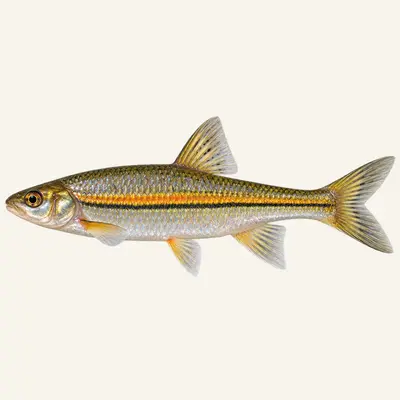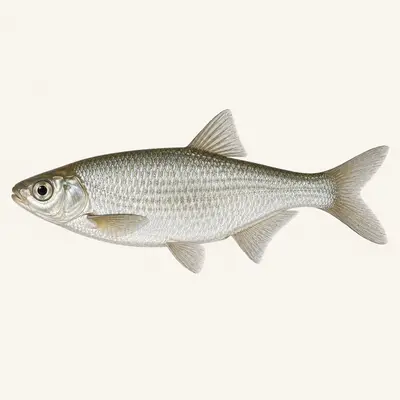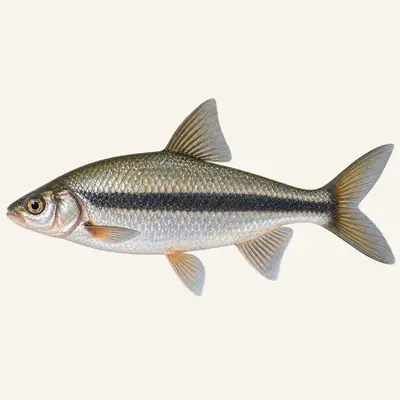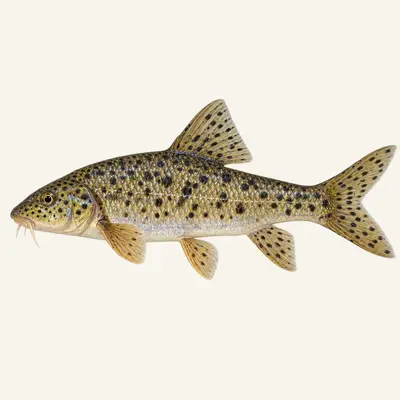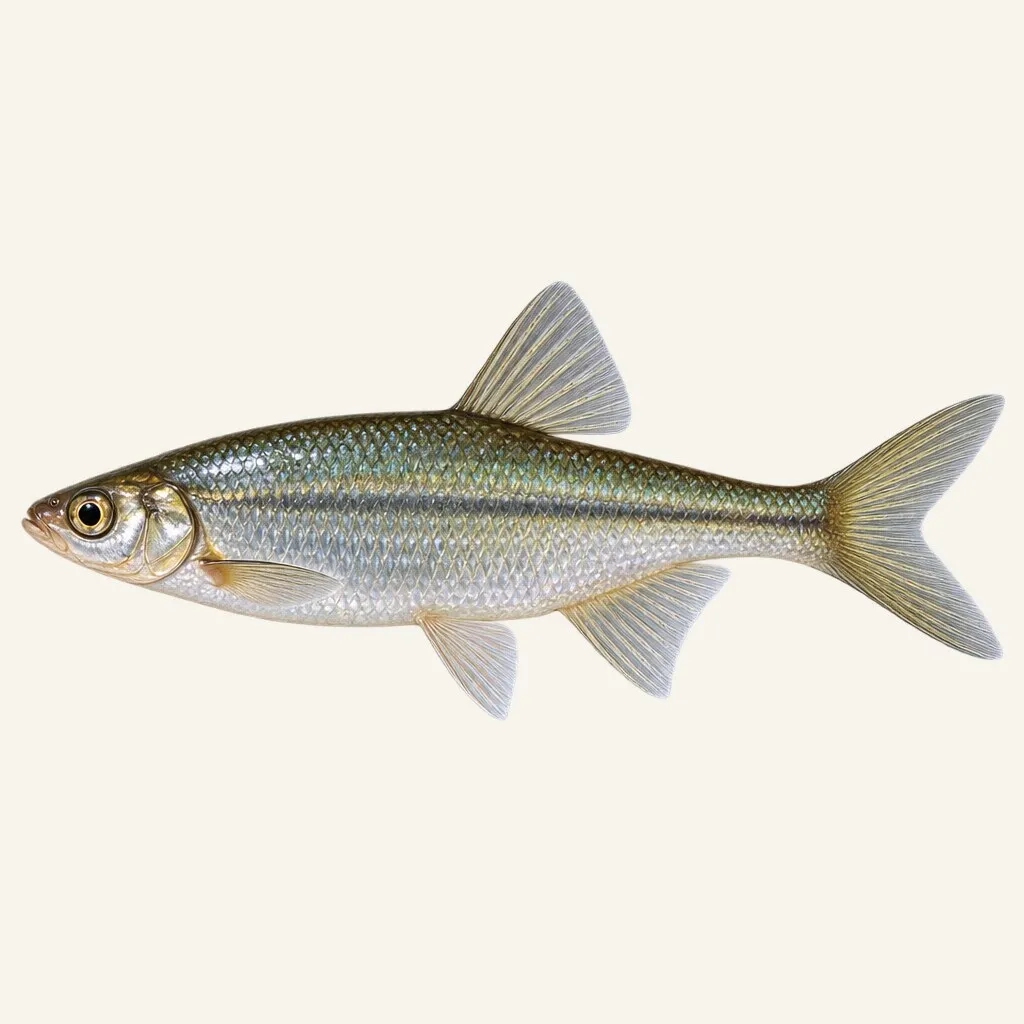
Italian bleak
Alburnus arborella · Cyprinidae
- Freshwater
- Carp & coarse
- Medium
- Size
13 cm
Where to fish
- Estuary
- Lake
- River
Habitat icons: Flaticon
Inhabits open surface waters across a range of habitats, from large subalpine lakes to small lowland streams. Feeds on plankton, insects and invertebrates.
Calendar
Recorded in 2 countries
GBIF occurrence records — native and introduced populations combined.
Its range
The range is Adriatic and broken up. It covers the Adriatic basin from the Soca to the province of Ancona, which puts the fish in Slovenia, Switzerland and Italy, plus the lower Zrmanja and Neretva in Croatia and Bosnia-Herzegovina. On the Tyrrhenian side it reaches only the Arno drainage.
That fragmented shape is the signature of endemism in separated basins. Each Adriatic drainage runs off its slope into an enclosed sea without meeting its neighbours, so a species that establishes itself in one is confined there — which is why the genus has produced so many small-range species in this region.
Transfers have been added to it: the Ricica in Croatia, the Ombrone and the Tiber in Italy. The fish is therefore simultaneously in retreat at home and introduced a few hundred kilometres away.
Identifying it
The flank stripe behaves backwards. On a living fish it is barely perceptible; on an individual preserved in alcohol it becomes very prominent indeed. That is a real determination trap: anyone comparing a fresh capture against a reference collection is looking at two different-looking fish that are the same animal, and the reference is the misleading one.
The second point is the ventral keel, and its peculiarity is that it decides nothing. It may be bare, partly scaled or completely covered — while that character is precisely what separates the other species of the genus from one another. There is no choice but to go to the counts.
They are low, all of them. The anal fin carries 13 to 16 and a half branched rays, and its origin falls under the fourth to eighth branched ray of the dorsal; the lateral line holds 40 to 47 scales plus three; there are 16 to 22 gill rakers. The pectoral fin does not reach the base of the pelvic. The mouth is set slightly upward.
Size finishes the identification. This is the smallest of the three Alburnus in the catalogue, and a full-grown adult stays shorter than an ordinary common bleak.
The water it needs
It occupies open surface water, and it does so across a spread of environments that is startling for a fish this small: from the great subalpine lakes down to little lowland streams. What determines it is not the volume of water but the presence of a clear surface layer to work.
Spawning stays in the shallows — thin riffles, the stony shores of lakes, occasionally over submerged plants. That requirement is more restrictive than the habitat list suggests, because it depends on margins that have been left alone.
Areas
- Lake littoral zones
- Vegetated margins
- Calm shallow rivers
- Stream mouths
Techniques
- Pole fishing
- Light waggler fishing
- Fine float fishing
- Fly fishing
Baits
- Bloodworm
- Fine maggot
- Pinkies
- Very fine paste
- Insect larvae
What it eats
Plankton, insects and invertebrates, taken high in the water. The slightly upturned mouth goes with it: this fish intercepts what floats and what falls rather than searching the bed for anything.
How to catch it
The size settles what the species is for. It is a bait fish and a target for fine tackle, not a capture sought for its own sake, and an adult of this length calls for the smallest hook available with a bait to match.
The layer to work is the first few centimetres under the surface, on the flats of the lakes as much as in the lowland streams. Any weighted rig drops out of the zone the fish occupies and fishes empty water.
Its condition invites restraint, though. The species is in decline, it is more tightly localised than either of its congeners, and a shoal taken for livebait is not a neutral act on the scale of a small watercourse.
Conservation · Near Threatened (IUCN) — This species is in decline. Release your catch quickly and handle it with care — wet hands, as little time out of the water as possible.
Conservation
The decline is observed rather than inferred, and two mechanisms are put forward for it: the contraction of its living space as habitat quality falls, and the effect of introduced species.
The second deserves naming. The common bleak, a shoaling planktivore with an identical diet and a larger body, has been locally introduced in Italy, and at least one country records an adverse ecological effect after that introduction. The two fish work the same layer of water and the same resource. The coincidence between that arrival and the retreat of the native species does not by itself establish a cause, but it is on the file.
The first mechanism is more ordinary and more general. A surface fish that spawns on thin riffles and shingle margins depends on unmodified banks and on a river keeping its shallows — which embankment, gravel extraction and level regulation remove everywhere in the same way, and without ever making the fish itself the subject of a decision.
Regulations
Check the local regulations in force (legal size limits, closed seasons, bag limits).
For guidance only. Legal sizes, quotas and open seasons vary by location and season: always check the local regulations in force before fishing.
Other names
Italian bleak in English; alborella in Italian, which is the everyday name for the fish throughout the Po plain and the source of the English one.
Its own scientific name was settled late and awkwardly. The species was long treated as a subspecies of the common bleak, and texts predating the revision call it Alburnus alburnus alborella; a dedicated paper was needed in 2005 simply to establish which name was valid. Note the spelling: the vernacular is alborella and the valid epithet is arborella, one letter apart, and both forms are in circulation.
Sources: fishbase.se · api.gbif.org · fishbase.se