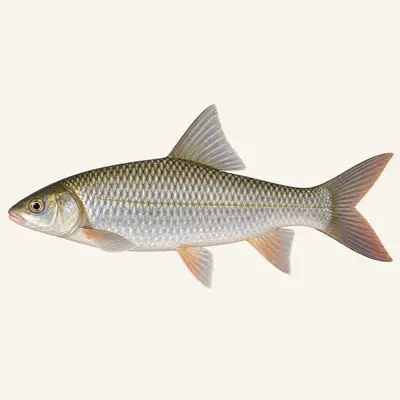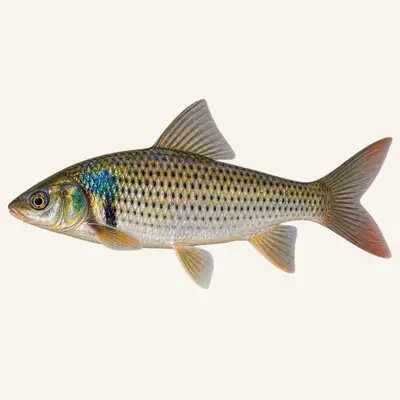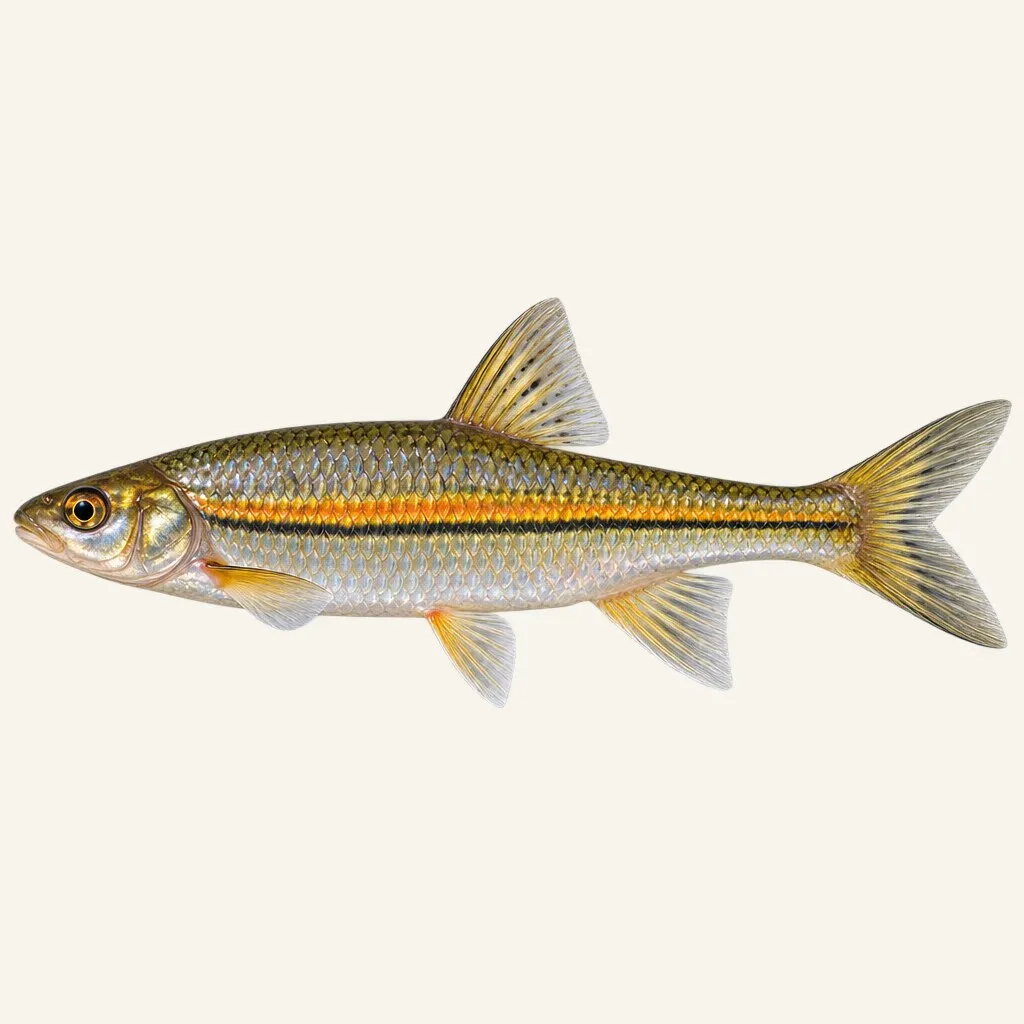
Italian riffle dace
Telestes muticellus · Cyprinidae
- Freshwater
- Carp & coarse
- Easy
- Size
10–15 cm
- Weight
0.0–0.0 kg
Where to fish
- River
Habitat icons: Flaticon
Small cyprinid endemic to Corsica - A threatened species
Calendar
Recorded in 3 countries
France · Italy · Switzerland
GBIF occurrence records — native and introduced populations combined.
Its range
The range covers both slopes of the Italian peninsula and stops at a stream on the French border.
On the Adriatic side it runs from the Brenta to the Vomano, reaching north into Switzerland. On the Tyrrhenian side it begins at the Bevera and ends at the Volturno. The Bevera is the one to remember: it straddles the French and Italian frontier, it is the western terminus of the whole distribution, and it is the only place the species comes into contact with French territory.
A second, later layer sits on top of that. Liguria and southern Italy hold introduced populations, placed in reaches adjacent to the natural range rather than far from it. Adjacency is what makes them awkward — the transferred fish are among the hardest kind to detect, because nothing about the locality looks wrong.
Identifying it
Two published diagnoses in this genus run through the same list of characters and give different numbers for each of them. That is unusually convenient, and it is the fastest route to a name.
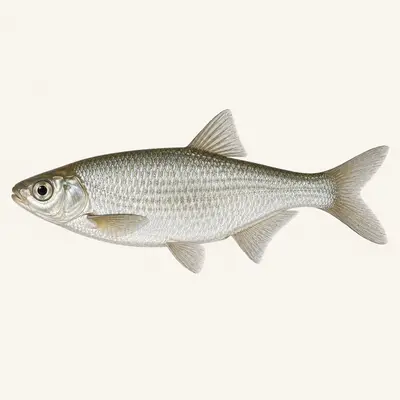
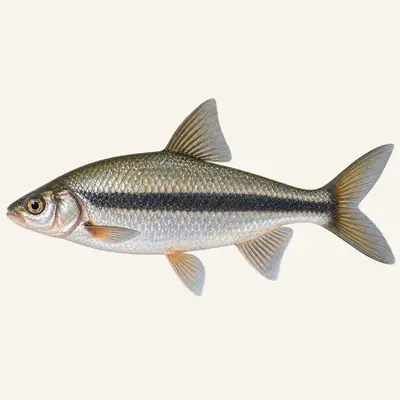
Here the eye goes 3.3 to 3.6 times into head length. In Telestes souffia the same measurement gives 4.0 to 4.6 — a fish with a visibly larger eye for the size of its head, and the two ranges do not touch. The lateral line holds 43 to 49 scales plus two or three more, against 44 to 57; three and a half scale rows separate it from the origin of the pelvic fin, against four and a half to five; the anal fin carries eight and a half branched rays, against nine and a half.
The scale-row count is the one to take first. It is a small number, it is read across the flank rather than along it, and half a row is the whole difference between the two species.
Colour is the character to take last, and only with the specimen's history in mind: the gold of the living flank and the black stripe of preserved material are the same marking at two stages of fixing, and the description a book gives will not be the description a net gives.
Breeding
Spawning happens in swift, shallow water. That is the entire published requirement, and it names a single feature of a stream: the riffle, where the current runs hard over a short depth.
A riffle is also the most easily destroyed part of a small watercourse. It is the first thing a weir drowns, the first thing an abstraction dries, and the first thing fine sediment fills. A species with one spawning habitat and no recorded alternative has no second option written down anywhere.
The water it needs
The preference is narrow, the tolerance is wide, and the record states both in consecutive sentences.
What the fish prefers is the piedmont and hill zone, streams of moderately cold water with gradient. What it accepts is nearly everything else, from large rivers down to small brooks. Densities follow the preference; presence follows the tolerance.
For anyone prospecting, that asymmetry cuts one way only. The piedmont reach is where the fish will be worth looking for. Its absence from a catchment is not evidence of the species' absence, because the species will also be sitting, thinly, in the water nobody would search first.
Areas
- Gravelly river riffles
- Moderate current zones
- Shaded undercut bank pools
- Weirs and shallow runs
Techniques
- Worms
- Micro baits
Baits
- Bloodworms
- Maggots
- Small natural insects
- Light flies
What it eats
Aquatic invertebrates make up most of the diet, with epilithic algae — the film growing on stone — behind them.
The ranking is worth reading precisely. Several cyprinids of these same rivers live the other way round, taking the film as the staple and the animals as the supplement. This one is an invertebrate feeder that grazes when the opportunity is there, which is a different animal at the end of a line and a different set of baits in the box.
How to catch it
Small fish, small tackle, and no complications beyond that. The invertebrate diet points at bloodworm, maggots, small natural insects and light artificials, on hooks matched to a mouth of that size.
Start on the piedmont water — gravel riffles, moderate-current runs, the shaded pools under an undercut bank, the shallow tails below a weir. If a catchment offers none of that, the species may still be present, and the search then becomes a matter of covering water rather than reading it.
Regulations
Check the local regulations in force (legal size limits, closed seasons, bag limits).
For guidance only. Legal sizes, quotas and open seasons vary by location and season: always check the local regulations in force before fishing.
Other names
Five of the six names this catalogue carries are built the same way: a group word plus a nationality. Italian vairone italiano, German Italienischer Strömer, Spanish vairón italiano, Portuguese vairão-italiano, French blageon italien. The country does all the work, which is the usual outcome when a species is separated from a wider group on geographical grounds.
English is the exception, and it is the only one of the six to name anything about the animal: Italian riffle dace. The habitat it picks out is the right one — the riffle is where the fish spawns — but the group word is borrowed from a fish it is not closely tied to. Dace, unqualified, means Leuciscus leuciscus to an English speaker, and a catch report that says dace in Italy is not describing that fish.
The unqualified Italian name, meanwhile, has gone to the congener. Vairone alone is Telestes souffia; the endemic of the peninsula is the one that has to carry the adjective.
Sources: fishbase.se · api.gbif.org