Iberian barbel
Luciobarbus comizo · Cyprinidae
- Freshwater
- Carp & coarse
- Medium
- Size
80 cm
Where to fish
- River
Habitat icons: Flaticon
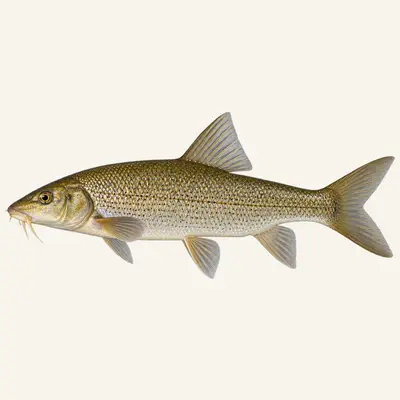
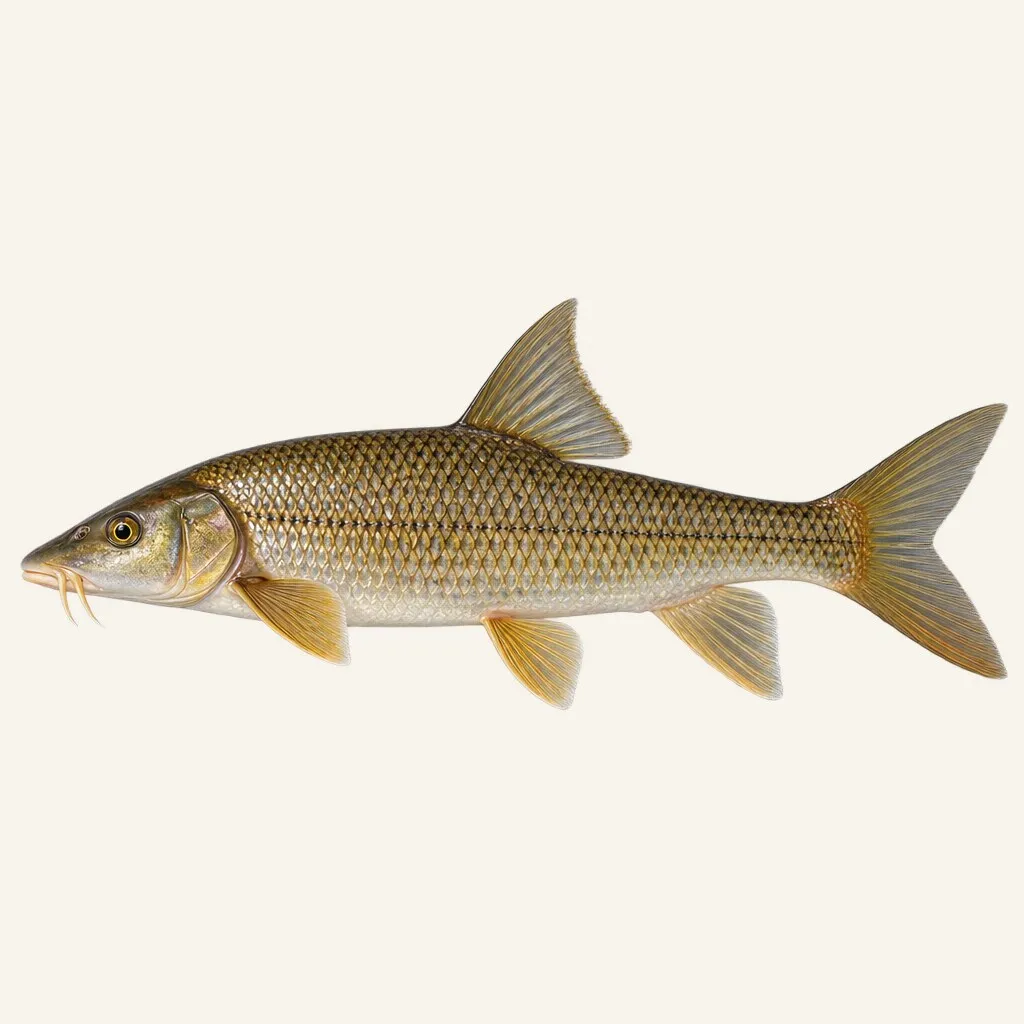
The comizo barbel is one of the largest barbels in the Iberian Peninsula, recognisable by its protruding snout and powerful, silver-flanked build. Endemic to the Tagus and Guadiana basins, it inhabits large rivers with moderate currents and reservoirs where it can reach exceptional sizes.
Calendar
Its range
Two basins are left, the Tagus and the Guadiana, shared between Portugal and Spain. A third has gone: the species is extinct in the Guadalquivir.
That loss is the most informative thing on the map. An endemic already confined to two river systems has watched a third population disappear outright — and the Guadalquivir is not empty of barbel, since another Luciobarbus lives there still. The basin did not become uninhabitable for the genus. This is the fish that failed in it.
Identifying it
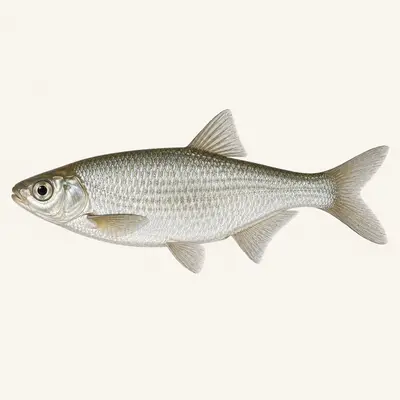
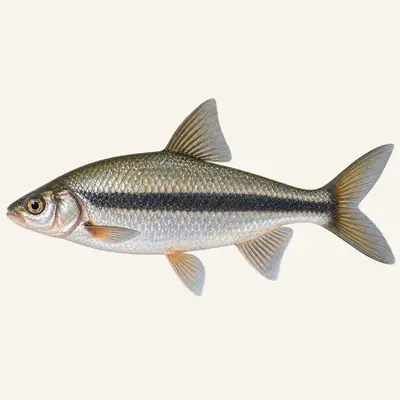
Look at the head in profile. The eye socket touches the upper line of the skull or breaks above it, and in adults that line dips into a distinct hollow between snout and nape. A concave forehead on a barbel is odd enough to settle the identification before anything has been counted.
The snout is long — 2.3 to 2.8 times into head length — and the head itself takes up 27 to 34 per cent of standard length, the largest head in the Iberian group. The lower lip is thin, has no central lobe, and covers the point of the jaw beneath it.
The dorsal is fully armed. Its first ray is spinous and heavily toothed down the rear margin, and this is the only Iberian member of the group that keeps a working saw into adulthood. There are 48 to 53 scales along the lateral line.
The water it needs
Deep, slow, and thick with submerged plants: three conditions that arrive together and that describe the broad, sluggish lowland stretches of Iberian rivers. Adults occupy the middle and lower course and nothing above it.
Current is largely absent from that description, which is unusual for a barbel and consistent with an animal whose feeding no longer depends on drift or on gravel. Spawning probably falls in May and June.
Areas
- Deep pools
- Calm areas below rapids
- Sandy margins
- Confluences
Techniques
- Feeder fishing
- Bottom fishing
- Float fishing
- Pole fishing
Baits
- Earthworms
- Flour paste
- Pellets
- Boilies
- Corn
What it eats
The fish changes trade as it grows. Juveniles work invertebrates like any barbel; large adults are mainly piscivorous. Plant material appears in the recorded diet as well, but the shift onto fish is what governs everything else about the animal.
It explains the head. A long snout, a hollowed skull profile, an eye carried high on the outline: the morphology that serves as an identification key is the morphology of a predator that has stopped sorting through sediment.
It also explains bait size. Lobworm, maize, pellets, flour paste and boilies are substantially larger presentations than anybody would offer a bottom-grubbing cyprinid of the same family, and they suit a fish that eats fish.
How to catch it
A barbel that hunts fish and grows as large as this one is not fished at the usual scale of the genus. The lies are deep holes, sandy margins, the quiet water below rapids, and confluences; bottom rigs there are laid and left rather than worked through the flow.
The species carries no commercial interest and is taken only by anglers. For a fish in retreat that is a comfortable position: the whole of the fishing pressure on it is pressure an angler decides on personally.
Unhooking asks for a method. This dorsal carries a functional set of teeth at every size, so the grip goes under the body and never across the back — the one member of the group where that matters as much on a small fish as on a large one.
Conservation · Near Threatened (IUCN) — This species is in decline. Release your catch quickly and handle it with care — wet hands, as little time out of the water as possible.
Conservation
Four pressures are named together: pollution, habitat destruction, the introduction of new species, and water abstraction. They converge on a single stretch of river, and it is the most exposed stretch in the network.
Deep, slow, weeded middle and lower reaches are exactly what dams, off-takes and discharges alter first. A headwater fish absorbs the impounding of a river; this one lives in the part of the river that the impoundment replaces.
Its place in the food chain compounds the problem. A fish-eater depends on the community it eats, and introduced species rearrange that community before they compete with it directly. The pressure reaches this predator twice over — once at its habitat, once at its prey.
Regulations
Check the local regulations in force (legal size limits, closed seasons, bag limits).
For guidance only. Legal sizes, quotas and open seasons vary by location and season: always check the local regulations in force before fishing.
Other names
Iberian barbel is the English name, and it claims a whole peninsula on behalf of one of the four species living on it, three of which reach a comparable size. Used in front of a Spanish or Portuguese angler it identifies nothing.
Comizo is a Spanish local name, taken up unchanged as the scientific epithet and then borrowed back by most European languages. Where the English name is too wide, that one is exact, and it is the word to reach for when the fish has to be named without ambiguity.
Sources: fishbase.se · api.gbif.org