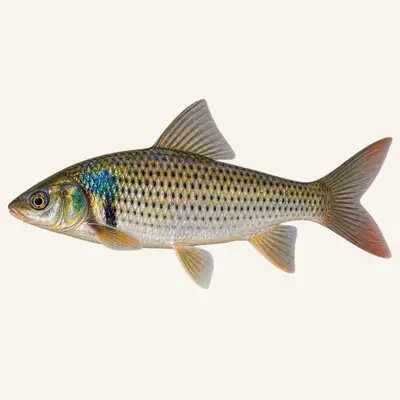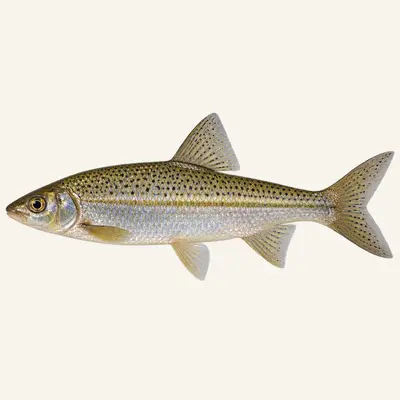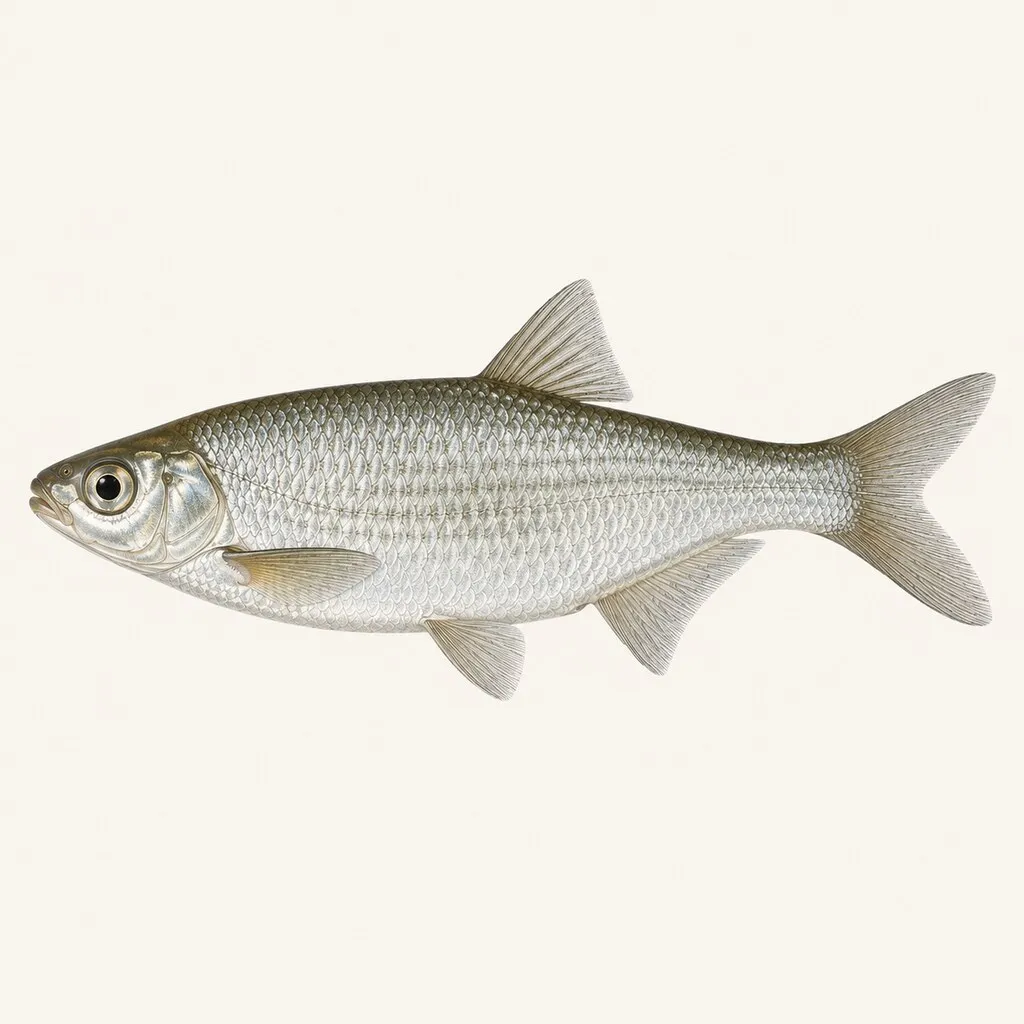
Lake bleak
Alburnus mento · Cyprinidae
- Freshwater
- Carp & coarse
- Medium
- Size
40 cm
Where to fish
- Lake
- River
Habitat icons: Flaticon
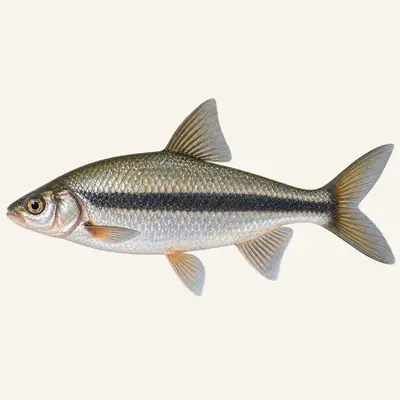
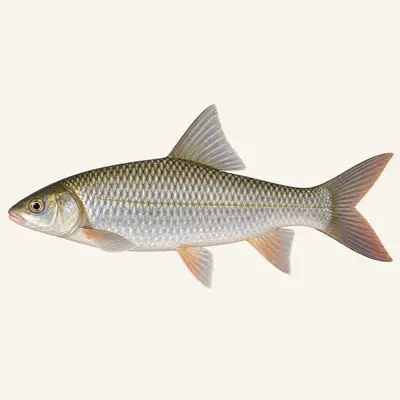
The lake bleak is a slender cyprinid with a greenish back and silvery flanks, similar to the common bleak but restricted to cold, clear alpine and pre-alpine lakes.
Calendar
Recorded in 1 country
GBIF occurrence records — native and introduced populations combined.
Its range
The range is among the narrowest in the catalogue: the subalpine lakes of the Danube drainage, in Germany and Austria. Two countries and a handful of waters.
That narrowness is a result rather than a gap in knowledge. The name long covered a set of forms spread from the Danube to the Black Sea, and a review of the counts split them into several distinct species. What carries the name today is the alpine share of that older assemblage, and maps drawn before the revision show a range that no longer applies to this fish.
Identifying it
The anal fin starts behind the dorsal, not under it. One and a half to two and a half scales separate the last dorsal ray from the origin of the anal, and that offset separates this fish from the common bleak immediately, since in the bleak the two fins overlap.
Size is the next surprise, and it is the reason the species is worth knowing at all: this is much the largest member of the genus in its region, and it lives on zooplankton. Nothing about the diet changes as the fish grows.
The rest is counted. The anal fin carries 15 to 17 and a half branched rays, there are 21 to 25 gill rakers, the lateral line holds 52 to 65 scales plus four on the tail, and the caudal peduncle is 1.8 to 2.4 times longer than it is deep. The ventral keel is exposed over eight to 12 scales in front of the vent, which amounts to almost the whole distance back from the base of the pelvic fins.
Breeding males are covered in small, very numerous tubercles. That is a useful division within the species group this fish belongs to, several members of which carry a few large tubercles instead.
Breeding
A lake fish that has to find a torrent. The whole of reproduction happens outside the water where the adult spends its year: the spawners make a short move into the lower reaches of tributary streams and spawn in strong current over a gravel bed. Laying along the stony margins of the lake itself is the exception, not the rule.
The eggs are sticky and adhere to pebbles and stones. Nothing else holds them against the flow — the adhesive coat of the egg does the entire job, and it is what makes spawning in fast water possible in the first place.
The return is immediate. Adults drop back down to the lake to feed as soon as they have spawned, and the larvae follow within days of hatching, carried downstream. The whole sequence occupies a few days and a few hundred metres of stream.
Areas
- Open water of Alpine lakes
- Rocky lake shores
- Inlet current zones
- Surface near the banks
Techniques
- Waggler fishing
- Lake pole fishing
- Light float fishing
- Dry fly fishing
Baits
- Maggot
- Bloodworm
- Pinkies
- Fine paste
- Caster
What it eats
Zooplankton, and nothing else is recorded. This is a mid-water filterer, and its 21 to 25 gill rakers are the instrument: the denser the comb on the gill arch, the finer the particles retained.
The size the species reaches takes on its interest at this point. Living on plankton does not prevent a fish from growing large, provided the resource is abundant and steady — which a deep lake supplies far better than a river does. The unusual thing here is not the diet but the combination of that diet with that body.
How to catch it
This is an open-water fish, looked for out from the bank rather than along it. The shoal holds the depth at which plankton concentrates, and that depth moves through the day, so sounding is the only prospecting that achieves anything.
A planktonic diet limits the options severely. No bait imitates zooplankton, so captures come on minute presentations at the fine end of match tackle, or on surface insects at the moment the shoal comes up for them.
The spawning run is the one occasion on which this fish becomes easy to locate: concentrated in the bottom of a tributary, over a few hundred metres, for a few days. It is also the worst possible moment to disturb it, and a run that thin is easily wrecked by attention.
Conservation
An entire species contained in the subalpine lakes of two countries has no margin at all. Each population is shut inside its own lake, with no prospect of recolonisation from a neighbouring one, and a loss anywhere is not recoverable.
The breaking point is the tributary. The adult lives in the lake, but nothing reproduces without access to fast water over gravel in the lower reach of an inflowing stream. A sill set a few hundred metres above the mouth is enough to end reproduction for a whole lake without a single fish being removed and without any water being polluted. The adults remain visible for years afterwards, which delays the diagnosis by exactly that long.
Regulations
Check the local regulations in force (legal size limits, closed seasons, bag limits).
For guidance only. Legal sizes, quotas and open seasons vary by location and season: always check the local regulations in force before fishing.
Other names
The German names are the ones in use: Seelaube, literally lake bleak, and Mairenke in the south of the range, after the month of the spawning run. English has no settled name of its own and generally uses Danube bleak.
The epithet mento means chin, for the prominent lower jaw. Older literature places the fish in the genus Chalcalburnus, now abandoned, and — more seriously — applies this name to populations from the Black Sea basin that have since been described as separate species. Any statement about the species that predates the revision has to be checked against the range it was made for.
Sources: fishbase.se · api.gbif.org · fishbase.se