Amur catfish
Silurus asotus · Siluridae
- Freshwater
- Catfish
- Medium
- Size
37–130 cm
- Weight
0.3–30 kg
- Water temp.
5–25 °C
Where to fish
- Lake
- River
Habitat icons: Flaticon
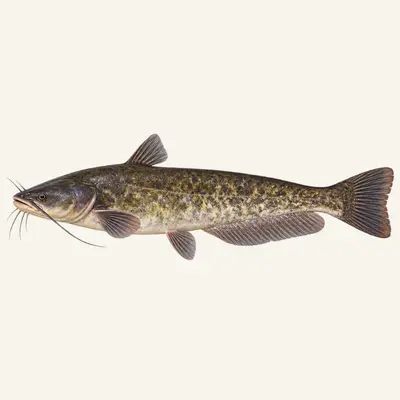
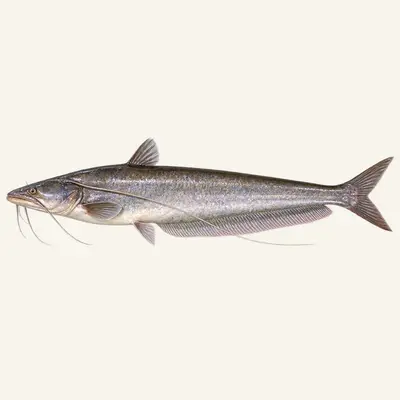
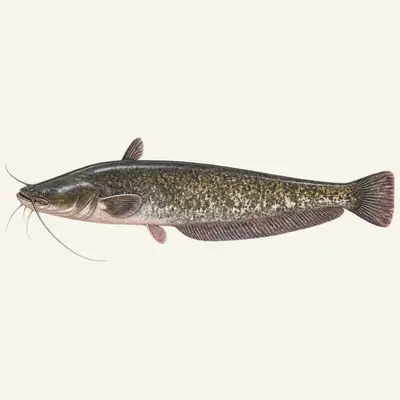
The Amur catfish is a large Asian catfish with an elongated, scaleless body, long barbels, and a wide mouth characteristic of the Siluridae family.
Calendar
Recorded in 5 countries
China · Japan · Russia · South Korea · Taiwan
GBIF occurrence records — native and introduced populations combined.
Its range
Honshu, Shikoku and Kyushu in Japan, the Korean peninsula, Taiwan, China and Russia. The thermal band that goes with that is 5 to 25 degrees, which is temperate rather than tropical, and it is what stops the species at both ends of its range.
Two lines in the file complicate the map. The fish is cultured commercially in Japan and has been raised in rice fields. A species farmed across the region it inhabits leaves a distribution that is part natural and part agricultural, and a paddy network is continuous with the rivers it drains into.
Identifying it
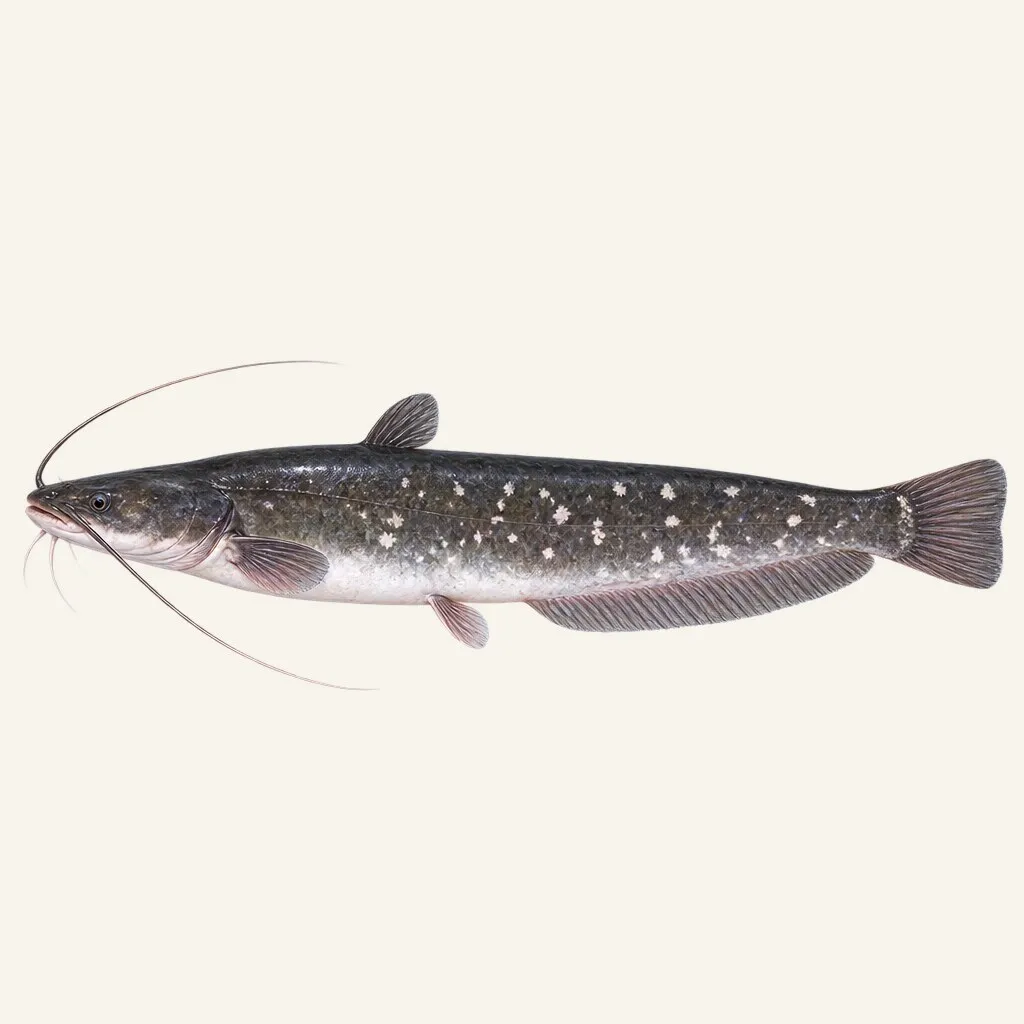
Count the barbels and stop at four. One pair on the upper jaw, longer than the head, and one pair under the chin running a fifth to a third of that length: two pairs, and the proportion between them is itself part of the published description. The European wels, in the same genus, carries three pairs.
The unpaired fins repeat the arrangement that defines the family. Four rays in the dorsal — four, on a large catfish — against 67 to 84 in the anal, which runs back along most of the underside.
Colour is dark grey down the side of the back and white on the belly, with irregular white dots scattered over the flanks. Those dots are worth looking for. They are pale marks on a dark ground, the reverse of the dark speckling that identifies several other large catfishes, and the account gives them as irregular rather than as a pattern. The body is elongated, oval in section.
Breeding
The mating sequence has been watched and broken into three named stages, and the third is what gives catfish spawning its knotted appearance.
First the male pursues, holding his head close to the female's belly. Then he clings to her flank, bending his tail or his head around her. Finally he enfolds her body with his vent brought alongside hers. Two to four males may follow one female, and two of them may enfold her at the same moment.
What did not happen is as informative as what did. No aggression was recorded between the males. Access was settled on size alone — the largest male approached and enfolded most often — without a fight taking place.
And the pair does not stay put. Spawning fish travel a long distance while they are at it, through ditches, paddy fields and creeks, shedding eggs as they go. The observation attached to that behaviour is that scattering eggs over distance may reduce losses among the young. There is no nest here and nothing to stand over, which sets the species apart from the European member of its own genus, where a male prepares a surface and guards the clutch until it leaves.
Maturity arrives at about 36 cm, inside a reported band of 35 to 37 — an unusually tight figure for a fish of this size. Set it beside a common length of 37 cm and the arithmetic is blunt: the ordinary individual encountered has only just begun to spawn.
Areas
- Deep holes
- Cluttered banks and snags
- River confluences
- Aquatic weed beds
Techniques
- Live bait fishing
- Worked dead bait
- Bottom jerkbait
- Soft plastic lure
Baits
- Live fish
- Dead fish
- Frog
- Shrimp
What it eats
Adults feed on all types of fish. The source says nothing further, and the phrasing carries no qualifier at all — no size class, no preference, no seasonal shift.
Read plainly, that describes a predator indifferent to what it takes so long as it is a fish. A wide mouth working in coloured water sorts nothing by species, and there is no reason for the animal to be selective about something it cannot see before it closes on it.
How to catch it
The spawning movement is the opening this species offers and its European relative does not. Fish that breed while travelling through ditches, paddy fields and creeks are, for a few weeks, in water a metre across and knee deep rather than in a river hole. Nothing else in the file puts the animal within reach so reliably.
Outside that window the search is the ordinary one for a large siluriform: deep, obstructed water in a big river after dark, with a bait that carries scent. The adjustment worth making is thermal. A ceiling of 25 degrees means midsummer at the southern end of the range pushes the fish down and slows it, while the same weeks at the northern edge are the best of the year.
Tackle follows the diet rather than the record book. A strictly piscivorous fish wants a fish bait, alive or dead, and the gape is wide enough that a small one buys no advantage.
Regulations
Check the local regulations in force (legal size limits, closed seasons, bag limits).
For guidance only. Legal sizes, quotas and open seasons vary by location and season: always check the local regulations in force before fishing.
Other names
Amur catfish is the English name, and it names the far northern corner of a range whose weight lies well to the south — Japan, Korea, Taiwan, China. The Amur is where this fish stops, not where it lives.
The other five languages in the catalogue keep the family word. Amurwels, siluro dell'Amur, silure d'Amour, siluro del Amur, bagre-do-amur: a German or an Italian reader is told immediately that the animal is a wels in the strict sense, a Silurus like the European fish. English substitutes catfish, a word covering several thousand species on every continent, and settles nothing.
The epithet is the Latin asotus, a spendthrift or a glutton, taken from Greek. It is a verdict on the appetite rather than a description of the animal, and a diet rubric that reads every kind of fish, with no qualification attached, does not argue with it.
Sources: fishbase.se · api.gbif.org